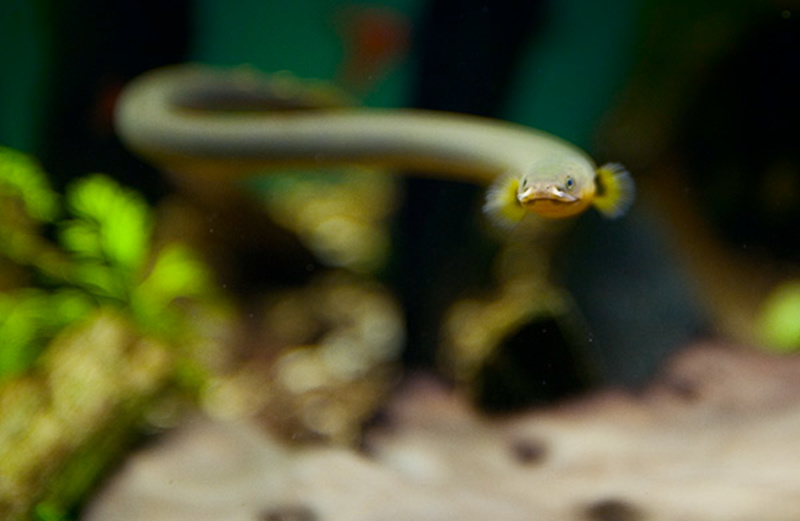
Reedfish
Erpetoichthys calabaricus
The reedfish, ropefish (more commonly used in the United States), or snakefish, Erpetoichthys calabaricus, is a species of fish in the family Polypteridae alongside the bichirs. It is the only member of the genus Erpetoichthys. It is native to fresh and brackish waters in West and Central Africa. The reedfish possesses a pair of lungs in addition to gills, allowing it to survive in very oxygen-poor water. It is threatened by habitat loss through palm oil plantations, other agriculture, deforestation, and urban development.
From the article Reedfish on Wikipedia (CC BY-SA), quoted section by section
Description
The largest confirmed reedfish museum specimen was 37 cm (15 in) long, and three studies where more than 2,000 wild reedfish were caught (using basket traps, meaning that only individuals longer than 15–20 cm [6–8 in] were retained) found none that exceeded 41.4 cm (16.3 in). Reedfish have sometimes been incorrectly claimed to reach up to 90 cm (3 ft) long. The sexes are very similar in both median and maximum length, but females average heavier than males of a similar length, and they can be reliably separated by the shape of their anal fin. Reedfish are dark above and on the sides, with lighter orangish or yellowish underparts. Males are generally more olive-green in colour, whereas females generally are more yellowish-brown. Larvae have conspicuous external gills, making them resemble salamander larvae. Body elongation in fishes, such as eels, usually happens through the addition of caudal (tail) vertebrae, but in bichirs it has happened through the addition of precaudal vertebrae. Reedfish have evolved a more snakelike body by having twice as many precaudal vertebrae as the members of its sister genus Polypterus, despite having the same number of tail vertebrae. …
Range & habitat
The reedfish inhabits slow-moving or standing, fresh or brackish, relatively warm tropical water, and usually in places with reeds or other dense plant growth. It occurs in Benin, Cameroon and Nigeria, spanning the area from the Ouémé River to the Sanaga River. There are old records from the Chiloango River in DR Congo and Cabinda in Angola, but these are unconfirmed and questionable.
Wikipedia: “Distribution and habitat”
What it does
The reedfish is nocturnal, and feeds on annelid worms, small crustaceans (such as shrimp), insects (both adults and their larvae), snails and small fish. When moving through water slowly, it tends to use its pectoral fins, and when moving quickly changes to an eel-like form of swimming (making more use of full-body movements and the caudal fin). Unlike their sister genus Polypterus, which does not leave water voluntarily, reedfish are known to explore land both in the wild and in captivity if given the opportunity, slithering along like a snake and also taking food items on land. Prey captured on land is brought back to the water. Females repeatedly deposit small batches of eggs between the anal fins of the male, where they are fertilized. The male reedfish then scatters the eggs among aquatic vegetation, where they stick to plants and substrate. Larvae hatch rapidly (after 70 hours) but remain attached to vegetation; they become independent and start to feed after ~22 days, when the egg's yolk sac has been consumed.
Wikipedia: “Ecology”
Where it lives
Recorded sightings
—
geo-referenced records in GBIF, from museums, herbaria and field observers.
Drag the globe to turn it. Dots are where records exist, not a range map; darker means more records.
In the stacks
Searching the stacks…
Every page naming Erpetoichthys calabaricus in the Biodiversity Heritage Library →
This page is assembled live from iNaturalist, GBIF, Wikipedia, the Source Library and the Internet Archive. It is not yet part of the hand-edited codex. iNaturalist taxon 100381.