- Animals
- ›Chordates
- ›Vertebrates
- ›Ray-finned Fishes
- ›Spiny-rayed fishes
- ›Swamp Eels
- ›Swamp Eels
- ›Swamp Eels
- ›Ophisternon
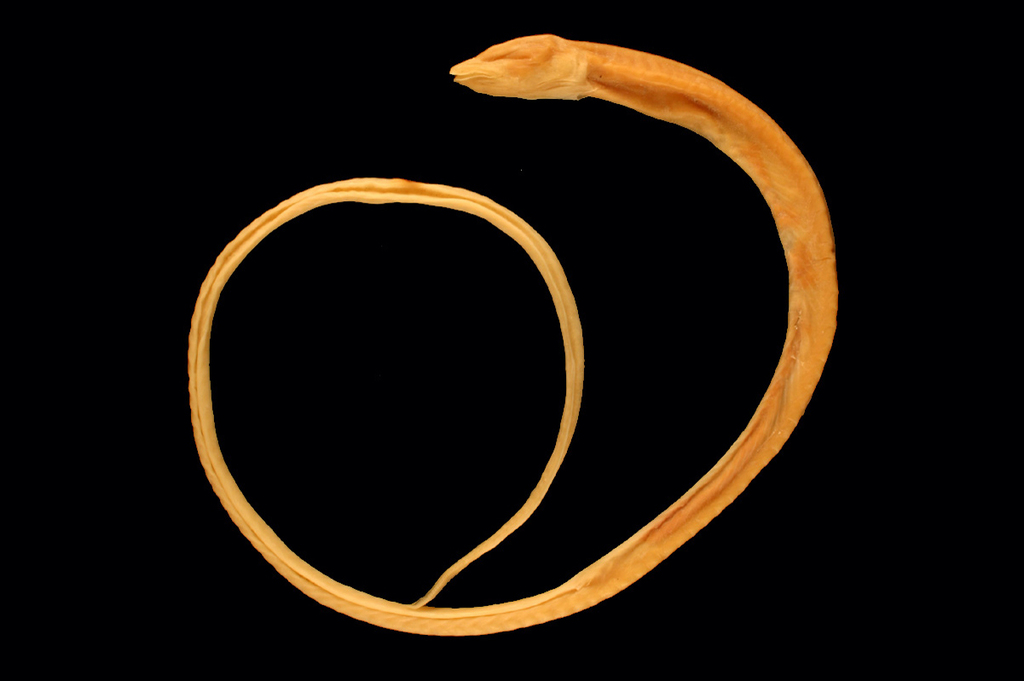
Blind Cave Eel
Ophisternon candidum
The blind cave eel (Ophisternon candidum) is a species of cavefish in the family Synbranchidae. It is the longest cavefish in Australia (up to 40 cm (16 in)) and one of the only three vertebrates in Australia that is restricted to underground waters, the other being the blind gudgeon (Milyeringa veritas) and the Barrow cave gudgeon (Milyeringa justitia). It is blind, its body is eel-like and elongated, and it has a non-pigmented skin with colours ranging from white to pink.
The blind cave eel is endemic to northwestern Australia, specifically in the Cape Range region, the Pilbara Region, and the Barrow Island region. It is rarely spotted due to its habitat and has only been spotted 36 times from 1959 to 2017. Notably, there is an evolving independent parentage in the Pilbara region showing a significant genetic difference from other blind cave eels.
From the article Blind cave eel on Wikipedia (CC BY-SA), quoted section by section
Description
The blind cave eel is Australia's longest cavefish and may grow up to 400 mm (16 in). However, common total lengths for mature adults have an average of 340 mm (13 in) and range between 60 and 385 mm (2.4 and 15.2 in) . Its head length accounts for 5.6–6.3%, pre-anus length accounts for 35.8–41.8%, snout length accounts for 0.82–1.11% and gape length accounts for 1.59–2.01% of its total length. Its body is round, elongated and eel-like. Its head is very short comparatively without visible external eyes. There are multiple indistinct pairs of slimy pores on its head. It has a large mouth and thick interior lips. It has several rows of strong teeth and a well-evolved tongue. There are two pairs of nostrils, the smaller pair being on top of the upper lip at the snout and the larger pair between the snout and its forehead. Several longitudinal cutaneous folds can be found around its throat. The blind cave eel has four pairs of evolved gills with a crescent in shape. The openings of its gills are extensive and horizontal. No scales or fins can be found except for the presence of a slim rayless membrane around the tail. There is an apparent lateral-line system from its head to close to the tip of its tail. Its anus is located in the front half of the body. …
Range & habitat
The Blind cave eel has only been spotted 36 times in 20 sites from 1959 to 2017. Observations were made in 3 regions; Cape Range, Pilbara, and Barrow Island, which makes the blind cave eel endemic to north-western Australia. In the Cape Range region, there are 14 sites in total as recorded by the Western Australian Museum, making the region the most common place to spot a blind cave eel. Sites include Tantabiddi Well, Milyering Well, Ned's Well, Dozer Cave, Pilgramunna Well, Kubura Well cave, South of Yardie Creek, Mowbowra Well, Kudumurra Well, Wobiri Rock Hole, New Mowbowra Well, Tidal Cave, Kudamurra Well and an unnamed site with a coordinate of 21'47'S, 114'10'E. In the Pilbara Region, there are 3 sites including the Exploration bore BC186-155, Borehole JW023, and Borehole JW024. In the Barrow Island Region, there are 3 sites including the Seismic testing site E1918, Anode Well T2, and Anode Well L15. Both the Pilbara Region and the Barrow Island Region were not discovered until 2009, from 1959 to 2009 blind cave eels were assumed to be restricted within 100 km in the Cape Range subterranean. Recovery of a specimen from the mineral exploration bore BC186-155 in the Pilbara region near Bungaroo Creek in 2009, extending the known distribution range to 200 km. …
Wikipedia: “Distribution and genetic difference”
What it does
The blind cave eel feeds primarily based on crustaceans in subterranean and other cave substrate organisms, but have also been documented to feed on terrestrials washed into the cave system. In the gut contents examined by the Western Australia Museum, Halosbaena tulki, Stygiocaris, Philosciidae, and larvae are found. Despite being restricted to subterranean waters adapting a characteristic of faecal ooze, it is sometimes observed in shallow water lying on rock surfaces on its own or in pairs.
Wikipedia: “Feeding”
Where it lives
Recorded sightings
—
geo-referenced records in GBIF, from museums, herbaria and field observers.
Drag the globe to turn it. Dots are where records exist, not a range map; darker means more records.
In the stacks
Searching the stacks…
Every page naming Ophisternon candidum in the Biodiversity Heritage Library →
This page is assembled live from iNaturalist, GBIF, Wikipedia, the Source Library and the Internet Archive. It is not yet part of the hand-edited codex. iNaturalist taxon 107676.