- Animals
- ›Chordates
- ›Vertebrates
- ›Ray-finned Fishes
- ›Carps, Characins, Catfishes and Allies
- ›Characins
- ›Characoidei
- ›African Pikes
- ›Hepsetus
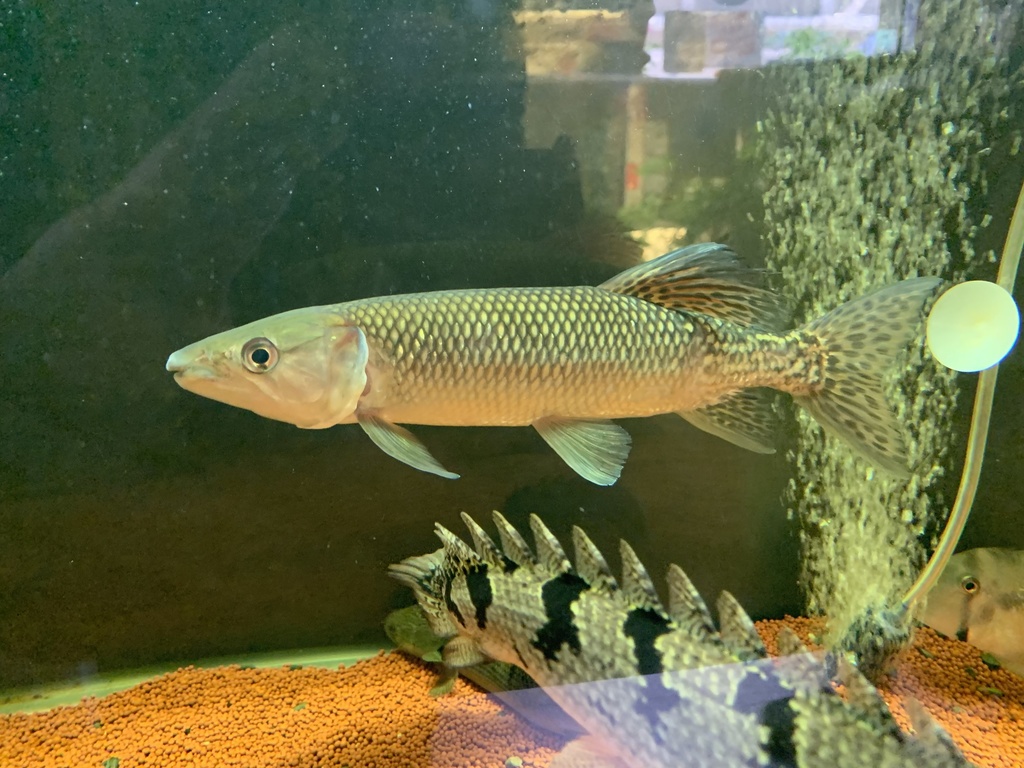
African Pike Characin
Hepsetus odoe
Hepsetus odoe, the African pike characin, is a predatory freshwater characin belonging to the family Hepsetidae. It was formerly considered that there was a single species of Hepsetus pike characin but recent studies have led to the species being split and Hepsetus odoe sensu stricto is the west African representative of the group.
From the article Hepsetus odoe on Wikipedia (CC BY-SA), quoted section by section
Description
Hepsetus odoe is an elongated fish with a pike-like body, however this species is a characin and the pike resemblance is due to convergent evolution. This species can reach up to about 28 cm (11 in) in length. The back is normally dark brown or green while the belly is silver. The head is normally light green or brown with distinct dark brown or black stripes radiating out from the eye. The colour and pattern of adult fish is relatively stable but juveniles are more variable.
Range & habitat
Hepsetus odoe is found in western sub-Saharan Africa, from the Sassandra River in the Côte d'Ivoire in the west to the Shari River in the Central African Republic in the east, and southwards up to the Kienke River in Cameroon.
Wikipedia: “Distribution”
In human culture
Hepsetus odoe has the genus name Hepsetus which was proposed by William Swainson in 1838, Swanson did not explain the etymology of this name but it is most likely derived from the ancient Greek hepsētós, a small fish, such as the anchovy, which is boiled for human consumption. This name, however, used for piscivorous fish resembling pikes, this may be an allusion to the Greek poet Archippus, who wrote: "An hepsetus fell in with an anchovy / And quick devoured him," and/or to the convergent South American characid Oligosarcus hepsetus. The specific name odoe is the local name for this species in Guinea, which appears to refer to its many teeth.
Wikipedia: “Etymology”
Where it lives
Recorded sightings
—
geo-referenced records in GBIF, from museums, herbaria and field observers.
Drag the globe to turn it. Dots are where records exist, not a range map; darker means more records.
In the stacks
Searching the stacks…
Every page naming Hepsetus odoe in the Biodiversity Heritage Library →
This page is assembled live from iNaturalist, GBIF, Wikipedia, the Source Library and the Internet Archive. It is not yet part of the hand-edited codex. iNaturalist taxon 102645.