- Animals
- ›Chordates
- ›Vertebrates
- ›Ray-finned Fishes
- ›Carps, Characins, Catfishes and Allies
- ›Characins
- ›Characoidei
- ›Iguana Tetras
- ›Piabucus
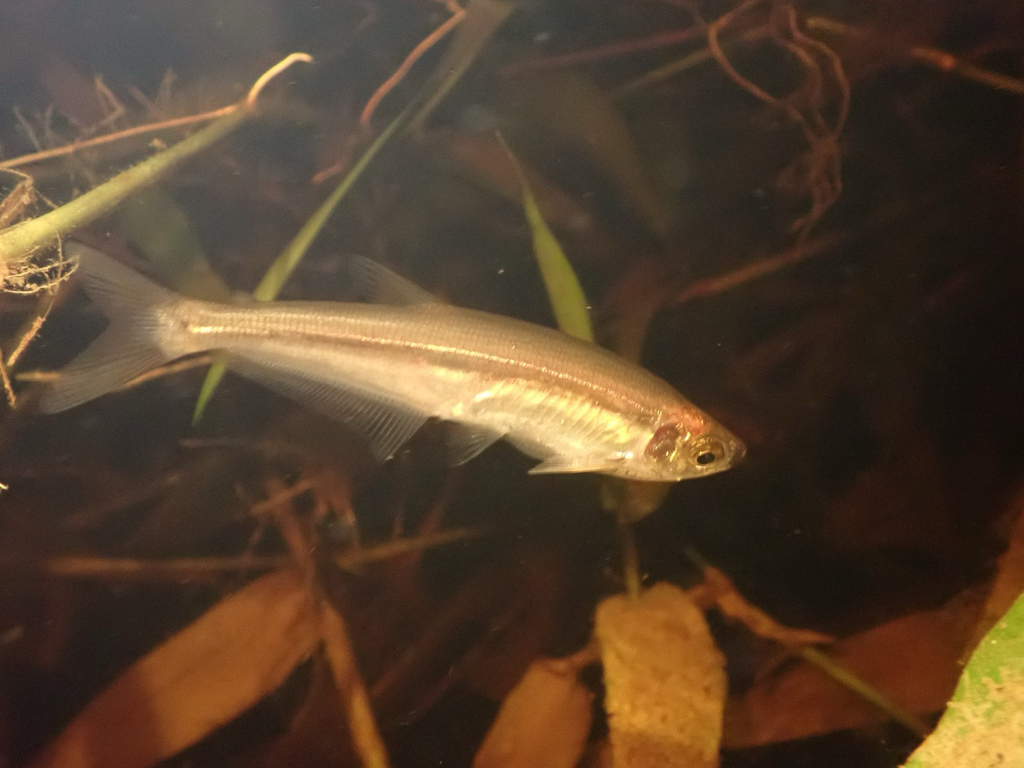
Piabucus dentatus
Piabucus dentatus, also called the chin tetra or the coastal piabucus, is a species of freshwater ray-finned fish belonging to the family Iguanodectidae. This species is found in coastal rivers of northern South America. Preferred habitats are generally high in silt content and are slow-moving, including floodplain streams and estuaries.
It is one of the earliest known South American fish in Northern ichthyology, believed to have been recorded first in 1648. It did not have a standard scientific name until 1766, though it had an earlier description in 1763 without a binomial moniker. German botanist Joseph Gottlieb Kölreuter was responsible for the 1763 description, while Swedish taxonomist Carl Linnaeus prescribed its first true scientific name - Salmo argentinus - in 1766.
From the article Piabucus dentatus on Wikipedia (CC BY-SA), quoted section by section
Description
Piabucus dentatus reaches a maximum length of 12.9 cm (5.1 in) SL (standard length), which makes it the largest of its genus. It has a generally slender body with a deep chest and long pectoral fins, which are characteristics that differentiate Piabucus from sister genus Iguanodectes. It is elongated and slight, with a compressed "torpedo" shape. It has a generally silvery color with a dark lateral stripe; its scales may reflect blue light ventrally, and its lateral line may contain yellow-gold and green. Congener Piabucus melanostoma has a distinctive patch of dark coloration on the lower jaw often absent in related species, but similar markings can be found on some specimens of P. dentatus. The presence of an adipose fin can be used to differentiate P. dentatus from its similar congeners. Notable morphometric characteristics include 80-84 perforated scales in the lateral line, 11 dorsal-fin rays, and 45-46 anal-fin rays. The dorsal and ventral fins are short, and the middle rays of the caudal fin are often pigmented, but the fins otherwise lack markings. Juvenile P. dentatus have rounder heads, smaller mouths, and a body that is proportionally elongate. Starting at a length of roughly 2 cm, juveniles start to resemble small adults.
Sexual dimorphism. Sexual dimorphism is minor in P. dentatus, but present. …
Range & habitat
Piabucus dentatus is a coastal dweller, found in river drainages from Venezuela's Paria Gulf to the mouth of the Amazon river. It demonstrates a preference for silty, turbid waters, including estuaries, floodplain streams, and various river tributaries, which places it in some brackish environments. Ichthyologist Carl H. Eigenmann once mistakenly cited it from Peru, and further instances from Bolivia are misidentifications. Though infrequent, it is found in Suriname.
Wikipedia: “Distribution and habitat”
What it does
Examination of stomach contents has shown that P. dentatus is a generalist feeder with a preference for algae and decaying plant matter, though it also targets microscopic invertebrates. Its varied diet earns it different classifications across various studies; it is classified as a detritivore based on its consumption of leaf litter, a micropredator based on its consumption of micro-invertebrates, or an algivore based on its consumption of various types of algae. Piabucus dentatus is known to be a schooling fish with a non-confrontational temperament. It tends to dwell near the surface of the water, and is often an active swimmer. Little is known of specific reproductive habits, but aspects of its biology indicate that it is likely an egg-scattering species that does not guard its young.
Presence and behavior in aquaria. While P. dentatus is known from the aquarium trade, and congeners are also seen in the industry, information on species-specific behavior and care is somewhat limited. Hobbyists report a generally pleasant disposition, but its large size in comparison to other aquarium tetras results in an intimidating presence for smaller fishes; still, it is often an appropriate addition to a community tank. It is known to be a generalist feeder that will accept most flake and pellet food, as well as biting at soft-leaved aquarium plants and hair algae.
Wikipedia: “Diet and ecology”
In human culture
The specific epithet "dentatus" refers to the dense set of 16 teeth present at the end of each mandible, as "dentatus" means "teeth". "Piabucus" is a Latinization of the Brazilian word "piabucu", which was and is used to refer to various small fishes of similar appearance. The common name "chin tetra" actually originates from markings seen on Piabucus melanostoma. P. melanostoma has a dark patch on the lower jaw, but is otherwise similar to its congeners, which means that all three are sometimes referred to by the same common name. The common name "coastal piabucus" comes from the fact that P. dentatus is common in estuaries and brackish waters along the northeastern coast of South America.
Wikipedia: “Etymology”
Where it lives
Recorded sightings
—
geo-referenced records in GBIF, from museums, herbaria and field observers.
Drag the globe to turn it. Dots are where records exist, not a range map; darker means more records.
In the stacks
Searching the stacks…
Every page naming Piabucus dentatus in the Biodiversity Heritage Library →
This page is assembled live from iNaturalist, GBIF, Wikipedia, the Source Library and the Internet Archive. It is not yet part of the hand-edited codex. iNaturalist taxon 615555.