- Animals
- ›Chordates
- ›Vertebrates
- ›Ray-finned Fishes
- ›Carps, Characins, Catfishes and Allies
- ›Characins
- ›Characoidei
- ›American tetras
- ›Multicusp characins
- ›Hyphessobrycon
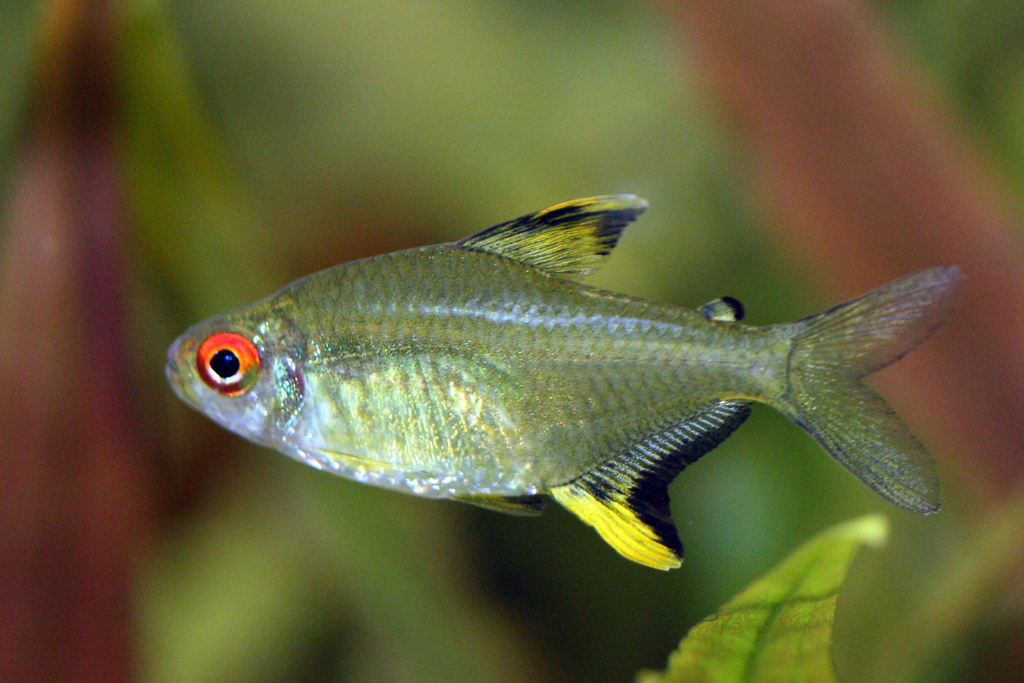
Lemon Tetra
Hyphessobrycon pulchripinnis
The lemon tetra (Hyphessobrycon pulchripinnis) is a species of freshwater ray-finned fish belonging to the family Acestrorhamphidae, the American characins. This fish is from South America. It is a small tetra growing to 5 cm (2 in) in length. The species is a long established favourite aquarium fish, being introduced to the aquarium in 1932.
From the article Lemon tetra on Wikipedia (CC BY-SA), quoted section by section
Description
The lemon tetra is one of the deeper-bodied tetras, contrasting with slender, torpedo-shaped relations such as the cardinal tetra and the rummy nosed tetra, whose approximate body shape when seen from the side is that of a lozenge (often referred to as a diamond, a form of rhombus). The basic body color of an adult specimen is a translucent yellow, with a pearlescent lustre emanating from the scales in particularly fine specimens. The dorsal and anal fin of the fish are marked with black and yellow: specifically, the anal fin is hyaline (glass-like appearance), with a black outer margin, the anterior three or four rays being an intense, acrylic lemon-yellow in hue, while the dorsal fin is principally black with a yellow central patch. The tail fin is mostly hyaline but in fine specimens (particularly alpha males) acquires a gunmetal-blue lustre. The pectoral fins are hyaline whilst the pelvic fins are translucent yellow, becoming more solidly and opaquely yellow with black posterior edges in fine specimens (again, alpha males are particularly notable in this regard). The eye is a notable feature of this fish, the upper half of the iris being an intense red, in some specimens almost gemstone-ruby in appearance. …
Range & habitat
The lemon tetra is an Amazon River fish species, first collected from the basin of the Rio Tapajos, near Santarém, Brazil. The fish can be found in both the Rio Tapajos and stretches of the Amazon proper in this region (the Rio Tapajos joins the Amazon at Santarém).
Wikipedia: “Distribution”
What it does
Lemon tetras exhibit an interesting behaviour pattern in the aquarium, replicated by several other characin species, in which males will adopt 'landmarks' within the aquarium and use these as places from which to display as maturity approaches. Displays are principally performed between rival males, which position themselves in a slightly head-up posture, unpaired fins held erect to appear as large and as imposing as possible, and swim forwards with 'flicking' movements of the body. If two rival males approach closely, they will then begin to make passes at each other, which to the causal observer look like attacks: this is an entirely ritualised behaviour, best referred to as 'jousting', where the males make darting movements toward each other but pull away at the last moment. No damage is incurred by either contestant in these events, and evenly matched males that are at a similar level in the social hierarchy will continue such behaviour for 30 minutes or more at a time. This behaviour serves not only to establish the social rankings of the males, but also serves as an indicator of reproductive fitness to the watching females. In the wild, the lemon tetra is a communally spawning fish. Tens of thousands of pairs will spawn together, and choose thickets of fine-leaved aquatic plants as the repository for their fertilised eggs. …
Wikipedia: “Reproduction”
Where it lives
Recorded sightings
—
geo-referenced records in GBIF, from museums, herbaria and field observers.
Drag the globe to turn it. Dots are where records exist, not a range map; darker means more records.
In the stacks
This page is assembled live from iNaturalist, GBIF, Wikipedia, the Source Library and the Internet Archive. It is not yet part of the hand-edited codex. iNaturalist taxon 103085.