- Animals
- ›Chordates
- ›Vertebrates
- ›Ray-finned Fishes
- ›Spiny-rayed fishes
- ›Sawbellies and squirrelfishes
- ›Squirrelfishes and soldierfishes
- ›Squirrelfishes and Soldierfishes
- ›Myripristinae
- ›Myripristis
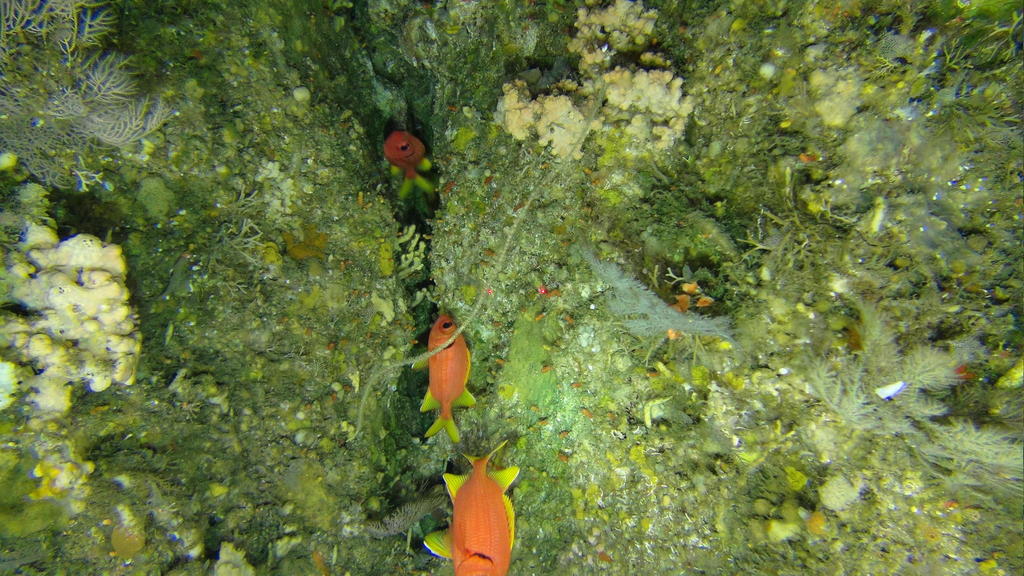
Yellowfin Soldierfish
Myripristis chryseres
Myripristis chryseres, the yellowfin soldierfish, is a nocturnal species of soldierfish from the genus Myripristis. It is found in the Indo-Pacific region, from Natal, South Africa to Samoa, Hawaii and the Tuamotu Islands, north to south Japan and the Ogasawara Islands, and south to Queensland, Australia It inhabits steep outer reef slopes and is often seen with Coelacanths at Ngazidja Island. It feeds on zooplankton and can be seen either solitary or in groups.
From the article Myripristis chryseres on Wikipedia (CC BY-SA), quoted section by section
Description
Myripristis chryseres have a bright red body and yellow fins. Their scales are large and their bodies are spiny, with large eyes help them with their nocturnal activity. They are distinguishable from other soldierfish by their black operculum. They usually range from 5–9 in (130–230 mm) long, but can reach 10 in (250 mm). Their main food source is large Zooplankton.
Range & habitat
While vast and patchy, the range of distribution of the Myripristis chryseres frequents 3° to 28°N, and 5° to 31° S. It is found in the Indo-Pacific region, from Natal, South Africa to Samoa, Hawaii and the Tuamotu Islands, north to south Japan and the Ogasawara Islands, and south to Queensland, Australia
They can sometimes be observed in shallow water, but are predominantly deep-sea fish. It inhabits steep outer reef slopes and is often seen with Coelacanths at Ngazidja Island. Myripristis chryseres specifically inhabit deep inshore coral reefs, from depths 12–350 m (39–1,148 ft) deep. Myripristis chryseres live under steep, rocky, and cavernous cliffs. They hide in their caves during the day, and depart at night to forage.
Wikipedia: “Distribution and habitat”
In human culture
In Hawaiian culture, Myripristis chryseres is used as food, usually caught at night using spears, nets, or line. Due to the difficulty of skinning the fish, it is more commonly broiled; if served raw, the fish is cleaned of its organs, dorsal & anal fins.
== References ==
Wikipedia: “Cultural significance”
Where it lives
Recorded sightings
—
geo-referenced records in GBIF, from museums, herbaria and field observers.
Drag the globe to turn it. Dots are where records exist, not a range map; darker means more records.
In the stacks
Searching the stacks…
Every page naming Myripristis chryseres in the Biodiversity Heritage Library →
This page is assembled live from iNaturalist, GBIF, Wikipedia, the Source Library and the Internet Archive. It is not yet part of the hand-edited codex. iNaturalist taxon 530165.