- Animals
- ›Chordates
- ›Vertebrates
- ›Ray-finned Fishes
- ›Carps, Characins, Catfishes and Allies
- ›Minnows, Suckers, Carps, and Loaches
- ›Carps and Minnows
- ›Cyprinids
- ›Snow Barbels
- ›Schizothorax
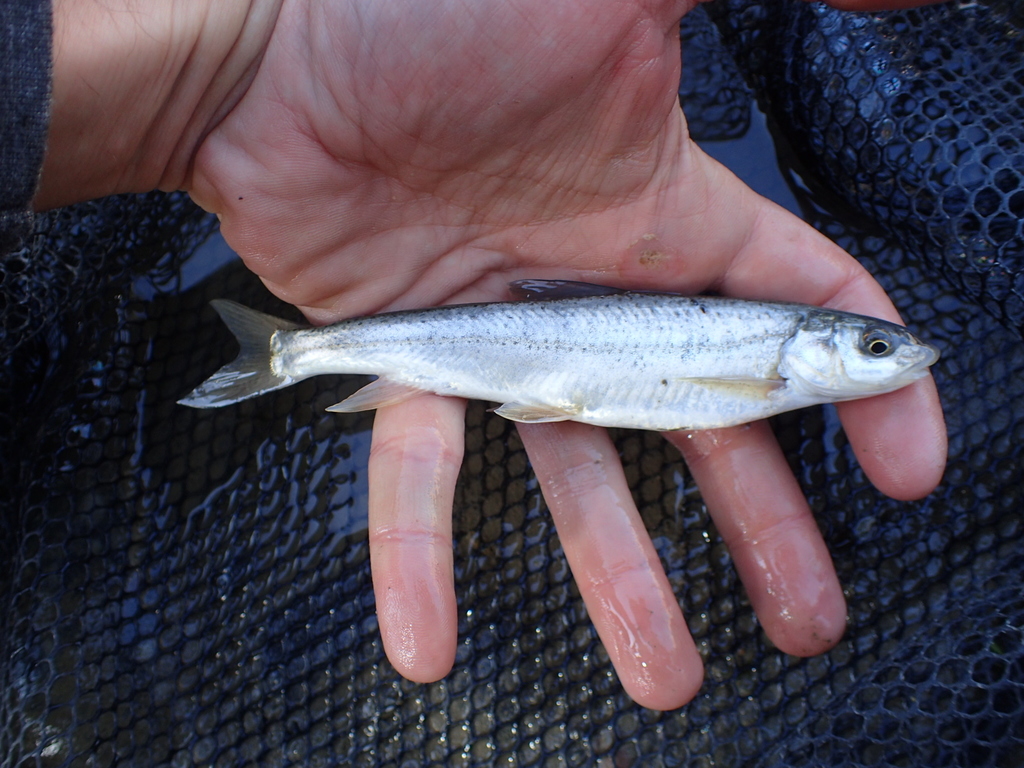
Common Snowtrout
Schizothorax richardsonii
The common snowtrout or snowtrout (Schizothorax richardsonii), also known as "Asala", or "Asela" by the locals, is a species belong to the class of ray-finned fishes, family Cyprinidae, order Cypriniformes in the genus Schizothorax. The genus name Schizothorax is derived from Greek word, "schizein" meaning to divide, and "thorax" which means breast.
Common snowtrout is commonly found in the Himalayan region of India, Bhutan, Nepal, Pakistan, and Afghanistan. This species is adapted to fast-flowing, cold-water streams of Himalayan rivers. This species can be found in mountain rivers dwelling among rocks, feeding on algae, aquatic plants and detritus. They usually breed in April and May.
From the article Common snowtrout on Wikipedia (CC BY-SA), quoted section by section
Range & habitat
Common snowtrout is the most common Schizothoracinae in the Himalayas. They can be found in almost all riverine systems of the Himalayas. They are distributed in India, Nepal, Bhutan, Pakistan, and Afghanistan. Water temperature is known to be the determining factor of geographical distribution and dispersal of common snowtrout. This species have the upper tolerance around 20 °C (68 °F) and are able to remain active in the near zero temperature in the streams of Lesser and Greater Himalayas during December and January.
Wikipedia: “Range, distribution and habitat preference”
What it does
The breeding season for snowtrout has been recorded to occur between June and October with the peak in September. There have been observations indicating that Schizothoracines including S. richardsonii exhibit multiple spawning throughout the year following the temperature rise and flow rates which support egg laying. The female eggs are maturing (not fully mature) around February–May and ready to spawn around August–September, while the male sperms mature in March–April and ready to spawn in July–October. However, the fish spawn during spring despite the relatively immature gonads. The reason is the gonads fully mature in winter, but they are in dormant phase due to the low temperature, thus the fish spawn only on the returning favorable conditions in spring. The rise of temperature in streams from near freezing to 10–17 °C (50–63 °F) during May – June induces common snowtrout to spawn. In Sutlej River, common snowtrout start the migration upstream along with the rise in water temperature in March. During the migration, the fish endure low water temperature of 8.0–9.5 °C (46.4–49.1 °F) due to the steady influx of snow-melt water. This low temperature induces the fish to migrate to side streams where the ground water temperature is around 17.5–21.5 °C (63.5–70.7 °F) to spawn. In other river, Ravi River, this species spawn in May. …
Wikipedia: “Reproduction”
Where it lives
Recorded sightings
—
geo-referenced records in GBIF, from museums, herbaria and field observers.
Drag the globe to turn it. Dots are where records exist, not a range map; darker means more records.
In the stacks
Searching the stacks…
Every page naming Schizothorax richardsonii in the Biodiversity Heritage Library →
This page is assembled live from iNaturalist, GBIF, Wikipedia, the Source Library and the Internet Archive. It is not yet part of the hand-edited codex. iNaturalist taxon 112292.