- Animals
- ›Chordates
- ›Vertebrates
- ›Ray-finned Fishes
- ›Carps, Characins, Catfishes and Allies
- ›Minnows, Suckers, Carps, and Loaches
- ›Carps and Minnows
- ›Cyprinids
- ›Cape Carps
- ›Barbodes
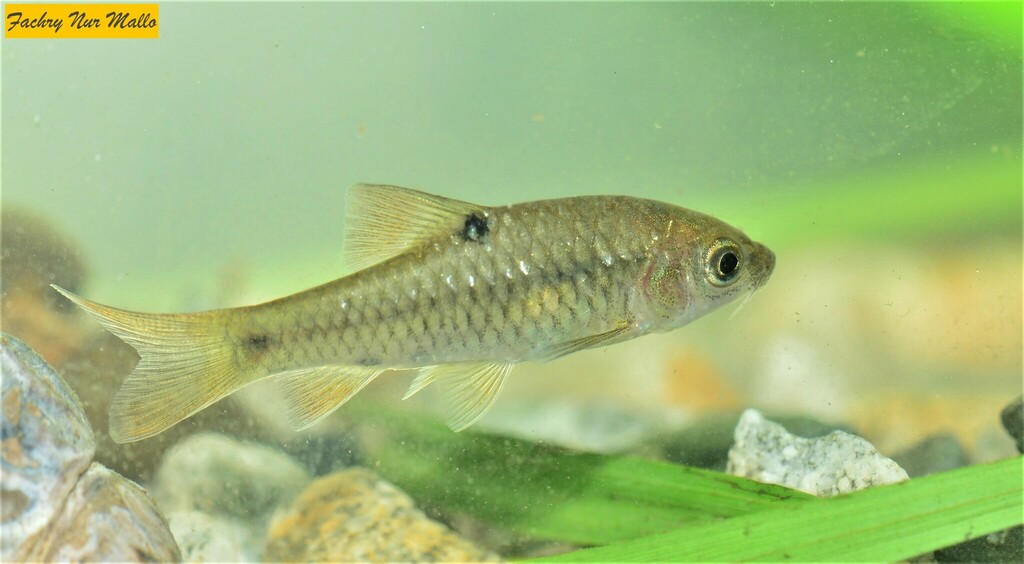
Spotted Barb
Barbodes binotatus
Barbodes binotatus, commonly known as the spotted barb or common barb, is a tropical species of cyprinid fish native to Southeast Asia. It has also become established as an exotic species in Palau and Singapore.
From the article Spotted barb on Wikipedia (CC BY-SA), quoted section by section
Description
Its color in life varies from a silvery gray to greenish gray, darker dorsally and paler or nearly white on its throat and belly. It has a bar behind the operculum on its shoulder. On large fish, body markings (spots or band) may be absent, except for the spot on the caudal base. It has a round, broad-tipped snout equal to or slightly larger than the eye. The fish will grow in length up to 7.75 inches (19.7 cm).
Range & habitat
The species was previously thought to have a much wider native range in Southeast Asia, but it is now known that B. binotatus sensu stricto is restricted to the island of Java in Indonesia. All other descriptions of B. binotatus sensu lato in other areas of Southeast Asia are either mistaken identifications of similar species or undescribed taxa superficially similar to B. binotatus. Its native environment occurs from about sea level to above 2,000 m above sea level. It is commonly found below waterfalls in isolated mountain streams and on small islands inhabited by few other freshwater fish. It inhabits medium to large rivers, stagnant water bodies. It is usually found in the middle to bottom depths of fairly shallow waters where it feeds on zooplankton, insect larvae and some vascular plants. They live in a tropical climate and prefer water with a 6.0 - 6.5 pH, a water hardness of 12.0 dGH, and a temperature range of 75–79 °F (24–26 °C).
Wikipedia: “Distribution and habitat”
Where it lives
Recorded sightings
—
geo-referenced records in GBIF, from museums, herbaria and field observers.
Drag the globe to turn it. Dots are where records exist, not a range map; darker means more records.
In the stacks
Searching the stacks…
Every page naming Barbodes binotatus in the Biodiversity Heritage Library →
This page is assembled live from iNaturalist, GBIF, Wikipedia, the Source Library and the Internet Archive. It is not yet part of the hand-edited codex. iNaturalist taxon 553203.