- Animals
- ›Chordates
- ›Vertebrates
- ›Ray-finned Fishes
- ›Carps, Characins, Catfishes and Allies
- ›Minnows, Suckers, Carps, and Loaches
- ›Carps and Minnows
- ›Cyprinids
- ›Mahseers, Yellowfishes and Allies
- ›Tor
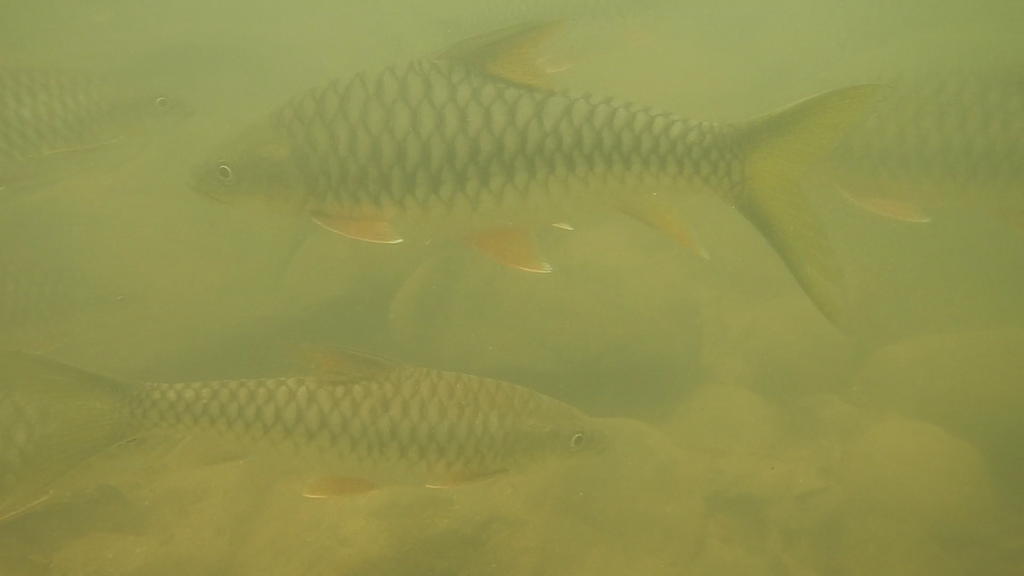
Deccan Mahseer
Tor khudree
Tor khudree, the Deccan mahseer, Khudree mahseer, or black mahseer, is a freshwater fish of the carp family found in major rivers and reservoirs of India and Sri Lanka. Found throughout India, following large-scale introductions of artificially-bred fish across the country (annex 2), but found of the largest size and in the greatest abundance in mountain or rocky streams.
The fish as originally described by Sykes in his November 1838 paper 'On the Fishes of the Dukhun' as Barbus khudree, is a silvery-bluish coloured fish, with blood red fins or fins tipped with a bluish tinge.
From the article Tor khudree on Wikipedia (CC BY-SA), quoted section by section
Description
The lips are thick, with an uninterrupted fold across the lower jaw, and with both the upper and lower lips in some specimens produced in the mesial line. The maxillary pair of barbels are longer than the rostral, and extending to below the last third of the eye. Fins the dorsal arises opposite the ventral, and is three fourths as high as the body; its last undivided ray is smooth, osseous, strong, and of varying length and thickness. Himalayan, Bengal, and Central Indian specimens generally have the spine strong, and from one half to two thirds the length of the head, it rarely exceeds this extent. In Canara, Malabar, and Southern India, where the lips are largely developed, the spine is very much stronger and as long as the head excluding the snout. Pectoral as long as the head excluding the snout; it reaches the ventral, which is little shorter. Anal laid flat does not reach the base of the caudal, which is deeply forked. Lateral line complete, 2 to 2.5 rows of scales between it and the base of the ventral fin; 9 rows before the dorsal. Colour silvery or greenish along the upper half of the body, becoming silvery shot with gold on the sides and beneath. …
Where it lives
Recorded sightings
—
geo-referenced records in GBIF, from museums, herbaria and field observers.
Drag the globe to turn it. Dots are where records exist, not a range map; darker means more records.
In the stacks
Searching the stacks…
Every page naming Tor khudree in the Biodiversity Heritage Library →
This page is assembled live from iNaturalist, GBIF, Wikipedia, the Source Library and the Internet Archive. It is not yet part of the hand-edited codex. iNaturalist taxon 114226.