- Animals
- ›Chordates
- ›Vertebrates
- ›Ray-finned Fishes
- ›Spiny-rayed fishes
- ›Mackerels, Tunas, Butterfishes, and Allies
- ›Scombroidei
- ›Mackerels, Tunas, and Bonitos
- ›Scombrinae
- ›Gymnosarda
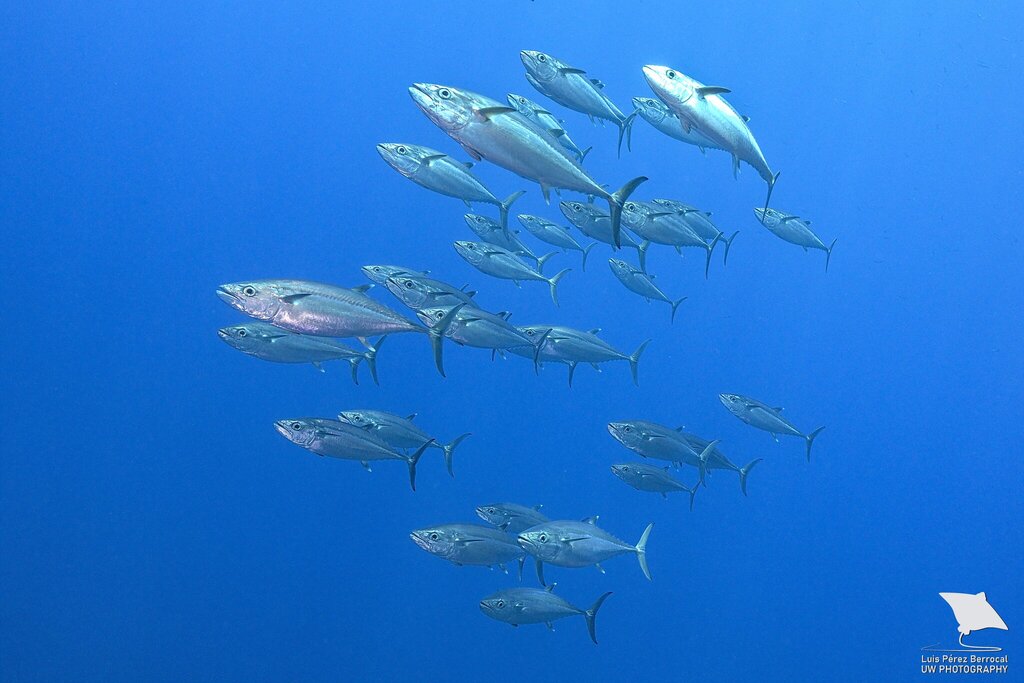
Dogtooth Tuna
Gymnosarda unicolor
The dogtooth tuna (Gymnosarda unicolor), also known as white tuna, is a species of pelagic marine fish which belongs to the family Scombridae. Despite the name "tuna", it is not actually a tuna. Instead, it is a bonito.
From the article Dogtooth tuna on Wikipedia (CC BY-SA), quoted section by section
Description
The dogtooth tuna can reach a length of 190 to 248 centimetres (75 to 98 in) in males and a weight of 130 kilograms (287 lb). The average length commonly observed is around 40 to 120 centimetres (16 to 47 in). They have 12 to 14 dorsal soft rays and 12 to 13 anal soft rays. The lateral line undulates strongly. These large tunas have a streamlined shape and a distinctive body coloration: brilliant blue green on the back, silvery on the side, and whitish on the belly, with two white tips on the two back fins close to the caudal peduncle. They always swim with open jaws. The upper jaw of the large mouth reaches the eye.
Range & habitat
The dogtooth tuna is widespread throughout the tropical waters of the Indo-Pacific area from the eastern coast of Africa, Red Sea included, to French Polynesia and oceanic islands of the Pacific Ocean (Hawaii excluded), north to Japan, south to Australia.
Wikipedia: “Distribution”
What it does
These offshore fishes can be found mainly in reef environments with smaller fish being more commonly found near shallow reef areas and larger ones haunting deep reef drop off areas, seamounts and steep underwater walls. Usually they are solitary or occur in small schools, to a depth of 10 to 300 metres (33 to 984 ft). The dogtooth tuna is one of the apex non-pelagic predators in its environment, sharing that position with giant trevally, Napoleon wrasse, and large groupers, as well as large sharks such as reef, bull and tiger sharks. These aggressive opportunistic predators feed on small schooling fishes and squids, and are capable of taking a wide variety of prey items. In most areas, the mainstay of its diet probably consists of pelagic schooling fish found near reef habitat (mainly, Caesio, Cirrhilabrus, Pterocaesio, carangids such as rainbow runners and Decapterus, mackerel scad, and scombrids). Preliminary estimates of longevity indicate a maximum observed age of at least 20 years.
Wikipedia: “Ecology”
Where it lives
Recorded sightings
—
geo-referenced records in GBIF, from museums, herbaria and field observers.
Drag the globe to turn it. Dots are where records exist, not a range map; darker means more records.
In the stacks
Searching the stacks…
Every page naming Gymnosarda unicolor in the Biodiversity Heritage Library →
This page is assembled live from iNaturalist, GBIF, Wikipedia, the Source Library and the Internet Archive. It is not yet part of the hand-edited codex. iNaturalist taxon 182584.