- Animals
- ›Chordates
- ›Vertebrates
- ›Ray-finned Fishes
- ›Spiny-rayed fishes
- ›Mackerels, Tunas, Butterfishes, and Allies
- ›Scombroidei
- ›Mackerels, Tunas, and Bonitos
- ›Scombrinae
- ›Cybiosarda
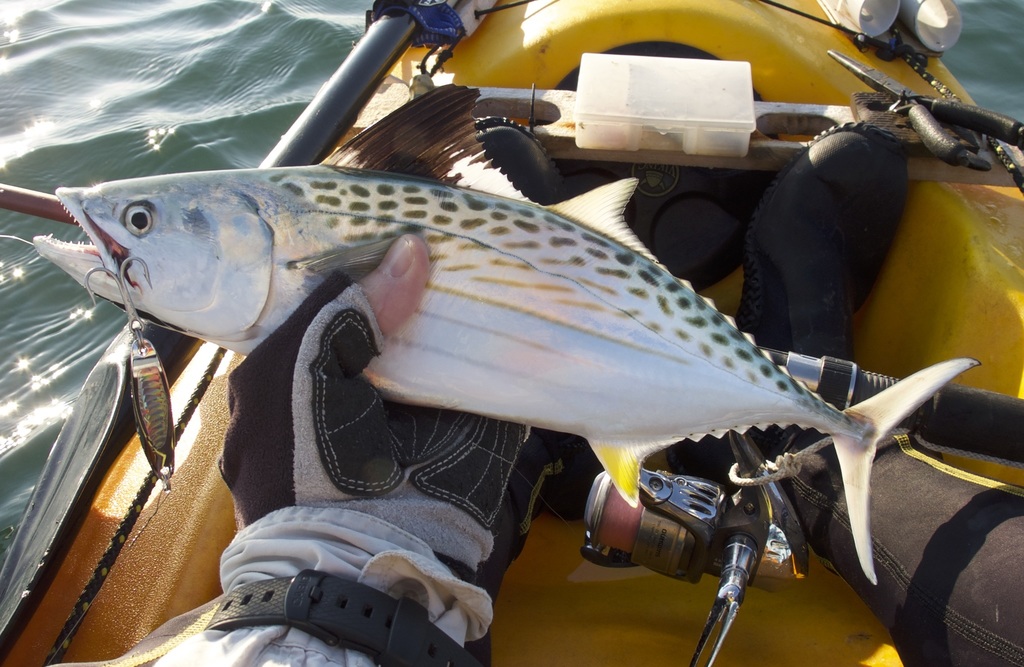
Leaping Bonito
Cybiosarda elegans
The leaping bonito (Cybiosarda elegans) is a species of saltwater finfish from the Scombridae (Mackerel) family. Scombridae includes such tribes as the mackerels, tunas, and bonitos – of the latter of which, the Sardini tribe, this fish is a member. It is the only member of the genus Cybiosarda, which is therefore called a monotypic taxon.
Since the bonitos and tunas are close relatives, this fish has variously been referred to by such other common names as Australian tuna, striped bonito and Watson's bonito.
From the article Cybiosarda elegans on Wikipedia (CC BY-SA), quoted section by section
Description
The leaping bonito, like other scombrids, has an elongated body with a deeply forked tail, and finlets. Like other tunas, it lacks a swim bladder. The dorsal fin is very high, and the anterior of it is black. The back displays a spotted pattern with lots of dark, oval-like spots, with a deep blue undertone. The sides display striped marks which fade as they closer to the belly, similar to the related skipjack tuna (Katsuwonus pelamis) and black skipjack (Euthynnus lineatus). The second dorsal and anal fin are yellow. It can reach 45 cm (18 in) in length and 2 kg (4.4 lb) in weight.
Range & habitat
It is found in coastal and oceanic waters of northern Australia and southern New Guinea. Like other tunas, it will travel in large schools to hunt down smaller fish, and may be found closer to shore following baitfish in winter months.
== References ==
Wikipedia: “Distribution and ecology”
Where it lives
Recorded sightings
—
geo-referenced records in GBIF, from museums, herbaria and field observers.
Drag the globe to turn it. Dots are where records exist, not a range map; darker means more records.
In the stacks
Searching the stacks…
Every page naming Cybiosarda elegans in the Biodiversity Heritage Library →
This page is assembled live from iNaturalist, GBIF, Wikipedia, the Source Library and the Internet Archive. It is not yet part of the hand-edited codex. iNaturalist taxon 187286.