- Animals
- ›Chordates
- ›Vertebrates
- ›Ray-finned Fishes
- ›Spiny-rayed fishes
- ›Butterflyfishes, Angelfishes, and Allies
- ›Emperor Breams
- ›Lethrininae
- ›Lethrinus
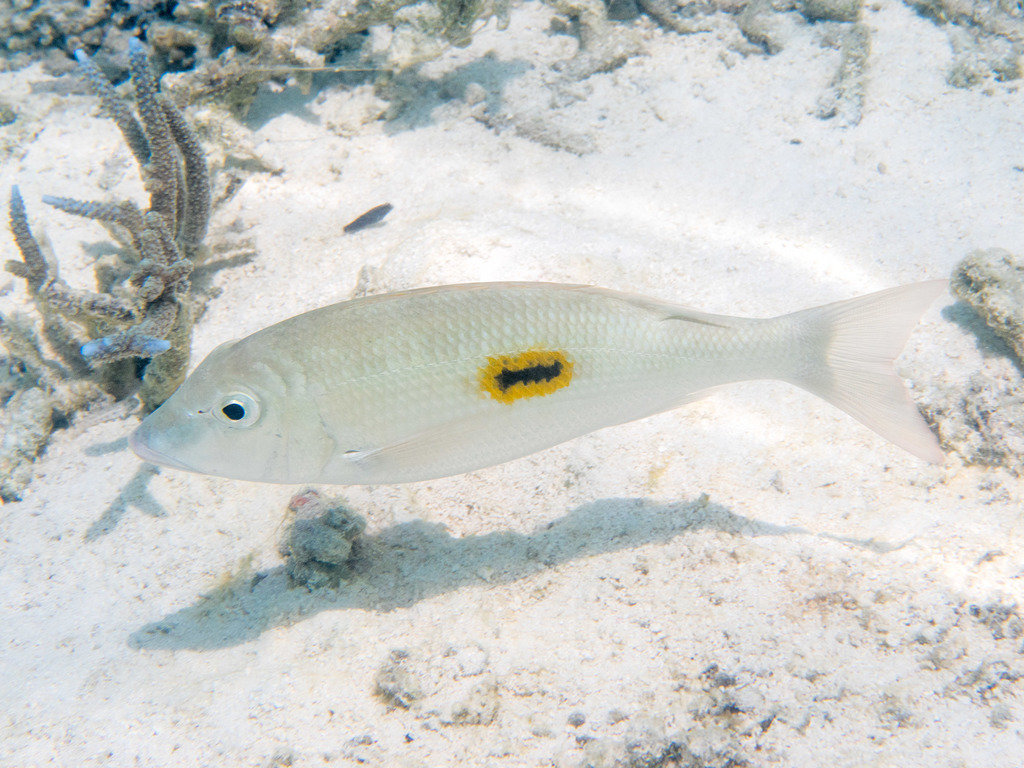
Thumbprint Emperor
Lethrinus harak
Lethrinus harak, common names the thumbprint emperor and blackspot emperor, is a species of emperor fish.
From the article Lethrinus harak on Wikipedia (CC BY-SA), quoted section by section
Description
Lethrinus harak has its dorsal fin supported by 10 spines and 9 soft rays while there are 3 spines and 8 soft rays supporting the anal fin. This species is olive-green in colour, becoming paler toward the belly. It can grow to a maximum length of 50 cm (20 in) but is commonly found at 30 cm (12 in). There is a characteristic large blotch on the sides. It is dark and elliptical, located directly under the lateral line. This blotch often has a yellow edge. There are occasionally pale blue dots around each nostril and bordering the lower rim of the eyes. The caudal fin is reddish or orange in colour. The pelvic, dorsal, and pectoral fins are all pinkish to white. The mouth is somewhat protractile with thick lips.
Range & habitat
Lethrinus harak has a wide Indo-Pacific distribution occurring along the eastern coast of Africa from the northern Red Sea south to South Africa, the islands of the western Indian Ocean, the Madives, Sri Lanka and southern India. It is then found from the Andmana Sea and Indo-Malayan Archipelago into the Pacific Ocean as far east as Samoa, north to Japan and soyth to northeastern Australia.
Wikipedia: “Distribution”
In human culture
Lethrinus harak has the specific name harak which Forsskål used in his notes, deriving it from the Arabic name for this fish in the Red Sea, Abu m'hárrak.
Wikipedia: “Etymology”
Where it lives
Recorded sightings
—
geo-referenced records in GBIF, from museums, herbaria and field observers.
Drag the globe to turn it. Dots are where records exist, not a range map; darker means more records.
In the stacks
Searching the stacks…
Every page naming Lethrinus harak in the Biodiversity Heritage Library →
This page is assembled live from iNaturalist, GBIF, Wikipedia, the Source Library and the Internet Archive. It is not yet part of the hand-edited codex. iNaturalist taxon 201024.