- Animals
- ›Chordates
- ›Vertebrates
- ›Ray-finned Fishes
- ›Spiny-rayed fishes
- ›Gobies, cardinalfishes and allies
- ›Gobies and allies
- ›Mudskippers and Allies
- ›Estuarine Gobies
- ›Rhinogobius
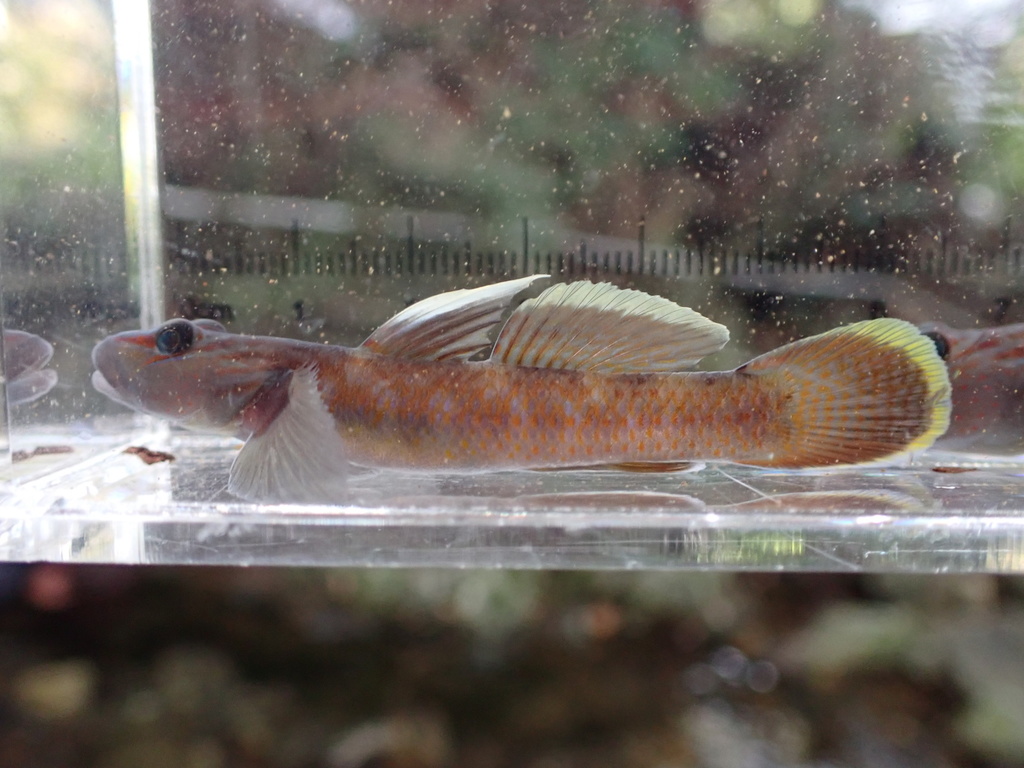
Brown Amur Goby
Rhinogobius brunneus
Rhinogobius brunneus, the common freshwater or the “amur” goby, is a complex of several species in the family Oxudercidae. It is found in the Asian river basins of the seas of the Pacific coasts of Japan, Taiwan, the rivers of Korea, China, the Philippines, and Vietnam.
From the article Rhinogobius brunneus on Wikipedia (CC BY-SA), quoted section by section
Description
Rhinogobius brunneus has a cylindrical body that tapers into a laterally compressed rear. The body is brown and may have patterning such as dark vertical banding. A red line runs from the eye's anterior edge to the snout's tip. Both sexes have an orange splotch at the base of the caudal fin, with it being less pronounced in females. R. brunneus measures at around 40 mm during the first two years of life, but will reach over 65 mm after four years. This species has fused pelvic fins that form a suction-cup structure on the chest. The lips are thick with the mouth ending at the anterior of the eye. Jaws have three or four rows of conical teeth. The vertebral count is 26. The common freshwater goby has two dorsal fins, the first with six spines and the second with a single spine and eight rays. It also has one anal spine, eight anal rays, and 18-20 pelvic fin rays. The first dorsal fin is tall and triangular shaped while the second is shorter, rounded, and begins at the midbody. The anal fin is positioned symmetrically to the second dorsal fin but is comparatively smaller. The pectoral fin and caudal fin are rounded. The Rhinogobius brunneus complex contains many color morphs. These color morphs are considered genetically different from each other and also show differences in microhabitat preference and egg size. …
Range & habitat
Rhinogobius brunneus is distributed throughout the East Asian river basins but tends to concentrate in short rivers facing the Pacific Ocean. It can be found in all river courses in Japan except for Hokkaido and Tohoku. R. brunneus has also been introduced to the Arabian Gulf and the United States.
Wikipedia: “Distribution and habitat”
What it does
The males and females are sexually mature after one year. Males build nests under rocks in the freshwater rapids and runs but return to the pools to look for females. Females will deposit their eggs in the nest and then leave the male to fan and protect the eggs for three to five days or up to two weeks (depending on water temperature) until they hatch. During this time, the males guard the eggs and do not leave to find sources of food. Therefore, a deteriorating male may cannibalize his eggs. Spawning occurs in early April to early July with clutches of 600-1,700 eggs. Females can spawn more than once in one breeding season, and nests may contain eggs from more than one female.
Male gobies of some species in this complex will perform courtship displays to attract females. The courtship display involves the male approaching the female, and then shaking his head. If the female bends her body as a sign of acceptance, the male will try to lead her to his nest while spreading his fins and vibrating his body. The display usually lasts less than 10 seconds. Females prefer males that court in faster currents, as it is an honest sign of good physical ability. …
Wikipedia: “Reproduction”
Where it lives
Recorded sightings
—
geo-referenced records in GBIF, from museums, herbaria and field observers.
Drag the globe to turn it. Dots are where records exist, not a range map; darker means more records.
In the stacks
Searching the stacks…
Every page naming Rhinogobius brunneus in the Biodiversity Heritage Library →
This page is assembled live from iNaturalist, GBIF, Wikipedia, the Source Library and the Internet Archive. It is not yet part of the hand-edited codex. iNaturalist taxon 111712.