- Animals
- ›Chordates
- ›Vertebrates
- ›Ray-finned Fishes
- ›Spiny-rayed fishes
- ›Blennies, Damselfishes and Allies
- ›Blennies
- ›Pike-Blennies, Tube-Blennies, and Flagblennies
- ›Neoclinus
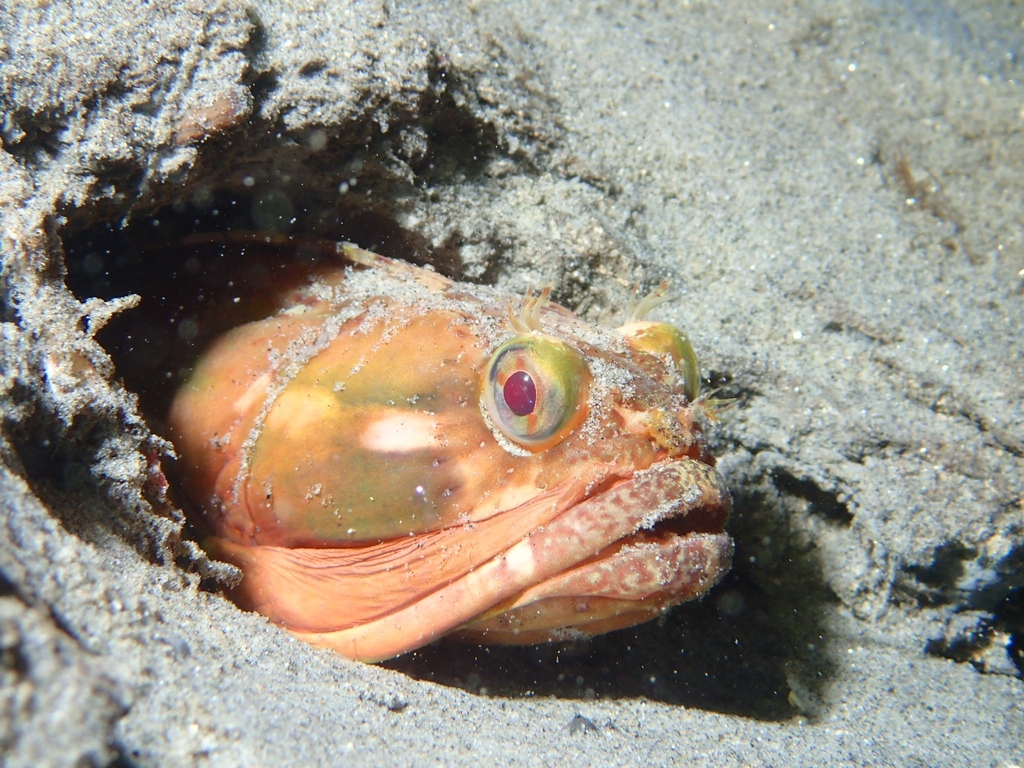
Sarcastic Fringehead
Neoclinus blanchardi
The sarcastic fringehead (Neoclinus blanchardi) is a small saltwater tube-blenny that possesses an extremely large, brightly coloured mouth, which males display during territorial encounters, for which it has been given its common name. The term 'fringehead' reflects the distinctive ruff of tissue surrounding the fish's neck. The specific name honors Dr. S. B. Blanchard of San Diego, California, who collected specimens of this blenny and passed them on to Charles Frédéric Girard, who described it.
From the article Sarcastic fringehead on Wikipedia (CC BY-SA), quoted section by section
Description
Sarcastic fringeheads can be up to 30 centimetres (12 in) long, and are mostly scaleless with great pectoral fins and reduced pelvic fins. Usually there are pale spots or patches on the cheeks. Males have a series of eye‑like markings on the spiny portion of the dorsal fin; each spot shows a vivid metallic blue centre bordered by a golden yellowish ring. The swimming movements of these fish mainly consist of short, dart-like movements. Their body coloration varies from warm brown to gray with a blotchy appearance. Male sarcastic fringeheads are distinguished by their extremely wide mouth gape, which, when open, may be as much as four times its size when closed. The interior of the mouth is brightly colored, with yellow at the posterior, which is hypothesized to amplify its display. Additionally, the buccopalatal membranes exhibit green fluorescence.
Wikipedia: “Appearance”
Range & habitat
Due to the size of their mouths, sarcastic fringeheads are categorized as ram-suction feeders, relying on fast burst speeds and moderate suction to capture prey. During squid spawning season, they can consume large numbers of squid eggs. Outside of that, they mainly feed on crustaceans and planktonic prey. They modulate their gape size during feeding, using only half of their maximum mouth opening to eat. Variability in daily foraging time, influenced by the frequency of territorial encounters, may shape evolutionary adaptations in fringeheads, including gut size and efficiency based on food availability.
Wikipedia: “Feeding habitats”
What it does
Sarcastic fringeheads live along sandy and muddy bottoms below the low tide line. They tend to back into objects and cavities, such shells, burrows, and crevices, exposing only their heads. They are also found living in man-made objects, such as bottles and soda cans. When two fringeheads have a territorial scuffle, they wrestle by pressing their distended mouths against each other, in a kissing motion. They press against each other until one is able to bite the other's head. This allows them to determine which is the larger fish, which establishes dominance. Territorial fights between males appear to be linked to competition for shelter, which is important for survival in crowded habitats. When a sarcastic fringehead loses a wrestling match with an intruder, it becomes displaced and must search for a new shelter, a process that can consume significant time and energy that could otherwise be spent foraging or mating. The time wasted searching for a new shelter can increase the risk of predation, as displaced fringeheads become more vulnerable while searching for a new home. …
Wikipedia: “Ecology and behavior”
Where it lives
Recorded sightings
—
geo-referenced records in GBIF, from museums, herbaria and field observers.
Drag the globe to turn it. Dots are where records exist, not a range map; darker means more records.
In the stacks
Searching the stacks…
Every page naming Neoclinus blanchardi in the Biodiversity Heritage Library →
This page is assembled live from iNaturalist, GBIF, Wikipedia, the Source Library and the Internet Archive. It is not yet part of the hand-edited codex. iNaturalist taxon 317244.