- Animals
- ›Chordates
- ›Vertebrates
- ›Ray-finned Fishes
- ›Spiny-rayed fishes
- ›Perches, Scorpionfishes, Sticklebacks, and Allies
- ›Perches, groupers and allies
- ›Perches, Darters, and allies
- ›Darters
- ›Etheostoma
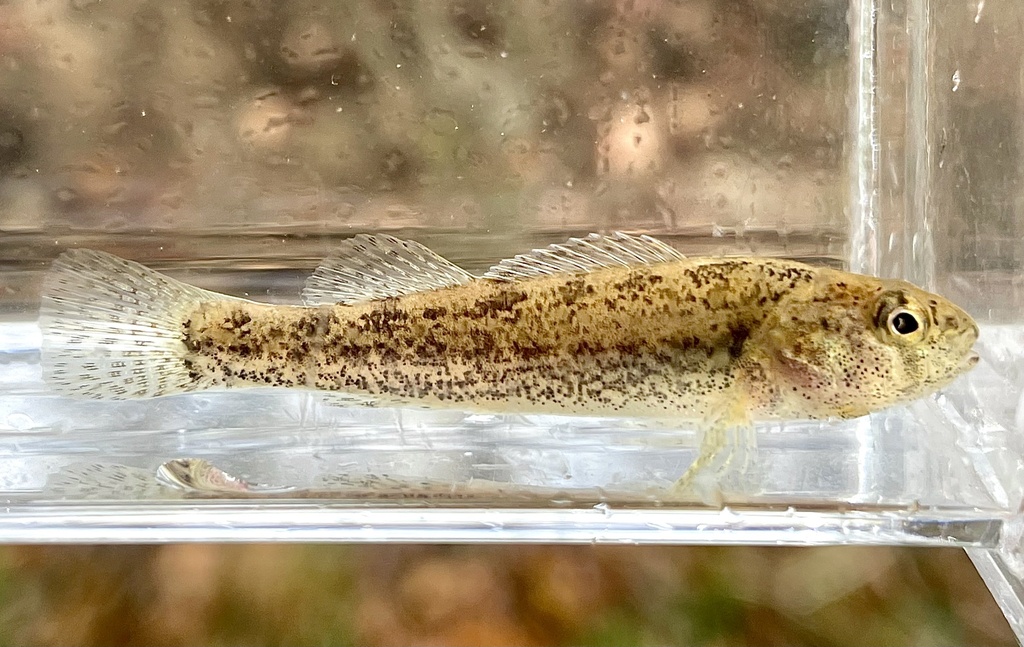
Arkansas Darter
Etheostoma cragini
The Arkansas darter (Etheostoma cragini) is a species of freshwater ray-finned fish, a darter from the subfamily Etheostomatinae, part of the family Percidae, which also contains the perches, ruffes and pikeperches. It is endemic to the United States where it is found in Kansas, Arkansas, Missouri, Colorado, and Oklahoma.
From the article Arkansas darter on Wikipedia (CC BY-SA), quoted section by section
Description
The Arkansas darter has an olive-brown dorsal surface spotted with fine black markings, and a yellowish-white underside except that in males during the breeding season, the belly turns bright orange. It has a blackish wedge-shaped blotch beneath its eye and there are 12 to 14 dark stripes along the sides. This species reaches a maximum size of 6 cm (2.4 in).
Range & habitat
The Arkansas darter, despite its name, is primarily found in Kansas. However, its range encompasses the Arkansas River drainage system and this extends into eastern Colorado, southwestern Missouri, northeastern Arkansas and north-central Oklahoma, as well.
Wikipedia: “Distribution”
What it does
The Arkansas darter moves up and down stream by as much as several kilometers in accordance with varying water flows. It feeds on small insects and their larvae and sometimes consumes plant material such as seeds. It reaches sexual maturity at about a year and spawns during the spring and summer. The eggs are laid in shallow water on gravel bottoms in open areas or among organic debris accumulations.
Wikipedia: “Behavior”
Where it lives
Recorded sightings
—
geo-referenced records in GBIF, from museums, herbaria and field observers.
Drag the globe to turn it. Dots are where records exist, not a range map; darker means more records.
In the stacks
Searching the stacks…
Every page naming Etheostoma cragini in the Biodiversity Heritage Library →
This page is assembled live from iNaturalist, GBIF, Wikipedia, the Source Library and the Internet Archive. It is not yet part of the hand-edited codex. iNaturalist taxon 100465.