- Animals
- ›Chordates
- ›Vertebrates
- ›Ray-finned Fishes
- ›Spiny-rayed fishes
- ›Wrasses and allies
- ›False scorpionfishes, wrasses, and parrotfishes
- ›Wrasses and Parrotfishes
- ›Pseudolabrinae
- ›Notolabrus
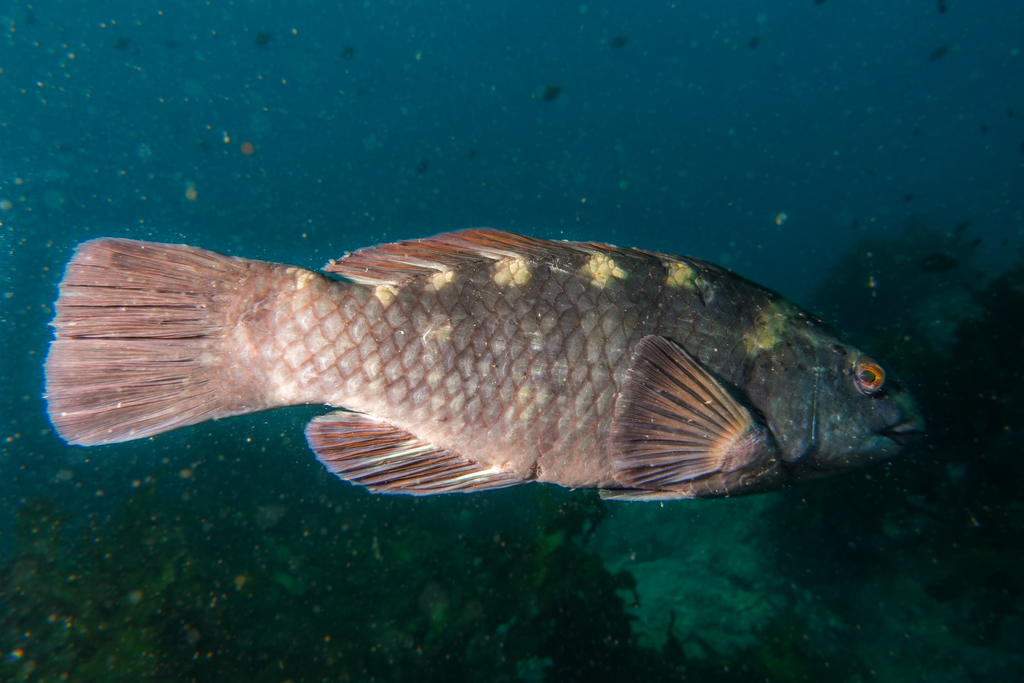
Purple Wrasse
Notolabrus fucicola
Notolabrus fucicola, the banded parrotfish, blue wrasse, kelpie, New Zealand banded wrasse, purple parrotfish, saddled wrasse, Southern purple wrasse, Southern wrasse, winter bream or yellow-saddled wrasse, is a species of wrasse native to the eastern Indian Ocean, off eastern Australia and all around New Zealand on rocky, weedy reef areas. Aging work in New Zealand suggested these wrasses can live at least 35 years.
From the article Notolabrus fucicola on Wikipedia (CC BY-SA), quoted section by section
Description
Notolabrus fucicola is the largest wrasse species occurring in New Zealand's waters. Its It grows to a length of 45 centimetres (18 in) in Australian waters but can be slightly larger around New Zealand, where they can reach lengths of 60 centimetres (24 in) and weights of up to 5 kilograms (11 lb). This species has quite a deep body and shows variable colouring, the young adult fish are reddish-brown mottled with green and orange and the adults are green-brown in colour with shades of purple and fuzzy yellowish vertical bars on their body and fins. Juveniles are a similar colour to young adults but have yellow markings.
Range & habitat
Notolabrus fucicola is found in the south eastern Indian Ocean and the south western Pacific Ocean in Australia and New Zealand. It is found throughout New Zealand including the Three Kings Islands, Stewart Island and Snares Island. In Australia it is found off the south east from southern New South Wales, Victoria to eastern South Australia, as well as Tasmania.
Wikipedia: “Distribution”
Where it lives
Recorded sightings
—
geo-referenced records in GBIF, from museums, herbaria and field observers.
Drag the globe to turn it. Dots are where records exist, not a range map; darker means more records.
In the stacks
Searching the stacks…
Every page naming Notolabrus fucicola in the Biodiversity Heritage Library →
This page is assembled live from iNaturalist, GBIF, Wikipedia, the Source Library and the Internet Archive. It is not yet part of the hand-edited codex. iNaturalist taxon 107182.