- Animals
- ›Chordates
- ›Vertebrates
- ›Ray-finned Fishes
- ›Spiny-rayed fishes
- ›Wrasses and allies
- ›False scorpionfishes, wrasses, and parrotfishes
- ›Wrasses and Parrotfishes
- ›North Atlantic wrasses
- ›Labrus
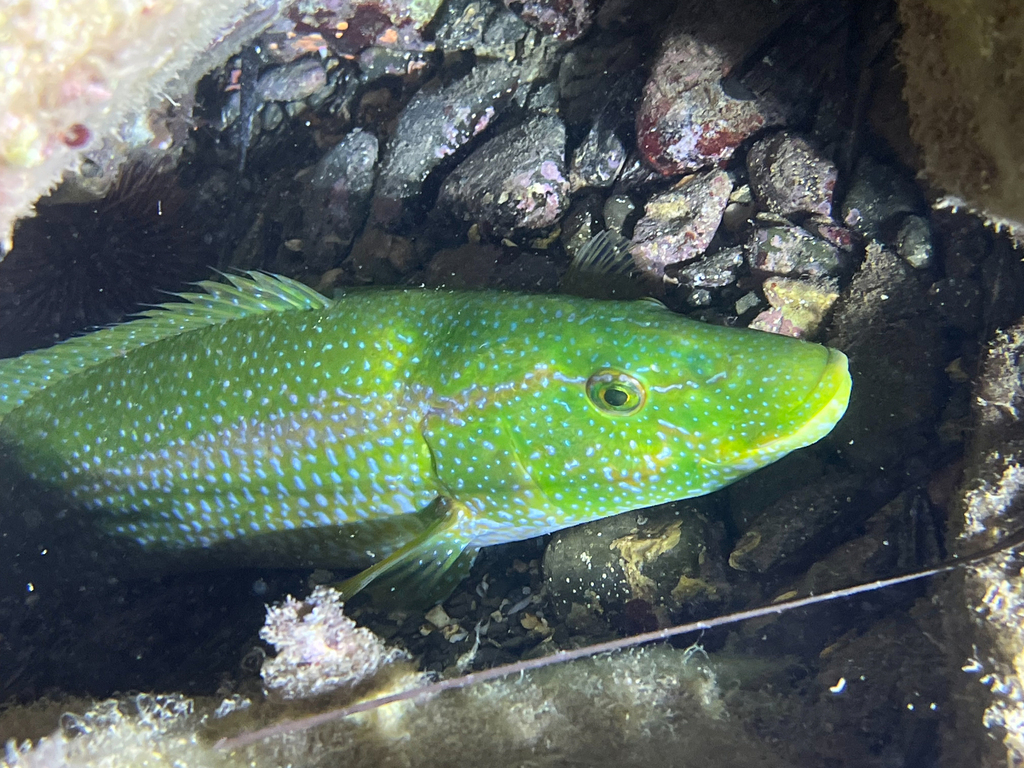
Green Wrasse
Labrus viridis
Labrus viridis (the green wrasse) is a species of wrasse native to the eastern Atlantic Ocean from Portugal to Morocco, as well as through the Mediterranean Sea to the Black Sea. This species is found around rocky reefs amongst the rocks or in eelgrass beds. It can reach 47 cm (19 in) in standard length, though most do not exceed 37.5 cm (15 in). It is one of several species called green wrasse.
From the article Labrus viridis on Wikipedia (CC BY-SA), quoted section by section
Description
The green wrasse grows to about 35 cm (14 in) and is a plump fish with a moderately large head. The eyes are large and the nostrils each have a double opening. The lips are thick and the mouth fairly small, with numerous large teeth. The back is slightly humped, and the belly is slightly convex. The skin is covered with large scales and is smooth and soft, being covered with mucus. The dorsal fin has 18 spines and 12 soft rays. The pectoral fins are large and the caudal fin undivided. In most individuals the colour is bright green with a blue line running along the flank, but some individuals are almost entirely black while others are spotted.
Range & habitat
The green wrasse is native to the eastern Atlantic Ocean between Portugal and Morocco, and most of the Mediterranean Sea, although it seems to be absent from the waters of Syria, Lebanon and Israel. It is also present in the western Black Sea. Its depth range is down to about 50 m (160 ft). Its typical habitat is in the vicinity of rocky reefs, especially those well-covered with seaweed, and seagrass meadows.
Wikipedia: “Distribution”
What it does
The green wrasse can occur in small groups but is more often found singly or in pairs. It feeds on small fish, crustaceans and other invertebrates. It is probably a protogynous hermaphrodite, that is it starts life as a female but at some stage changes its sex to male. This means that male fish are normally larger than females. A breeding pair of fish will prepare a dish-shaped nest among vegetation, and the adhesive eggs laid by the female are guarded and cared for by the male. The age of attaining maturity is probably three years, and the fish may live for twenty years.
Wikipedia: “Ecology”
Where it lives
Recorded sightings
—
geo-referenced records in GBIF, from museums, herbaria and field observers.
Drag the globe to turn it. Dots are where records exist, not a range map; darker means more records.
In the stacks
Searching the stacks…
Every page naming Labrus viridis in the Biodiversity Heritage Library →
This page is assembled live from iNaturalist, GBIF, Wikipedia, the Source Library and the Internet Archive. It is not yet part of the hand-edited codex. iNaturalist taxon 103914.