- Animals
- ›Chordates
- ›Vertebrates
- ›Ray-finned Fishes
- ›Spiny-rayed fishes
- ›Wrasses and allies
- ›False scorpionfishes, wrasses, and parrotfishes
- ›Wrasses and Parrotfishes
- ›Rainbow Wrasses and Allies
- ›Labroides
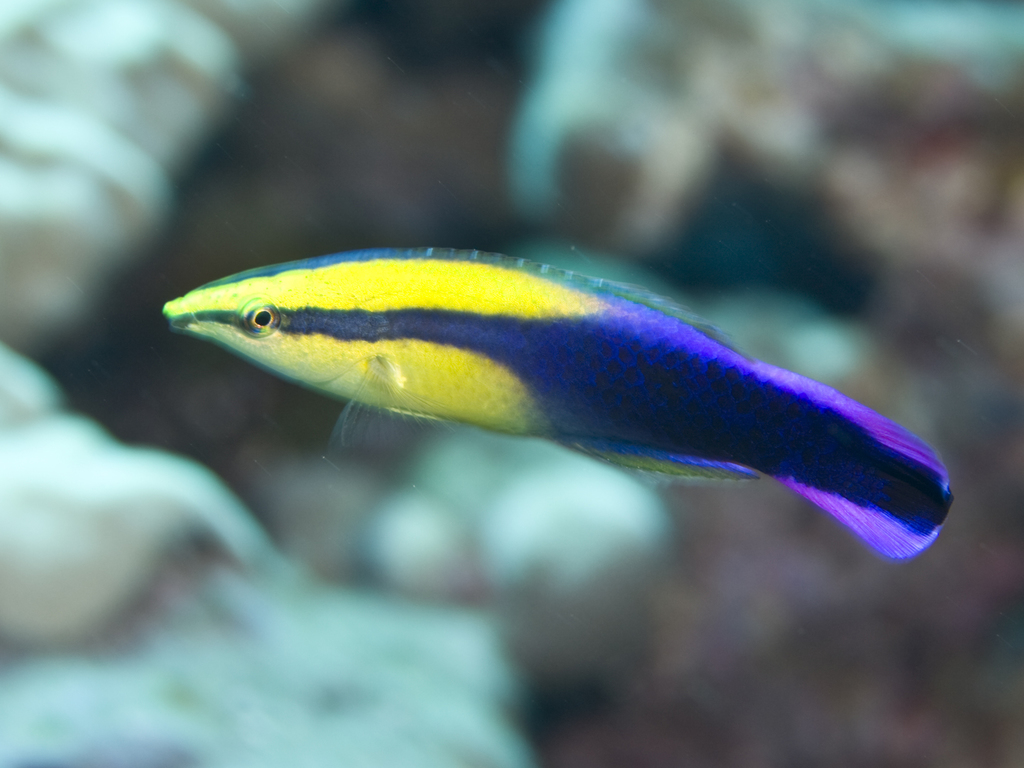
Hawaiian Cleaner Wrasse
Labroides phthirophagus
The Hawaiian cleaner wrasse or golden cleaner wrasse (Labroides phthirophagus), is a species of wrasse (genus Labroides) found in the waters surrounding the Hawaiian Islands. The fish is endemic to Hawaii. These cleaner fish inhabit coral reefs, setting up a territory referred to as a cleaning station. They obtain a diet of small crustacean parasites by removing them from other reef fish in a cleaning symbiosis.
From the article Hawaiian cleaner wrasse on Wikipedia (CC BY-SA), quoted section by section
Description
The Hawaiian cleaner wrasse grows to a maximum length of about 12 cm (5 in). This fish is strikingly coloured; the anterior part is golden, with a dark lateral stripe running from the eye to the tail, becoming wider at the back. The posterior part of the fish has purple and violet colouration on the fins.
Range & habitat
This fish is endemic to the Hawaiian Islands and nearby Johnston Atoll. It is typically found on coral and rocky reefs, but avoids the surge zone. It is found at depths down to about 90 m (300 ft).
Wikipedia: “Distribution and habitat”
What it does
The Hawaiian cleaner wrasse moves with a graceful flitting movement. At night it may rest in a balloon-like cocoon it builds from mucus. The species is monogamous, with a pair bond being formed during the breeding season. It is an obligate feeder on the ectoparasites of other fish to the extent that it will fail to thrive in an aquarium where these feeding needs are not met. The behaviour of this fish is very similar to that of the closely related bluestreak cleaner wrasse (Labroides dimidiatus), widely found in the rest of Indo-Pacific region. Both species operate cleaning stations where larger fish (clients) visit and cooperate in the removal by the cleaner fish of their ectoparasites, loose flakes of skin and mucus. The arrangement is mutually beneficial, with the client fish having its parasites removed and the wrasse gaining protection and finding an easy meal. The process is not without danger for the cleaner fish as many of the client fish are piscivores, but observations in the wild show an apparent absence of "cheating" by the client fish, which seem to appreciate the tactile stimulation provided by the cleaner fish moving around their skin and fins. It seems that cleaner fish build up a relationship with their clients and there is some communication between them. …
Wikipedia: “Ecology”
Where it lives
Recorded sightings
—
geo-referenced records in GBIF, from museums, herbaria and field observers.
Drag the globe to turn it. Dots are where records exist, not a range map; darker means more records.
In the stacks
Searching the stacks…
Every page naming Labroides phthirophagus in the Biodiversity Heritage Library →
This page is assembled live from iNaturalist, GBIF, Wikipedia, the Source Library and the Internet Archive. It is not yet part of the hand-edited codex. iNaturalist taxon 103903.