- Animals
- ›Chordates
- ›Vertebrates
- ›Ray-finned Fishes
- ›Spiny-rayed fishes
- ›Wrasses and allies
- ›False scorpionfishes, wrasses, and parrotfishes
- ›Wrasses and Parrotfishes
- ›Rainbow Wrasses and Allies
- ›Halichoeres
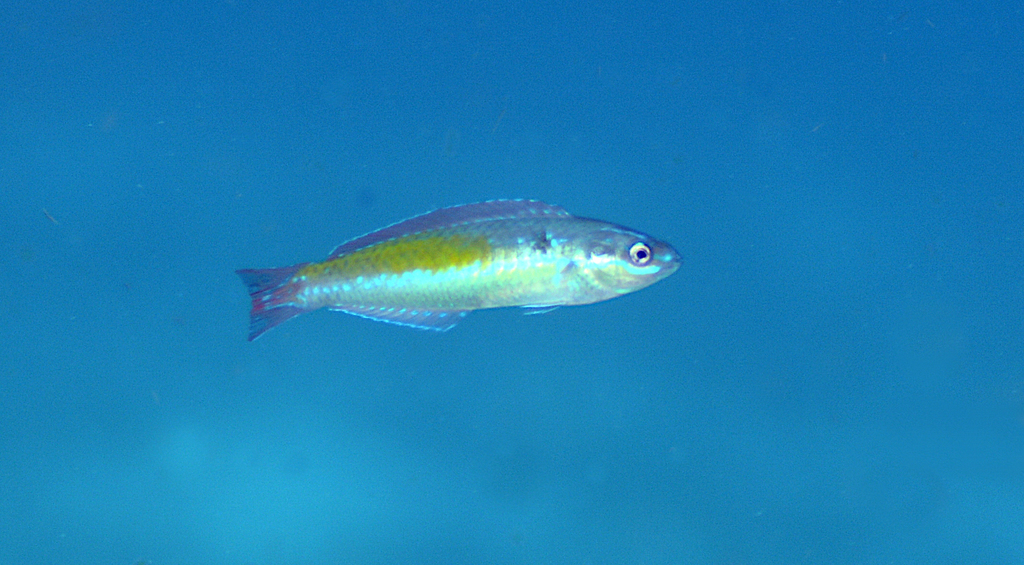
Social Wrasse
Halichoeres socialis
Halichoeres socialis, the social wrasse, is an endangered species of salt water wrasse found in Belize. They are found mainly in the mangrove forests in the Pelican Cays along said coast. These fish are absent from mangroves and reefs farther from the shore. They live close to the shore from a depth of 0-7 m (~22.9 ft) and over a variety of substrates such as sand, coral, rocks, or seagrass. When threatened, these fish group up into schools and swim away from the threat. This is unlike the more solo diving behaviors found in other members of this genus. They are currently being threatened by pollution and invasive lionfish species.
From the article Halichoeres socialis on Wikipedia (CC BY-SA), quoted section by section
Description
From the snout to the base of the caudal fin, the males were 29.0–34.6 mm while females were 27.5–36.4 mm in length. Females, juveniles, and Initial phase males all share the same appearance. They are pale green on top and light grey on the bottom with a set of three stripes running down the middle that terminate at the base of the caudal fin where there is a black ocellus. The top stripe is a dark brown and starts at the tip of the snout while the middle stripe is bright white and starts from underneath or just behind the eye. Lastly, the bottom stripe starts at the base of the pectoral fin and terminates at the same place as the other two stripes. Terminal phase males are much more colorful than their female counterparts. They become a yellowish green with a lighter green ventral area. Their dorsal and anal fins are red with bright blue dots lining the base and the top outlined in the same bright blue. The pelvic and caudal fins remain mostly clear with a darker red spot occurring at their base. The caudal fin also has a series of bright blue dots that form a three sided box around the darker red dot. This box also has two sets of horizontal stripes running through it. There are two sets of stripes running the length of the terminal phase male’s body. One starts just above the maxilla, passes back under the eye and ends at the base of the pectoral fin. …
Wikipedia: “Appearance”
Range & habitat
Halichoeres socialis have been recorded living in the Meso-American Barrier Reef lagoon off the coast of Belize. They prefer living in and around the reefs found near the inshore mangrove forests from Wee Wee Cay to the Pelican Cays and are absent from mangroves and reefs farther from the shore. There have been claimed sightings of these fish appearing as far away as Bahia Trujillo at Honduras, but there have been no formal recorded sightings of this species there. They have been found close to shore in the intertidal and neritic zones at depths of 0-7 m (~22.9 ft) over a variety of substrates such as sand, coral, rocks, or seagrass.
Wikipedia: “Distribution”
Where it lives
Recorded sightings
—
geo-referenced records in GBIF, from museums, herbaria and field observers.
Drag the globe to turn it. Dots are where records exist, not a range map; darker means more records.
In the stacks
Searching the stacks…
Every page naming Halichoeres socialis in the Biodiversity Heritage Library →
This page is assembled live from iNaturalist, GBIF, Wikipedia, the Source Library and the Internet Archive. It is not yet part of the hand-edited codex. iNaturalist taxon 102083.