- Animals
- ›Chordates
- ›Vertebrates
- ›Ray-finned Fishes
- ›Spiny-rayed fishes
- ›Wrasses and allies
- ›False scorpionfishes, wrasses, and parrotfishes
- ›Wrasses and Parrotfishes
- ›Rainbow Wrasses and Allies
- ›Thalassoma
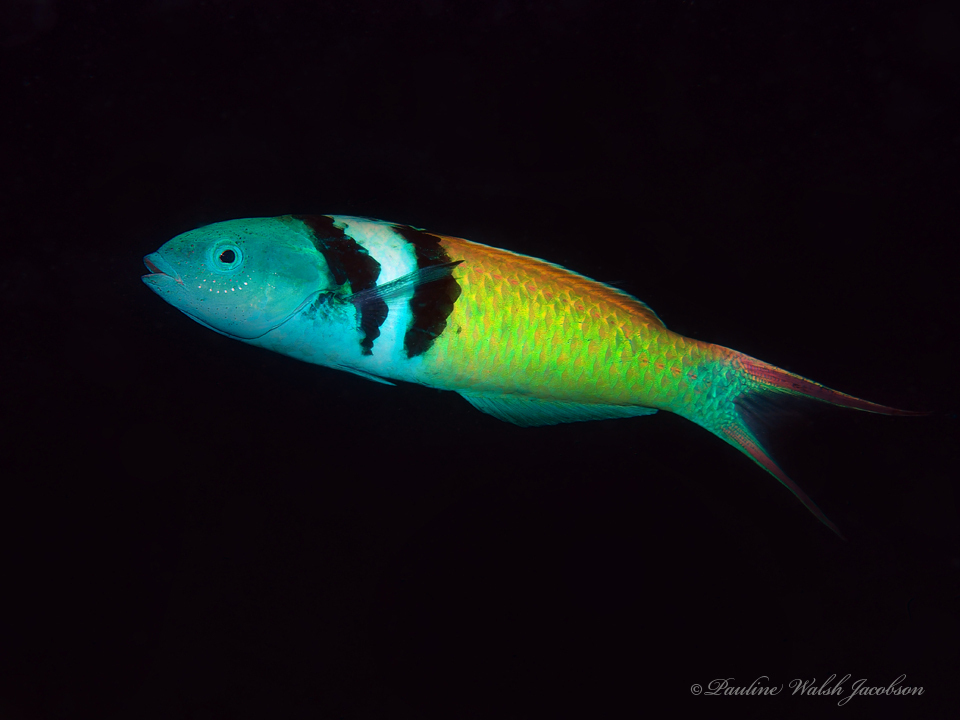
Caribbean Bluehead Wrasse
Thalassoma bifasciatum
Thalassoma bifasciatum, the bluehead, bluehead wrasse or blue-headed wrasse, is a species of marine ray-finned fish, a wrasse from the family Labridae. It is native to the coral reefs of the tropical waters of the western Atlantic Ocean. Individuals are small (less than 110 mm standard length) and rarely live longer than two years. They form large schools over the reef and are important cleaner fish in the reefs they inhabit.
From the article Thalassoma bifasciatum on Wikipedia (CC BY-SA), quoted section by section
Description
Young/small females and males have yellow upper bodies and white lower bodies, often with green or black lateral stripes and occasionally dark vertical bars. This coloration is known as the initial phase. They can rapidly alter the presence or intensity of their yellow color, stripes, and bars, and these color changes appear to correspond to behavioral changes. Large females and some males can permanently change coloration and/or sex and enter the terminal phase coloration, which has a blue head, black and white bars behind the head, and a green body. This color phase gives the species its name. Terminal phase males are larger (70 to 80 mm) than the initial phase males (60 mm).
Range & habitat
Thalassoma bifasciatum is found in coral reefs of the Atlantic Ocean. Its main range includes the Caribbean Sea and the southeast area of the Gulf of Mexico. In Punta Cana, Dominican Republic, the bluehead wrasse is a common sight for scuba divers and snorkelers exploring local reefs.
Wikipedia: “Distribution and habitat”
What it does
Thalassoma bifasciatum forages for zooplankton, mollusks, small crustaceans (such as shrimp and krill), worms, other motile invertebrates, and the eggs of smaller fish, as well as ectoparasites on other fish. Initial phase males eat primarily zooplankton from currents, and females and initial phase males have certain hunting times during the day.
Wikipedia: “Diet”
Where it lives
Recorded sightings
—
geo-referenced records in GBIF, from museums, herbaria and field observers.
Drag the globe to turn it. Dots are where records exist, not a range map; darker means more records.
In the stacks
Searching the stacks…
Every page naming Thalassoma bifasciatum in the Biodiversity Heritage Library →
This page is assembled live from iNaturalist, GBIF, Wikipedia, the Source Library and the Internet Archive. It is not yet part of the hand-edited codex. iNaturalist taxon 49491.