- Animals
- ›Chordates
- ›Vertebrates
- ›Ray-finned Fishes
- ›Spiny-rayed fishes
- ›Butterflyfishes, Angelfishes, and Allies
- ›Splendid Perches
- ›Callanthias
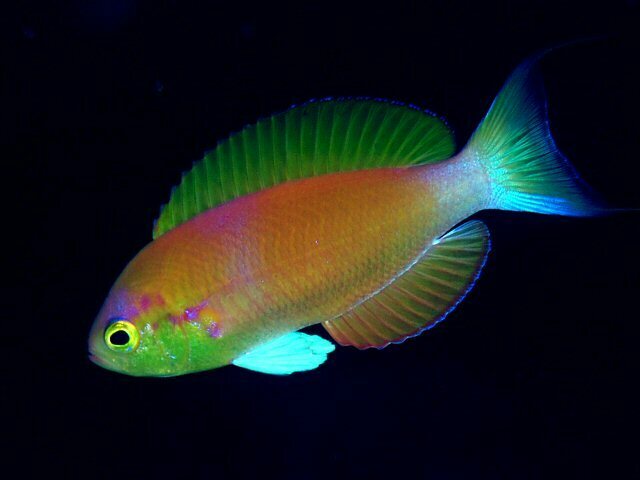
Japanese splendid perch
Callanthias japonicus
Callanthias japonicus, the Japanese splendid perch or yellowsail sea bass, is a species of marine ray-finned fish belonging to the family Callanthiidae. This species is found in the northwestern Pacific Ocean.
From the article Callanthias japonicus on Wikipedia (CC BY-SA), quoted section by section
Description
Callanthias japonicus has a dorsal fin which is supported by 10 spines and between 11 or 12 soft rays while the anal fin has 3 spines and 10 or 11 soft rays. It has an elongate, compressed body with a short, blunt snout. The preoperculum is rounded and has no spines or serrations but the operculum has 2 spines. The overall colour is pink, shading to yellow on the blower body. This species has a maximum published standard length of 23.3 cm (9.2 in).
Range & habitat
Callanthias japonicus is found in the northwestern Pacific Ocean where it is found from southern Japan, southern South Korea south through the Ryukyu Islands to Taiwan. It has been claimed from the Emperor Seamounts but this has to be verified. This species is found over rocky reefs at depths greater than 60 m (200 ft). It feeds on zooplankton and frequently forms mixed schools with anthiin serranids.
Wikipedia: “Distribution and habitat”
Where it lives
Recorded sightings
—
geo-referenced records in GBIF, from museums, herbaria and field observers.
Drag the globe to turn it. Dots are where records exist, not a range map; darker means more records.
In the stacks
Searching the stacks…
Every page naming Callanthias japonicus in the Biodiversity Heritage Library →
This page is assembled live from iNaturalist, GBIF, Wikipedia, the Source Library and the Internet Archive. It is not yet part of the hand-edited codex. iNaturalist taxon 609557.