- Animals
- ›Chordates
- ›Vertebrates
- ›Ray-finned Fishes
- ›Spiny-rayed fishes
- ›Butterflyfishes, Angelfishes, and Allies
- ›Snappers
- ›Fusiliers
- ›Lutjanus
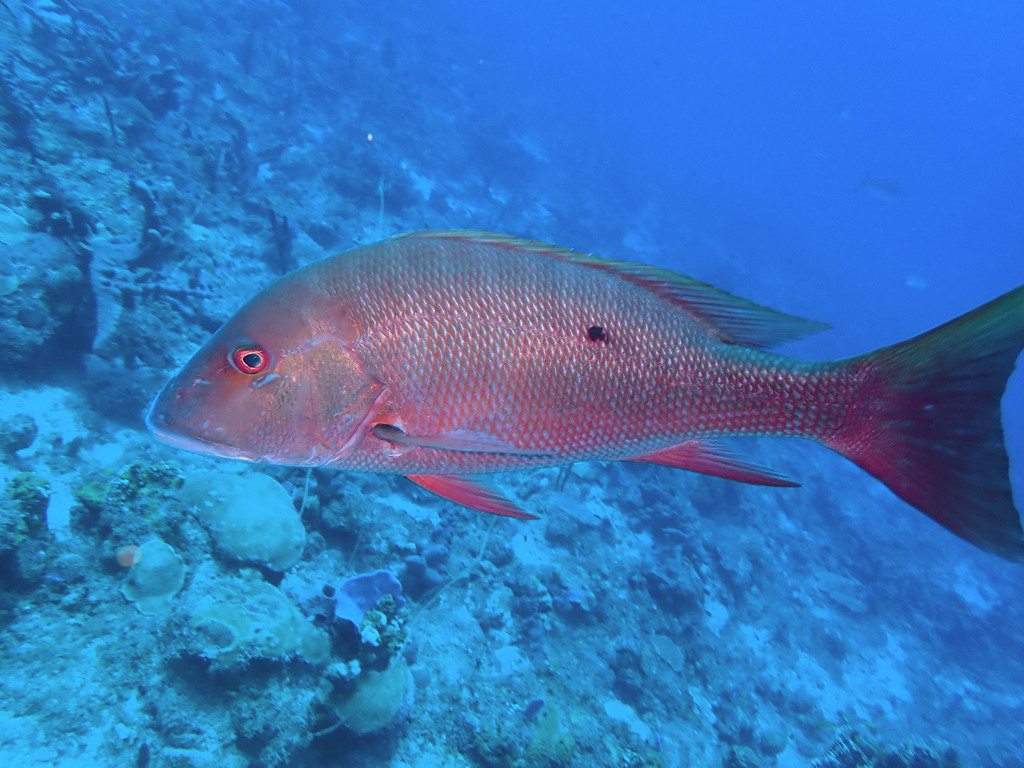
Mutton Snapper
Lutjanus analis
The mutton snapper (Lutjanus analis) is a species of marine ray-finned fish, a snapper belonging to the family Lutjanidae. It is found in the Western Atlantic Ocean.
From the article Mutton snapper on Wikipedia (CC BY-SA), quoted section by section
Description
The mutton snapper has a moderately deep, almond shaped body, with a nearly lunate caudal fin. The dorsal fin is almost two lobed and it has a sharply pointed anal fin. The pectoral fin is long, extending just past the origin of the anal fin. Both pairs of nostrils are simple holes. It has small eyes, a straight dorsal profile on the forehead and comparatively large terminal mouth with a protrusible upper jaw which is mostly covered by the cheek bone when the mouth is closed. The jaws are equipped with 1-2 tows of conical teeth with some of the outer row being enlarged into canine-like teeth. The vomerine teeth are arranged in a chevron shaped patch with another patch of teeth on each side of the palate. The dorsal fin has 10-11 spines and 13-14 soft rays while the anal fin contains 3 spines and 7-8 soft rays. The pectoral fin has 15-17, typically 16, rays. This is a colourful species with olive green on the back and upper flanks shading to reddish the lower flanks and abdomen. There is a black spot on the between the lateral line and the spiny part of the dorsal fin. There is a pair of blue stripes beneath the eyes and the higher one continues on to the operculum. The caudal fin has a black margin. When the fish is resting it has 10 to 12 dark vertical bars on the body, these merge into a solid colour when the fish is swimming. The fins are red. …
Range & habitat
The mutton snapper is native to the western Atlantic Ocean where it occurs from Massachusetts in the north to Brazil in the south. It is commonest in the warmer waters of Florida, the Bahamas, the Caribbean Sea and in the Gulf of Mexico. This species occurs in comparatively shallow clear waters at depths from 25 to 95 m (82 to 312 ft) where the water temperature is between 18.9 and 27.8 °C (66.0 and 82.0 °F). The larger adults live in and around offshore reefs and in area of rock rubble, and the juveniles stay in inshore waters where they can be abundant in habitats such as tidal mangrove creeks, canals and shallow protected bays. The juveniles often shelter within turtle grass beds.
Wikipedia: “Distribution and habitat”
Where it lives
Recorded sightings
—
geo-referenced records in GBIF, from museums, herbaria and field observers.
Drag the globe to turn it. Dots are where records exist, not a range map; darker means more records.
In the stacks
Searching the stacks…
Every page naming Lutjanus analis in the Biodiversity Heritage Library →
This page is assembled live from iNaturalist, GBIF, Wikipedia, the Source Library and the Internet Archive. It is not yet part of the hand-edited codex. iNaturalist taxon 104853.