- Animals
- ›Chordates
- ›Vertebrates
- ›Ray-finned Fishes
- ›Spiny-rayed fishes
- ›Butterflyfishes, Angelfishes, and Allies
- ›Butterflyfishes
- ›Butterflyfishes
- ›Chaetodon
- ›Roaops
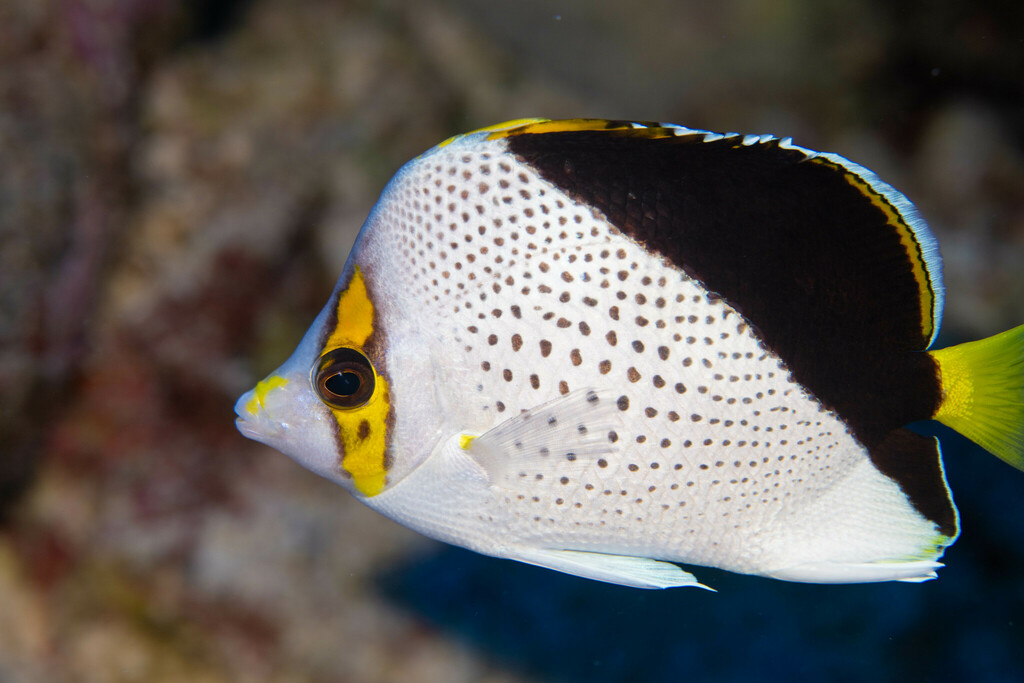
Tinker's Butterflyfish
Chaetodon tinkeri
The Hawaiian butterflyfish, Chaetodon tinkeri, is a member of the family Chaetodontidae of order Perciformes. It is also known as Tinker's butterflyfish, after Spencer W. Tinker who discovered it in 1949, trapping them in fish traps at 90 feet (27 m) off Oahu, Hawaii.
From the article Hawaiian butterflyfish on Wikipedia (CC BY-SA), quoted section by section
Description
The Hawaiian (Tinkers) butterflyfish display the morphological features that are shared by all butterflyfish species including a compressed oval body shape with small eyes located above the longitudinal axis of the fish. This species also has a single dorsal fin that is continuous and smooth which contains 13-14 dorsal spines and 18-22 dorsal rays. They have a single anal fin which contains 3 spines and 16-17 soft rays. They have a truncated caudal fin and paired pectoral fins on either side of their body. The exact coloring of the Hawaiian butterflyfish is how it may be distinguished from other similar species such as the Chaetodon flavocoronatus and Chaetodon burgessi. Specifically, naturalists will use a dichotomous key to match the exact markings with the species of butterflyfish. The Hawaiian butterflyfish has a relatively straight, sharp colour demarcation extending diagonally from near the start of the dorsal fin diagonally down to the middle of the anal fin. The section of the fish ventral to the split is white with dark or black spots and dorsally to the split is black. The Hawaiian butterflyfish also has a yellow caudal fin and a yellow stripe down its face. This yellow stripe is often used by naturalists as the distinguishing trait to recognize a Hawaiian butterflyfish. Adults may range in size from approximately 10–15 cm. …
Range & habitat
The Hawaiian butterflyfish is found only in Marine coral reef ecosystems in a few areas of the world. They were long believed to be endemic to the Hawaiian islands but have more recently been discovered in the Johnston and Marshall islands in the South Pacific. This small range of areas where they can be found means that they are relatively rare. As well they only exist in relatively deep reefs in the vicinity of steep slopes from 27–80 meters deep. This differs from many other fish in the butterflyfish family, who occupy coral reefs at much shallower depths and is considered a key characteristic that sets the Hawaiian butterflyfish apart from other species. Living at such depths may come from their mutualistic relationship with Black coral which tends to live at depths of at least 60 meters deep. Although the exact nature of this symbiosis is unknown, the Hawaiian butterflyfish are strongly associated with black coral and seem to be found largely in territories which contain Black coral structures. The exact abundance of Hawaiian butterflyfish within their range is largely unknown. The average depth that these fish occur is deeper than is easily accessible by naturalists and recreational divers using SCUBA gear. …
Wikipedia: “Distribution”
In human culture
Hawaiian butterfly fish form monogamous pairings during breeding and are found in these pairs for much of their life history and often for life. They reproduce through external fertilization of eggs between a monogamous pair and do not provide parental care. Hawaiian butterflyfish feed on a variety of benthic and planktonic organisms in their environment, this includes but is not limited to coral polyps, worms, plankton, and other invertebrates. Due to the relatively rare nature of this species it is difficult to tell if they are territorial in nature, however based upon studies on other butterflyfish species it is common for mating pairs to have a section of coral as their territory which they defend together for exclusive access to food and shelter in that area. It has been found that defending territory as a pair is more efficient than as an individual and may be the reason for forming these monogamous pairings. However, there has been little evidence of butterflyfish using aggression of any type to defend their territory, so it is possible that these home ranges should not be classified as territories. …
Wikipedia: “Biology and Life History”
Where it lives
Recorded sightings
—
geo-referenced records in GBIF, from museums, herbaria and field observers.
Drag the globe to turn it. Dots are where records exist, not a range map; darker means more records.
In the stacks
Searching the stacks…
Every page naming Chaetodon tinkeri in the Biodiversity Heritage Library →
This page is assembled live from iNaturalist, GBIF, Wikipedia, the Source Library and the Internet Archive. It is not yet part of the hand-edited codex. iNaturalist taxon 97203.