- Animals
- ›Chordates
- ›Vertebrates
- ›Ray-finned Fishes
- ›Spiny-rayed fishes
- ›Butterflyfishes, Angelfishes, and Allies
- ›Butterflyfishes
- ›bannerfishes
- ›Heniochus
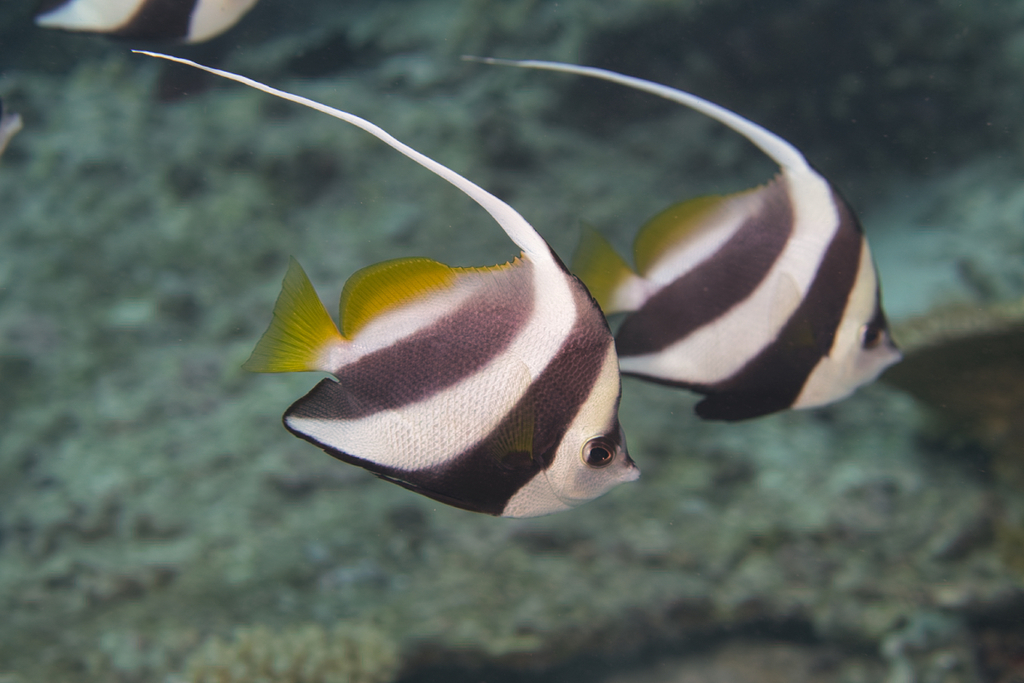
Schooling Bannerfish
Heniochus diphreutes
The schooling bannerfish (Heniochus diphreutes), also known as the false moorish idol, is a marine ray-finned fish, a butterflyfish from the family Chaetodontidae. It is native to the Indo-Pacific area.
From the article Schooling bannerfish on Wikipedia (CC BY-SA), quoted section by section
Description
The schooling bannerfish is a small fish that can reach a maximum length of 18–21 cm. Its body is compressed laterally, and the first rays of its dorsal fin stretch in a long white filament. Its background color is white with two large black diagonal bands. Beyond the second black stripe, the dorsal, caudal fins and pectoral fins are yellow. The head is white, the eyes are black and linked together by a black to gray band. The short snout, spotted with black to gray, has a small terminal, extensible mouth.
Range & habitat
The schooling bannerfish is widespread throughout the tropical, subtropical and temperate waters of the Indo-Pacific from the eastern coast of Africa, Red Sea included, to Polynesia and Hawaii and from the Great Barrier Reef, to south Japan to the Kermadec Islands (New Zealand). The schooling bannerfish prefers external reef slopes and channels. It has a large depth range and is usually observed at 5–30 m depth, but may reach 210 meters deep in some localities.
Wikipedia: “Distribution and habitat”
What it does
As is indicated by its common name, the schooling bannerfish lives in large groups. It feeds on zooplankton in the open water, and juveniles may act as cleaner fish, and this has also been seen in adults. This oviparous species forms pairs to breed. They have been observed cleaning parasites off the short sunfish (Mola ramsayi) off the Maldives.
Wikipedia: “Ecology”
Where it lives
Recorded sightings
—
geo-referenced records in GBIF, from museums, herbaria and field observers.
Drag the globe to turn it. Dots are where records exist, not a range map; darker means more records.
In the stacks
Searching the stacks…
Every page naming Heniochus diphreutes in the Biodiversity Heritage Library →
This page is assembled live from iNaturalist, GBIF, Wikipedia, the Source Library and the Internet Archive. It is not yet part of the hand-edited codex. iNaturalist taxon 102633.