- Animals
- ›Chordates
- ›Vertebrates
- ›Ray-finned Fishes
- ›Spiny-rayed fishes
- ›Butterflyfishes, Angelfishes, and Allies
- ›Louvars
- ›Luvarus
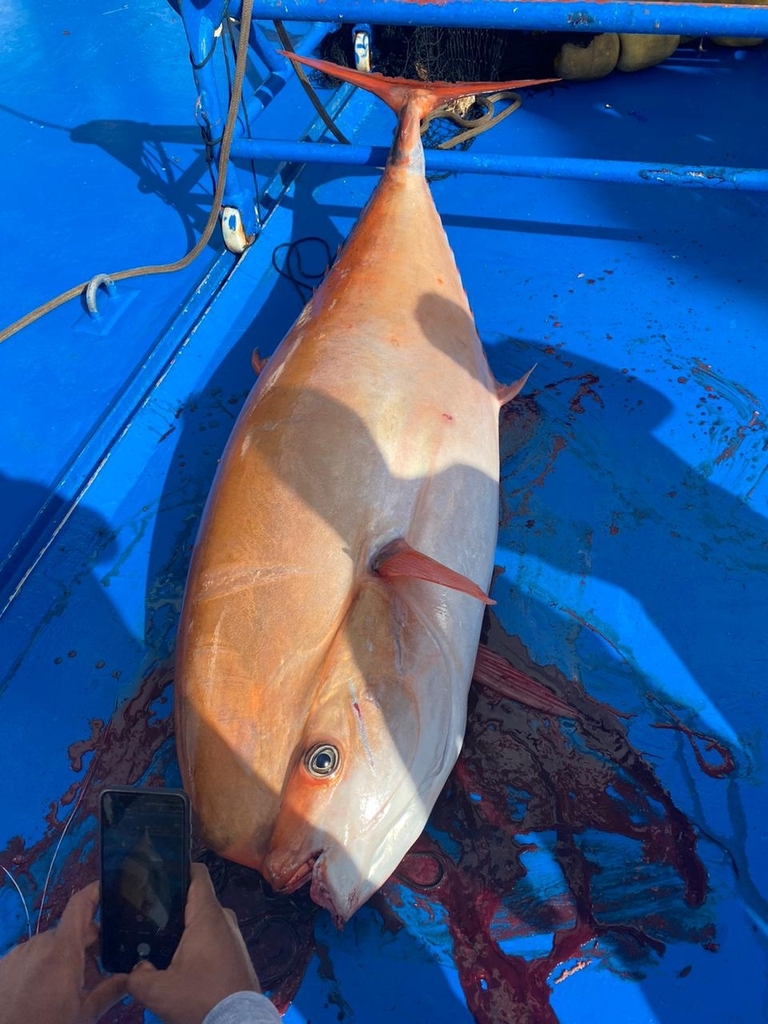
Louvar
Luvarus imperialis
The louvar or luvar (Luvarus imperialis) is a species of marine ray-finned fish, it is the only extant species in the genus Luvarus and family Luvaridae. This taxon is classified within the suborder Acanthuroidei, which includes the surgeonfish, of the order Acanthuriformes, and is the only pelagic species of this order. The juvenile form has a pair of spines near the base of the tail, like the surgeonfish, though they are lost in the adult.
From the article Louvar on Wikipedia (CC BY-SA), quoted section by section
Description
The louvar has a robust, ovoid body tapering towards the caudal fin with a small mouth and eyes that are placed low on the head, behind the mouth and beneath a large bulging forehead. The anal and dorsal fins are long-based and are not tall and have no spines, the anal fin has 18 soft rays and the dorsal fins have 20. The caudal fin is large and concave with the slender caudal peduncle having either one or two keels close to the base of the caudal fin. The pelvic fins are tiny while the long pectoral fins have pointed tips. These fishes have a covering of rough skin with very small spines. The overall colour is a metallic bluish-grey with some pinkish or orange tint. The dorsal and caudal fins are reddish. The juveniles have longer dorsal and anal fins than the adults and the origin of these fins is closer to the head. They also have long pelvic fins and teeth in the jaws, features that are lost as they change to adults. The louvar has a maximum published total length of 200 cm (79 in), although 152 cm (60 in) is more typical, and a maximum weight of 150 kg (330 lb).
Range & habitat
The louvar has an almost cosmopolitan tropical and temperate distribution. It is widespread in the Indo-Pacific region but in the Atlantic the distribution is more localised, although it appears to be less uncommon in the eastern Atlantic than it is in the western Atlantic, and there are a number of widely dispersed records from the Mediterranean. This is an oceanic or epipelagic species found near the surface or in deep water, down to 200 m (660 ft).
Wikipedia: “Distribution and habitat”
In human culture
The louvar's binomial Luvarus imperialis is based on the Sicilian name for this fish, Luvari imperiali, which was used because this species resembles the actual luvari, the common pandora (Pagellus erythrinus). The specific name imperialis means "imperial" or "majestic", perhaps referring to the palatability of its flesh.
Wikipedia: “Etymology”
Where it lives
Recorded sightings
—
geo-referenced records in GBIF, from museums, herbaria and field observers.
Drag the globe to turn it. Dots are where records exist, not a range map; darker means more records.
In the stacks
Searching the stacks…
Every page naming Luvarus imperialis in the Biodiversity Heritage Library →
This page is assembled live from iNaturalist, GBIF, Wikipedia, the Source Library and the Internet Archive. It is not yet part of the hand-edited codex. iNaturalist taxon 120654.