- Animals
- ›Chordates
- ›Vertebrates
- ›Ray-finned Fishes
- ›Spiny-rayed fishes
- ›Perches, Scorpionfishes, Sticklebacks, and Allies
- ›Eelpouts and allies
- ›Wrymouths
- ›Cryptacanthodes
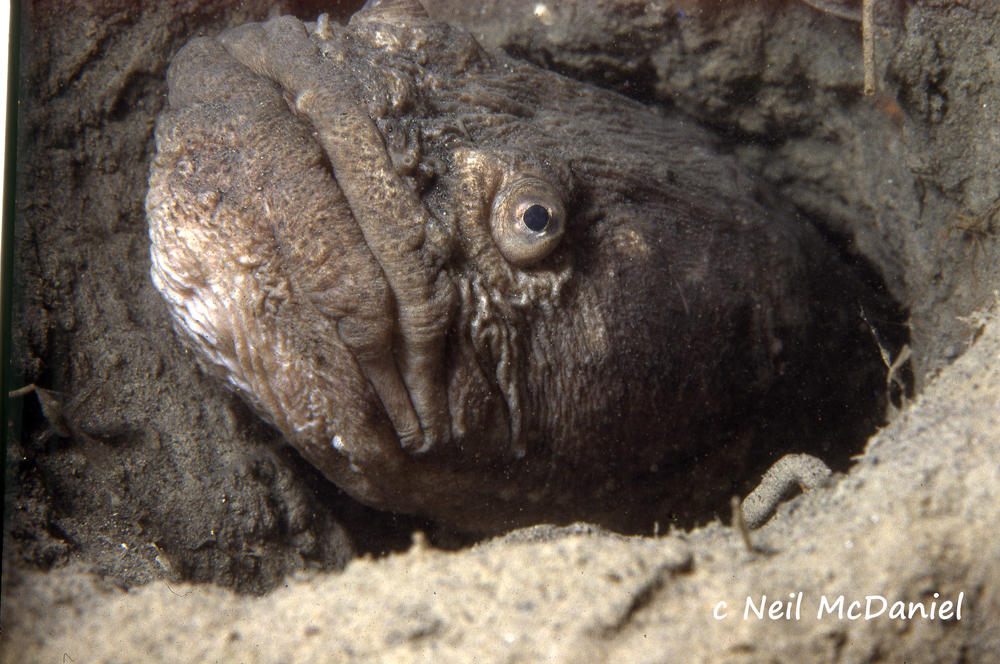
Giant Wrymouth
Cryptacanthodes giganteus
Cryptacanthodes giganteus, the Giant wrymouth, is a species of wrymouth found in the northeastern Pacific Ocean from the Bering Sea to northern California where it is believed to spend most of its life buried in soft areas at the bottom of the ocean at depths of from 6 to 128 metres (20 to 420 ft). This fish can reach a length of 117 centimetres (46 in) TL. Like the wolf eel, giant wrymouths are easily mistaken for eels...
From the article Giant wrymouth on Wikipedia (CC BY-SA), quoted section by section
Description
Cryptacanthodes giganteus, or the Giant Wrymouth, is one of four species from the family Cryptacanthodidae. This bottom dwelling, burrowing fish is long and anguilliform which makes it commonly get mistaken for an eel. The family is characterized by their “small, dorsally positioned eyes, a compressed head, and strongly upturned mouths with a heavy jaw” and long eel-like body. The Giant Wrymouth, as the name specifies, is the largest of these four species and is about 123–127 cm in length at maturity. Little is known about the Cryptacanthodes, especially the Giant Wrymouth, as they live a demersal lifestyle in borrows. However, by looking at the family, Cryptacanthodidae is considered a very distinct monophyletic group due to three features that distinguish it from other members of the suborder. The features include, "1) extension of the braincase into the anterior myodome; 2) greatly enlarged bone foramina passing the cephalic lateralis canals; and 3) greatly elongated pectoral fin actinosts (radials)’ (Anderson, 1984:14)".
The Giant Wrymouth coexists with another Cryptacanthode, the Dwarf Wrymouth, in the North Pacific. At maturity the Giant Wrymouth is easily distinguished from C. aleutensis as it is the Dwarf Wrymouth and reaches a length of about 30 cm. …
Range & habitat
The Giant Wrymouth is found in the eastern North Pacific ranging from the Bering Sea to the coast of northern California. Specifically along the Alaska Peninsula, in the Alaska Bay, and to the south along the coast of North America (Humboldt Bay). As mentioned above, in the larval stage they live on the tumultuous surface of the water. As they mature they, like all Cryptacanthodidae, are demersal and live on the deep, soft bottom of the tidal zone shelf and upper part of the continental slope and sometimes up to 350 m deep. The fish can be found at depths of 6 to and up to 128 m, however they are usually found in a depth less than 20 m. On the deep ocean sandy floors they burrow to create intricate structures and tunnels throughout the silty bottom. Their burrows are typically 3–8 cm from the surface of the bottom and have numerous exits.
Wikipedia: “Distribution”
In human culture
Due to their unique burrowing system, when the Giant Wrymouth is mature, they feed on small amphipods and shrimps. A study on humpback shrimp in British Columbia, a benthic species, shows that a main predator on their juvenile and adult life stage is the Giant Wryfish. The study also shows that other species that may prey on the shrimp include eelpouts, english sole, sand sole, pricklebacks, staghorn sculpins, great sculpin, red rock crabs, and graceful crabs. It is unknown how the Giant Wryfish interacts but it is possible that at the least they are competition for food sources. Little is known on the specifics on the Giant Wryfish, however a study was conducted on the diet of Cryptacanthodes maculatus which is commonly known as the Wrymouth. Due to their similar life history as benthic soft bottom fish some of the conclusions drawn may be the same. Annelids and arthropods were among the most highly consumed by the Wrymouth. The study showed that nine species of amphipods, two species of mysid shrimp, one isopod, and one decapod were among arthropods found in the Wrymouth’s stomach. A couple of demersal fish which were intact were also found in the stomach contents. This shows that the Wrymouth is an important benthic predatory fish in the community that preys on soft-bottom residents. …
Wikipedia: “Life History”
Where it lives
Recorded sightings
—
geo-referenced records in GBIF, from museums, herbaria and field observers.
Drag the globe to turn it. Dots are where records exist, not a range map; darker means more records.
In the stacks
Searching the stacks…
Every page naming Cryptacanthodes giganteus in the Biodiversity Heritage Library →
This page is assembled live from iNaturalist, GBIF, Wikipedia, the Source Library and the Internet Archive. It is not yet part of the hand-edited codex. iNaturalist taxon 217787.