- Animals
- ›Chordates
- ›Vertebrates
- ›Ray-finned Fishes
- ›Spiny-rayed fishes
- ›Perches, Scorpionfishes, Sticklebacks, and Allies
- ›Perches, groupers and allies
- ›Anthiases
- ›Pseudanthias
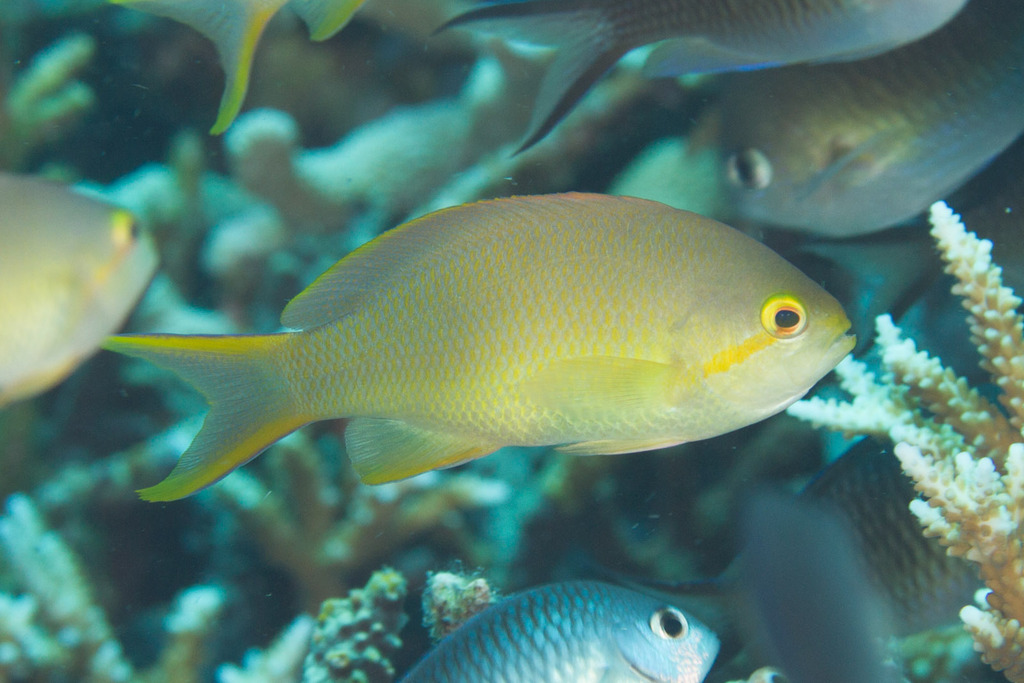
Threadfin Anthias
Pseudanthias huchtii
Pseudanthias huchtii, the red cheek fairy basslet, threadfin anthias or Pacific basslet is a species of marine ray-finned fish, a member of the genus Pseudanthias which is part of the subfamily Anthiinae, which in turn is part of the family Serranidae, the groupers and sea basses. It comes from the Western Central Pacific Ocean. It occasionally makes its way into the aquarium trade. It grows to a size of 12 cm in length.
From the article Pseudanthias huchtii on Wikipedia (CC BY-SA), quoted section by section
Description
Pseudanthis huchti is a very distinctively colour member of the genus Pseudanthias, as well as having the third dorsal fin spine and elongated caudal fin lobes. The males possess an obvious orange stripe which runs from their eye to the centre of their pectoral fin and a broad maroon band on the forward margin of the pelvic fin. The females and juveniles are greenish-yellow in colour. There are 10 spines in the dorsal fin and 17 soft rays while the anal fin contains 3 spines and 7 soft rays. The maximum recorded total length for a male is 12 centimetres (4.7 in) and for a female it is half that.
Range & habitat
Pseudanthias huchtii is found in the Western Pacific Ocean from the Maluku Islands and the Philippines east to Vanuatu, south as far the Great Barrier Reef in the Tasman Sea, as well as the Scott Reef and the Ashmore Reefs in the Timor Sea their distribution extends as far east as Palau in Micronesia.
Wikipedia: “Distribution”
What it does
Pseudanthias huchtii is found in aggregations at drop offs around the outer crests of coral reefs. Like all species of Pseudanthias they are nonandric protogynous hermaphrodites in which all the fish are born female and the largest and most dominant females will change sex to become males. The males are territorial and guard a harem of females. They will interact with Pseudanthias squamipinnis.
Wikipedia: “Habitat and ecology”
Where it lives
Recorded sightings
—
geo-referenced records in GBIF, from museums, herbaria and field observers.
Drag the globe to turn it. Dots are where records exist, not a range map; darker means more records.
In the stacks
Searching the stacks…
Every page naming Pseudanthias huchtii in the Biodiversity Heritage Library →
This page is assembled live from iNaturalist, GBIF, Wikipedia, the Source Library and the Internet Archive. It is not yet part of the hand-edited codex. iNaturalist taxon 179885.