- Animals
- ›Chordates
- ›Vertebrates
- ›Ray-finned Fishes
- ›Spiny-rayed fishes
- ›Perches, Scorpionfishes, Sticklebacks, and Allies
- ›Perches, groupers and allies
- ›Sea Basses
- ›Paralabrax
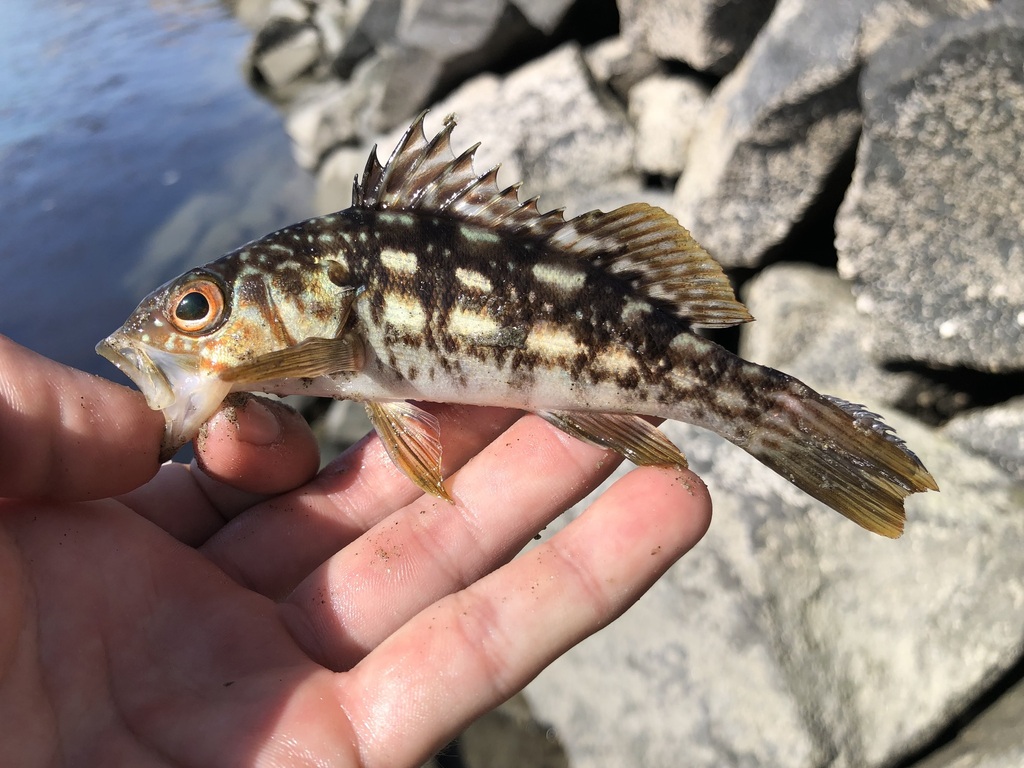
Kelp Bass
Paralabrax clathratus
Paralabrax clathratus, the kelp bass, sometimes referred to as the Calico bass or western fish (leading to easy confusion with the freshwater fishes from the genus Pomoxis), is a species of marine fish found in the eastern North Pacific Ocean from Baja California, Mexico, to Washington, United States (although rare in the northernmost part of its range). As suggested by its common name, it is typically associated with kelp beds, but may also be found in...
From the article Paralabrax clathratus on Wikipedia (CC BY-SA), quoted section by section
Description
Paralabrax clathratus has an elongate, relatively deep, compressed body with a pointed snout and a large, downturned mouth. The mouth extends back as far as the centre line of the pupil and the lower mandible protrudes to form part of the snout. There are teeth all over the roof of the mouth. The margins of the preopercle have fine serrations. There is a large spine on the edge of the gill cover. The dorsal fin has 10 spines and 13–14 soft rays, the 3rd and 4th spine are the longest, both being nearly twice the height of the 2nd spine. The anal fin has 3 spines and 7 soft rays. The caudal fin is truncated, although the margin can be wavy. The juvenile fish are light brown in colour, while the adults are brown to olive-green fading ventrally The dorsal part of the head has a mottling of light yellow spots while the dorsal part of the body is patterned with black, white, and/or olive green blotches. Along the back there are rows of white, rectangle shaped spots. All of the fins are yellow at the tips. The males may develop an orange tint on their lower jaw and chin during mating season. Kelp bass can also change color depending on their surroundings. For example, fish moving from the kelp forest to the open ocean can change from being dark green or brown, to being pale green. …
Range & habitat
Paralabrax clathratus is found in the eastern North Pacific Ocean off the western coast of North America. Its range extends from the central California south to the southern tip of Baja California. It was formerly found as far north as the mouth of the Columbia River on the boundary between Oregon and Washington State but it is now rare anywhere north of Point Conception in California.
Wikipedia: “Distribution”
Where it lives
Recorded sightings
—
geo-referenced records in GBIF, from museums, herbaria and field observers.
Drag the globe to turn it. Dots are where records exist, not a range map; darker means more records.
In the stacks
Searching the stacks…
Every page naming Paralabrax clathratus in the Biodiversity Heritage Library →
This page is assembled live from iNaturalist, GBIF, Wikipedia, the Source Library and the Internet Archive. It is not yet part of the hand-edited codex. iNaturalist taxon 108547.