- Animals
- ›Chordates
- ›Vertebrates
- ›Ray-finned Fishes
- ›Spiny-rayed fishes
- ›Perches, Scorpionfishes, Sticklebacks, and Allies
- ›Perches, groupers and allies
- ›Sea Basses
- ›Hypoplectrus
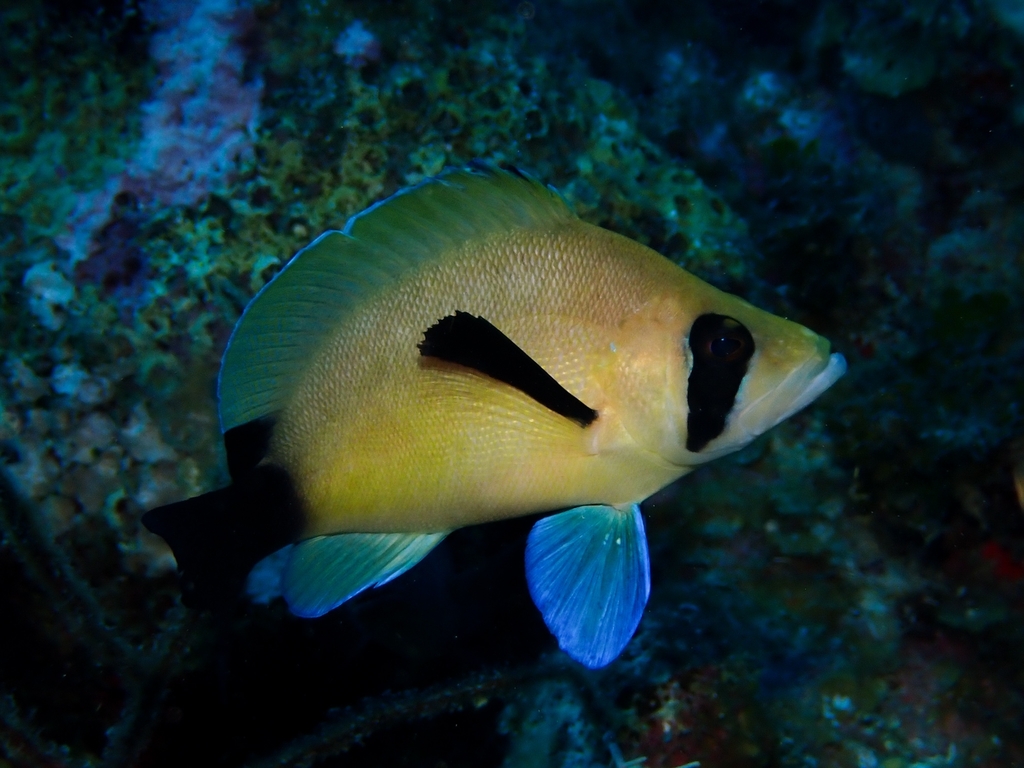
Masked Hamlet
Hypoplectrus providencianus
The masked hamlet (Hypoplectrus providencianus) is a species of marine ray-finned fish, a sea bass from the subfamily Serraninae which is part of the family Serranidae, which also includes the groupers and anthias. This species is found in the western Atlantic Ocean in the Caribbean Sea and has been recorded from the coast of Central America from Quintana Roo in Mexico to Bocas del Toro in Panama and from Jamaica to Puerto Rico, as well as in the Turks and Caicos and the Cayman Islands. Its specific name refers to Providencia Island, Colombia where the type was collected. It was also recorded from other islands in the Archipelago of San Andrés, Providencia and Santa Catalina. They are a unique species in the Hypoplectrus genus, defined by their unique color morph. Their behavior is largely similar to that of other hamlets, especially in their diet and egg-trading spawning patterns.
From the article Masked hamlet on Wikipedia (CC BY-SA), quoted section by section
Description
H. providencianus can reach lengths of up to 13 cm. This species' body plan is similar to that of unicolor hamlets. H. providencianus possesses a spine at the base of the dorsal fin, a protruding upper jaw, a flattened head, and a lateral line running down the flank. Presumed to be unique to H. providencianus is a streak of black that surrounds the eye. In addition to this, black coloration is present in most areas of the pectoral fins, being accented around the upper edges of the fin. The caudal fin is also black, with a darker shade of black being present in the upper and lower lobes of the fin. Also, a black caudal saddle may be present, or completely absent entirely. The body is white in areas lacking black pigmentation. Also, in comparison to other hamlets, H. providencianus lacks spots on the rostrum. Due to the similarities between the morphology of H. providencianus in comparison to that of its relatives, it is a difficult to classify the various species of the Hypoplectrus genus. It is believed that H. providencianus is a color morph of the genus Hypoplectrus.
Range & habitat
H. providencianus resides in coastal waters of the Caribbean, including near Mexico, Panama, Jamaica, Puerto Rico, Turks and Caicos, the Cayman Islands, Colombia, and the Archipelago of San Andrés, Providencia and Santa Catalina. H. providencianus commonly makes its habitat in patch corals inside lagoons in relatively shallow waters of depths of about three to ten meters below sea level. While the species may be present in the offshore waters of islands, they are the only species of Hypoplectrus that is completely absent from continental shelves. In addition, there is a lack of specific areas where H. providencianus congregate. The masked hamlet tends to swim in lower sections of the water column near its habitat. In terms of diet, H. providencianus feeds on crustaceans and other small fish, much like the diets of other species in the Hypoplectrus genus.
Wikipedia: “Distribution and habitat”
What it does
Hamlets, as a genus, are generally territorial and eat invertebrates by gleaning (plucking them off from structures). Each species in the genus generally exhibits the same feeding behaviors, except for the H. indigo which mostly eats Chromis cyaneus. This species lives a primarily solitary life and interacts with others during mating periods. Hamlets, including H. providencianus, are simultaneous hermaphrodites, which means they can produce both sperm and eggs at the same time, and each individual can play the role of male or female. They egg trade which is the process of switching gender roles during a spawning session while exchanging gametes. They spawn multiple times during each session. It is unknown exactly how frequently they switch off roles, but in Hypoplectrus sp., it has been hypothesized that each individual swaps their gender role after each successive spawn, one releasing sperm and the other releasing eggs. They broadcast spawn, which means they release the gametes into the water. To figure out when to release their gametes, they use sounds to communicate with their partner. Hamlets are able to colonize new areas because their pelagic larvae move throughout the water column. Hamlets spawn at dusk. …
Wikipedia: “Behavior”
Where it lives
Recorded sightings
—
geo-referenced records in GBIF, from museums, herbaria and field observers.
Drag the globe to turn it. Dots are where records exist, not a range map; darker means more records.
In the stacks
Searching the stacks…
Every page naming Hypoplectrus providencianus in the Biodiversity Heritage Library →
This page is assembled live from iNaturalist, GBIF, Wikipedia, the Source Library and the Internet Archive. It is not yet part of the hand-edited codex. iNaturalist taxon 103146.