- Animals
- ›Chordates
- ›Vertebrates
- ›Ray-finned Fishes
- ›Spiny-rayed fishes
- ›Blennies, Damselfishes and Allies
- ›Surfperches
- ›Cymatogaster
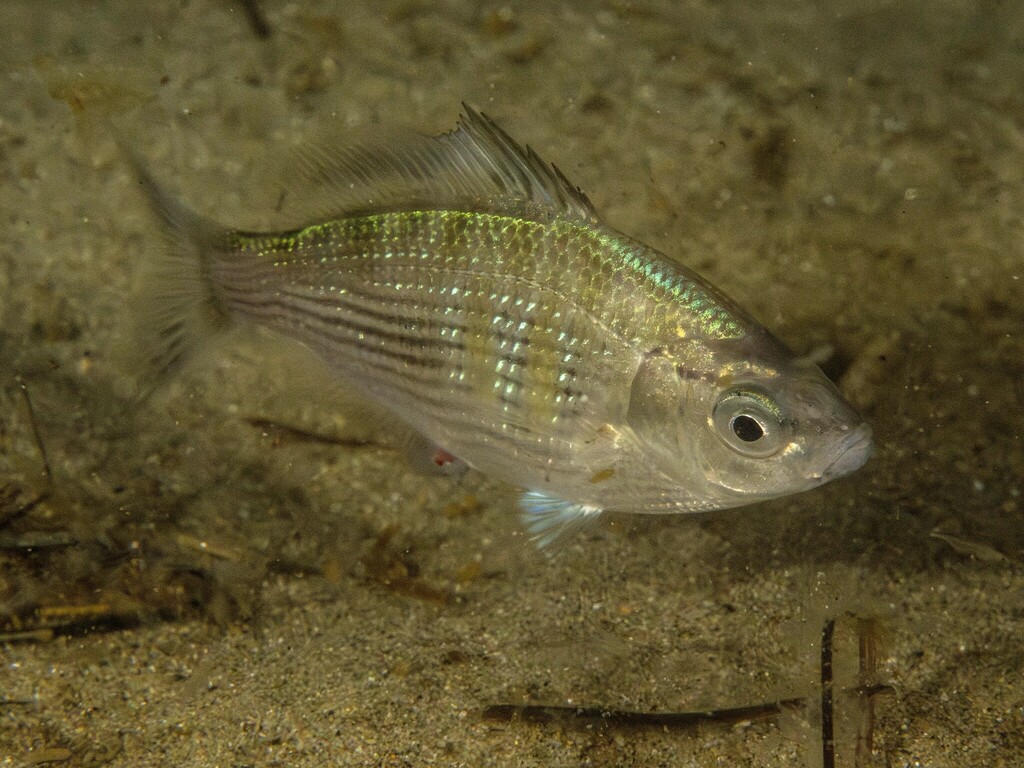
Shiner Surfperch
Cymatogaster aggregata
The shiner perch (Cymatogaster aggregata) is a common surfperch found in estuaries, lagoons, and coastal streams along the Pacific coast from Alaska to Baja California. It is the sole member of its genus. The shiner perch is also known as seven-eleven and shiner seaperch.
From the article Shiner perch on Wikipedia (CC BY-SA), quoted section by section
Description
Shiner perch is similar to tule perch; it is deep-bodied with a dusky greenish back and silvery sides that have a pattern combining fine horizontal bars with three broad yellow vertical bars. Breeding males turn almost entirely black, the barred pattern being obscured by dark speckles. Shiner perch is distinguished from tule perch by having fewer dorsal fin spines, just 8–9 vs the 15–19 of the tule perch. The rayed part of the dorsal fin has 18 to 23 rays. The anal fin has 3 spines followed by 22–25 rays.
Shiner perch can reach a maximum length of 21 centimetres (8.3 in), but are most commonly under 10–15 centimetres (3.9–5.9 in) in total length. Shiner perch mature soon after birth, but females often wait until one year of age before spawning. Breeding males can turn almost completely black.
Range & habitat
Shiner perch range from Punta Baja, Northern Baja California, to Saint John Baptist Bay near Sitka in Southeastern Alaska.
Wikipedia: “Distribution”
What it does
It primarily feeds on zooplankton such as copepods and gammarid amphipods, but has also been observed to feed on bottom species like small crustaceans, marine worms, and mollusks. It also feeds on fish eggs.
Wikipedia: “Diet”
Where it lives
Recorded sightings
—
geo-referenced records in GBIF, from museums, herbaria and field observers.
Drag the globe to turn it. Dots are where records exist, not a range map; darker means more records.
In the stacks
Searching the stacks…
Every page naming Cymatogaster aggregata in the Biodiversity Heritage Library →
This page is assembled live from iNaturalist, GBIF, Wikipedia, the Source Library and the Internet Archive. It is not yet part of the hand-edited codex. iNaturalist taxon 98855.