- Animals
- ›Chordates
- ›Vertebrates
- ›Ray-finned Fishes
- ›Spiny-rayed fishes
- ›Perches, Scorpionfishes, Sticklebacks, and Allies
- ›Icefishes and allies
- ›Crocodile Icefishes
- ›Channichthys
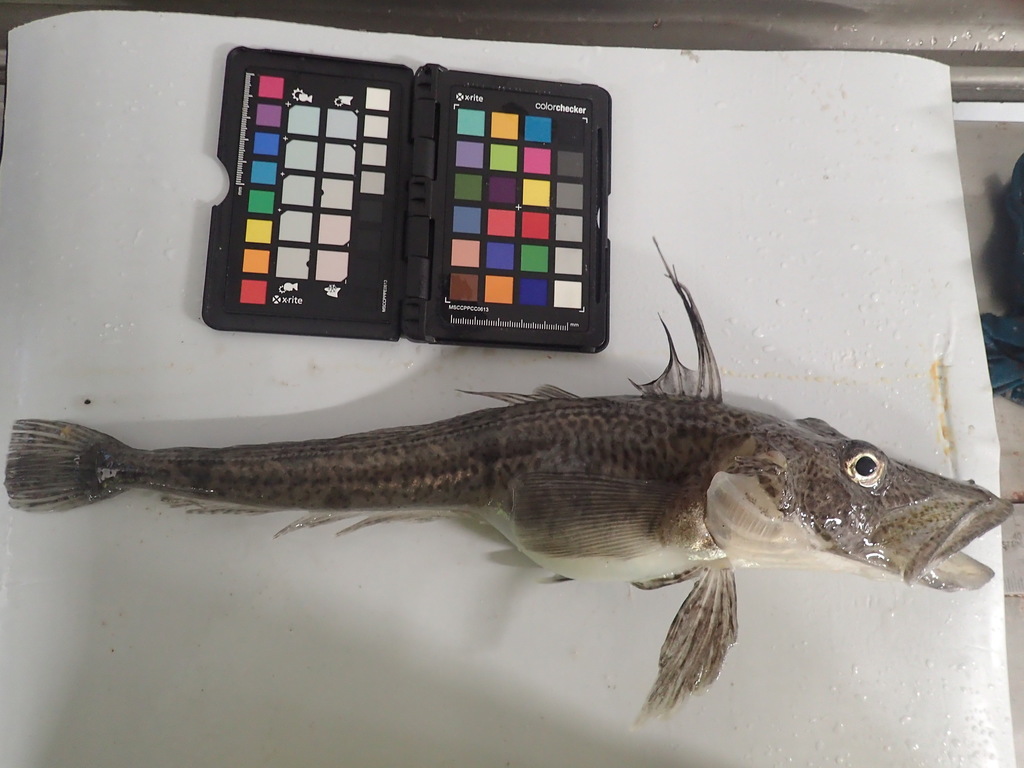
Unicorn Icefish
Channichthys rhinoceratus
Channichthys rhinoceratus, the unicorn icefish, is a species of marine ray-finned fish belonging to the family Channichthyidae, the crocodile icefishes. It is endemic to the Kerguelen-Heard Plateau in the Southern Ocean. It is a demersal species living from surface waters to depths up to 750 m (2,460 ft). It is considered by some researchers as the only species in the genus Channichthys.
From the article Channichthys rhinoceratus on Wikipedia (CC BY-SA), quoted section by section
Description
Described by Sir John Richardson in 1844 and being the type species of the genus Channichthys, the unicorn icefish is generally pale brown, though smaller specimens have four dark cross-bars present on each side of the body, and dark spots are present on the body, sometimes with reddish patches and dark reticulations are present. Dark spots may be present on the blackish first dorsal fin. Other fins are colored pale or dusky. It grows up to a maximum length of 60 cm (24 inches) and a maximum published weight of 0.5 kg (1.1 lbs). A more common length is 40 cm (16 inches). Its size (being the largest of the Channichthys species) and the fact that it has the smallest eye diameter relative to snout length of the Channichthys species (28% to 31.6%) distinguish it from its congeners. The large interorbital space of this species should also help distinguish it from C. irinae and C. bospori. C. rhinoceratus was redescribed in 2020 and the species C. aelitae, C. mithridatis and C. richardsoni were synonymised with that species.
At the table
Its flesh is of good quality, though not as good as that of the mackerel icefish, and is of minor importance to commercial fisheries, caught in bottom trawls for mackerel icefish as a bycatch species. Total catches amounted to 80 tonnes (88 tons) in 2010. This has increased to 151 tonnes (166 tons) in 2019. However, this was still much less than the 1,663 tonnes (1,833 tons) allowed for that year.
== References ==
Wikipedia: “Uses”
Where it lives
Recorded sightings
—
geo-referenced records in GBIF, from museums, herbaria and field observers.
Drag the globe to turn it. Dots are where records exist, not a range map; darker means more records.
In the stacks
Searching the stacks…
Every page naming Channichthys rhinoceratus in the Biodiversity Heritage Library →
This page is assembled live from iNaturalist, GBIF, Wikipedia, the Source Library and the Internet Archive. It is not yet part of the hand-edited codex. iNaturalist taxon 541731.