- Animals
- ›Chordates
- ›Vertebrates
- ›Ray-finned Fishes
- ›Spiny-rayed fishes
- ›Butterflyfishes, Angelfishes, and Allies
- ›Rovers
- ›Plagiogeneion
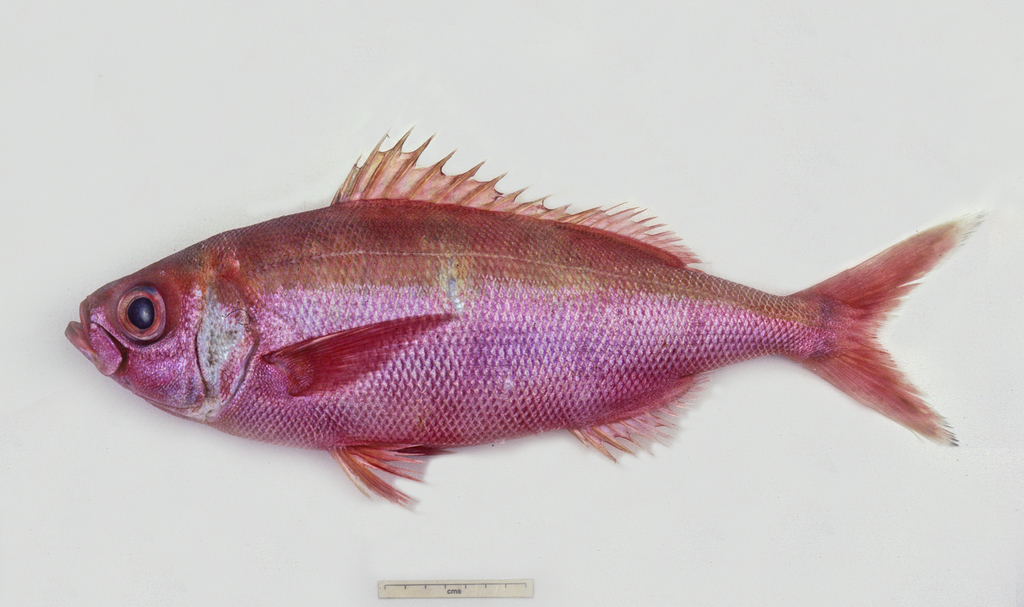
Cosmopolitan Rubyfish
Plagiogeneion rubiginosum
The rubyfish (Plagiogeneion rubiginosum), also known as the cosmopolitan rubyfish, red ruby or ruby rover, is a species of marine ray-finned fish, belonging to the family Emmelichthyidae, the rovers, bonnetmouths and rubyfishes. This species is found from the southeastern Atlantic Ocean off South Africa through the Indian Ocean to the southwestern Pacific Ocean around Australia and New Zealand. This species is commercially important.
From the article Rubyfish on Wikipedia (CC BY-SA), quoted section by section
Description
The rubyfish has a moderately elongated body with a single continuous dorsal fin and a strongly forked caudal fin, with a highly protrusible mouth. The dorsal fin is supported by 12 or 13 spines and 10 or 11 soft rays, while the anal fin has 3 spines and 10 soft rays. The body has a depth of between 27% and 34% of the standard length. The head and upper body are red with a silvery lower body and blackish tips to the caudal fin. This species reaches a maximum published total length of 60 cm (24 in).
Range & habitat
The rubyfish is found in the southeastern Atlantic over the Vema Seamount to the west of Cape Town, and Walvis Bay in Namibia. In the Indian Ocean it is found off Algoa Bay in the Eastern Cape, around Île Saint-Paul and Île Amsterdam and east to southern Australia and New Zealand. In Australia its range extends from West of Bunbury, Western Australia, along the temperate southern coast to Cape Byron, New South Wales, including Tasmania. It is a bathydemersal fish found at depths of from 50 to 600 m (160 to 1,970 ft), near sand or mud bottoms, typically in the vicinity of the edge of the continental shelf and around seamounts. The juveniles are epipelagic, and as they mature, they descend into deeper waters.
Wikipedia: “Distribution and habitat”
In human culture
The specific name rubiginosum means "rusty" and refers to the overall reddish colour of this fish. As Forbes's generic name Plagiogeneion is neuter, the ending of Hutton's specific name had to be altered to -um.
Wikipedia: “Etymology”
Where it lives
Recorded sightings
—
geo-referenced records in GBIF, from museums, herbaria and field observers.
Drag the globe to turn it. Dots are where records exist, not a range map; darker means more records.
In the stacks
Searching the stacks…
Every page naming Plagiogeneion rubiginosum in the Biodiversity Heritage Library →
This page is assembled live from iNaturalist, GBIF, Wikipedia, the Source Library and the Internet Archive. It is not yet part of the hand-edited codex. iNaturalist taxon 411095.