- Animals
- ›Chordates
- ›Vertebrates
- ›Ray-finned Fishes
- ›Spiny-rayed fishes
- ›Jacks, Flounders, Barracudas, and Allies
- ›Jacks, Remoras, and Allies
- ›Jacks
- ›Caranginae
- ›Alepes
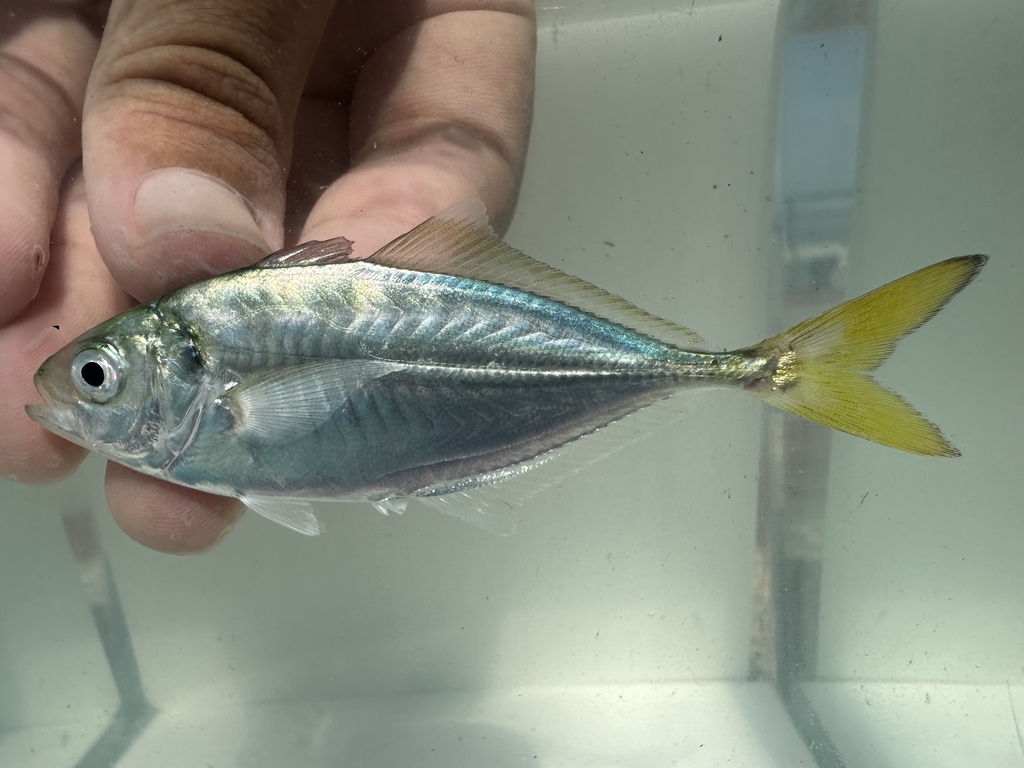
Shrimp scad
Alepes djedaba
The shrimp scad (Alepes djedaba) (also known as the slender yellowtail kingfish), is a species of widespread tropical marine fish of the jack family, Carangidae. The shrimp scad is widely distributed in the tropical and subtropical western Indian Ocean and areas of the eastern Pacific Ocean, ranging from South Africa in the west to Hawaii in the east, including Japan and Australia to the north and south. The species is commonly found on inshore reefs and sandy substrates. It has the common body profile of a scad, and may be difficult to differentiate from others in the genus Alepes. It is one of the larger scads, growing to 40 cm, but often is encountered at much smaller sizes. The shrimp scad often forms large schools, and is carnivorous, consuming a variety of crustaceans and small fish. It is of moderate importance to fisheries throughout its range.
From the article Shrimp scad on Wikipedia (CC BY-SA), quoted section by section
Description
The shrimp scad is can grow to a large size compared to other scads, reaching a maximum known length of 40 cm, but more often seen around 25 cm. The shrimp scad has a body profile very similar to other scads and some other carangids, with an oblong, compressed body and dorsal and ventral profiles which are almost evenly convex. The snout is pointed and the eye diameter is nearly equal to the snout length, with an adipose eyelid well developed on the posterior half of eye. There are two moderately high, separate dorsal fins, the first of which has eight spines, while the second has a single spine followed by 23 to 25 soft rays. The anal fin has two detached spines followed by one spine connected to 18 to 20 soft rays. The anterior section of the lateral line is strongly curved, containing thirty one to thirty six scales, while the straight section consists of seventy seven to eighty five scutes. The colour of the body is an overall silver colour, with a green-blue tone on the upper body, while the underside fades to a more white colour. There is a diffuse dusky blotch on margin of operculum which is bordered by a smaller white spot. The spinous dorsal fin, including the last dorsal fin spine is blackish or dusky, the soft dorsal fin is blackish or dusky above the scaly sheath and the margin of first to fourth upper soft rays is whitish. …
Range & habitat
The Shrimp scad is present in the Indo-Pacific region from the Red Sea and east Africa to the Hawaiian Islands, north to Japan and south to Australia. Observed in the Mediterranean Sea since it was recorded first off Palestine in 1927 as Caranx calla, it later extended to the Aegean Sea, Egypt, Libya and Tunisia. It is also recorded in the Marmara Sea. The species is primarily an inshore inhabitant of reefs and over open sand patches, even in moderately turbid waters, often forming large schools. The species has in isolated circumstances also been found close to shore in surf zones in Japan and in estuarine waters in South Africa. The species is occasionally found in offshore environments, suggesting it can lead a pelagic lifestyle also.
Wikipedia: “Distribution and habitat”
Where it lives
Recorded sightings
—
geo-referenced records in GBIF, from museums, herbaria and field observers.
Drag the globe to turn it. Dots are where records exist, not a range map; darker means more records.
In the stacks
Searching the stacks…
Every page naming Alepes djedaba in the Biodiversity Heritage Library →
This page is assembled live from iNaturalist, GBIF, Wikipedia, the Source Library and the Internet Archive. It is not yet part of the hand-edited codex. iNaturalist taxon 84529.