- Animals
- ›Chordates
- ›Vertebrates
- ›Ray-finned Fishes
- ›Spiny-rayed fishes
- ›Jacks, Flounders, Barracudas, and Allies
- ›Jacks, Remoras, and Allies
- ›Jacks
- ›Caranginae
- ›Alepes
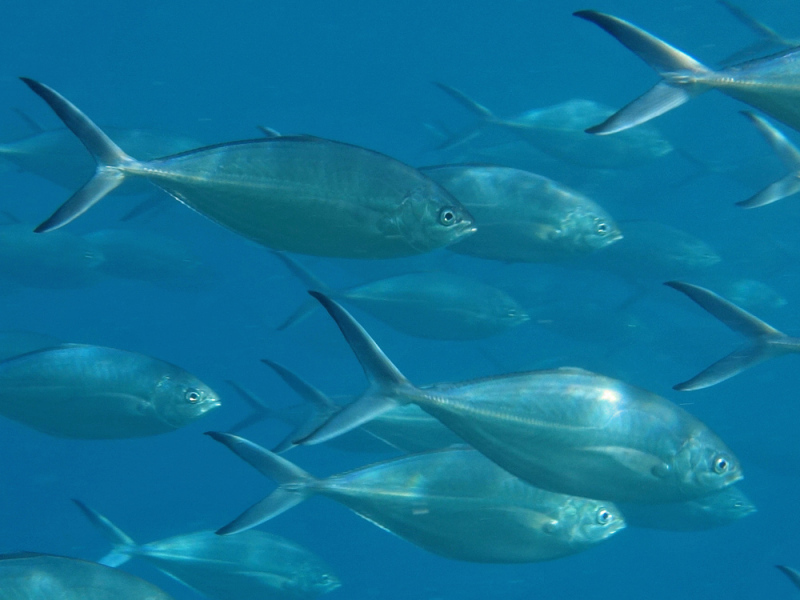
Herring Scad
Alepes vari
The herring scad (Alepes vari) (also known as the duskyfin crevalle and trevally scad), is a common species of tropical marine fish in the jack family Carangidae. The species inhabits the surface waters of coastal regions throughout the Indo-West Pacific region, feeding on a variety of crustaceans and small fishes. It is the largest fish of the scad genus Alepes, growing to a recorded length of 56 cm. The herring scad is identified among the genus Alepes by its more numerous and smaller scutes and the number of gill rakers on the first arch. It is of minor importance to fisheries throughout its range.
From the article Herring scad on Wikipedia (CC BY-SA), quoted section by section
Description
The herring scad has a body profile very similar to other members of the genus Alepes, having a strongly compressed, ovate body. The ventral and dorsal profiles of the fish are almost evenly convex, joined anteriorally by a pointed snout. There are two separate dorsal fins, the first containing 8 spines while the second has a single spine followed by 24 to 27 soft rays. The anal fin consists of two anteriorally detached small spines followed by a single spine connected to 20 to 23 soft rays. The lateral line is strongly arched anteriorally with the junction of the curved and straight sections located the origin of second dorsal to the third soft ray. The curved section contains 42 to 50 scales and 0 to 2 scutes, while the straight section has 0 to 7 scales and 48 to 69 scutes. There is a well-developed adipose eyelid on the posterior half of the eye. The jaws hold a single row of numerous comb like teeth. There are 32 to 38 gill rakers and a total of 24 vertebrae. The herring scad is by far the largest species in Alepes, growing to 56 cm in total length, although is more commonly encountered at below 30 cm. The species is an ash blue above, fading to a silvery white below, with a diffuse dusky blotch on margin of operculum. The fins are dusky with the exception of the spinous dorsal fin which is pale to dark dusky. …
Range & habitat
The herring scad is distributed throughout tropical to subtropical regions of the Indo-West Pacific oceans. The species has been recorded from the Red Sea, eastward to Sri Lanka, India, Southeast Asia, China, Indonesia, the Philippines, New Guinea, and as far north as Taiwan and as far south as northern Australia. The herring scad is most commonly found in shallow coastal regions where it inhabits the surface layers of the ocean over a variety of substrates.
Wikipedia: “Distribution and habitat”
Where it lives
Recorded sightings
—
geo-referenced records in GBIF, from museums, herbaria and field observers.
Drag the globe to turn it. Dots are where records exist, not a range map; darker means more records.
In the stacks
Searching the stacks…
Every page naming Alepes vari in the Biodiversity Heritage Library →
This page is assembled live from iNaturalist, GBIF, Wikipedia, the Source Library and the Internet Archive. It is not yet part of the hand-edited codex. iNaturalist taxon 93643.