- Animals
- ›Chordates
- ›Vertebrates
- ›Ray-finned Fishes
- ›Spiny-rayed fishes
- ›Jacks, Flounders, Barracudas, and Allies
- ›Jacks, Remoras, and Allies
- ›Jacks
- ›Caranginae
- ›Caranx
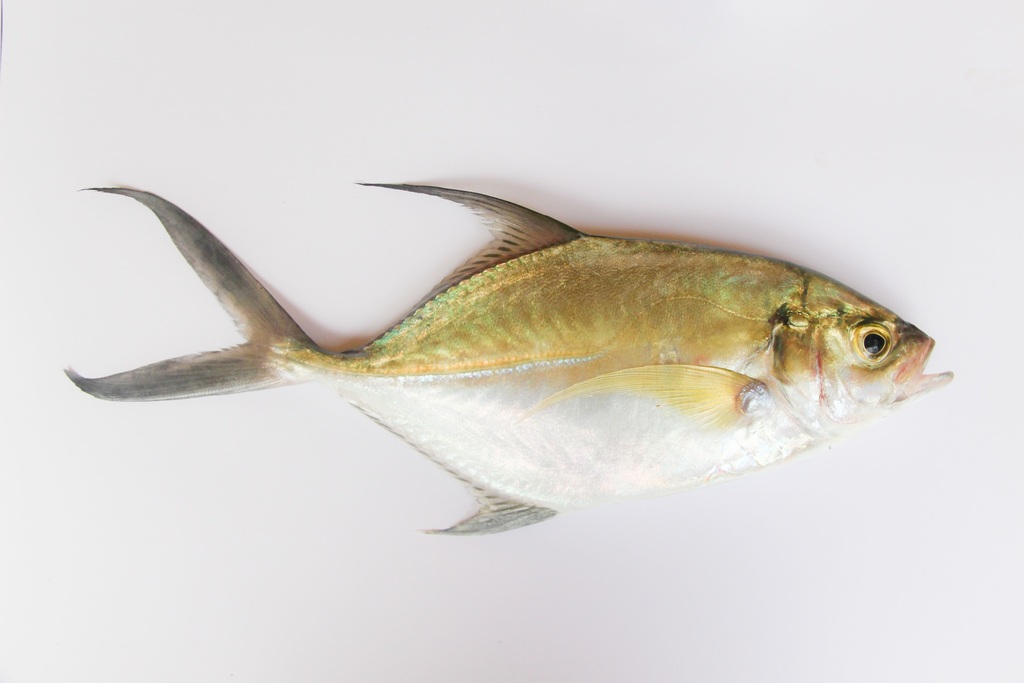
Senegal Jack
Caranx senegallus
The Senegal jack (Caranx senegallus), also known as the African jack, is a species of large marine fish classified in the jack family Carangidae. The species is distributed through the tropical waters of the eastern Atlantic Ocean, ranging along the west African coast from Angola in the south to Mauritania in the north. It can be distinguished from co-occurring relatives by its longer dorsal fin lobe, as well as a host of other anatomical features. The Senegal jack grows to a known maximum length of 1 m. It is a coastal species, known to live semi-pelagically, inhabiting both the sea floor and surface waters to depths of around 200 m. The Senegal jack is a predatory species, taking fish, crabs and shrimps as its main prey items. The species reaches sexual maturity at 21 cm in females and 24 cm in males, with spawning occurring in two periods; February to April and September to November. The species is of minor importance to fisheries, and is not discriminated from other jacks in catch statistics. It is taken by trawls, seines and hook and line, and sold fresh or preserved.
From the article Senegal jack on Wikipedia (CC BY-SA), quoted section by section
Description
The Senegal jack is a large species of fish, known to reach a length of 1 m, but is more common at around 30 cm. It has a body shape typical of most other species of Caranx, with a moderately compressed ovate form and blunt pointed snout. The dorsal profile is slightly more convex than the ventral profile. The dorsal fin is in two distinct sections, the first consisting of 8 spines while the second has 1 spine and 20 or 21 soft rays. The anal fin consists of 2 detached spines anteriorly followed by 1 spine and 17 or 18 soft rays. Both the anal and dorsal fins are elongate, with the dorsal lobe being over twice the length of the head. The pectoral fin is falcate, and also longer than the head. The lateral line has a short, strong anterior arch, with 40 to 45 scutes on the straight posterior section. Above and below the terminus of the lateral line on the caudal peduncle are bilateral caudal keels. The rest of the body is covered in small cycloid scales, with the exception of the breast which is naked. The Senegal jack's eye has a weakly developed adipose eyelid, with the end of the upper jaw extending to directly under the middle of the eye. The upper jaw contains an inner band of villiform teeth with an irregular series of outer canines, while the lower jaw contains only a band of villiform teeth. …
Range & habitat
The Senegal jack has a relatively restricted range compared to most of the other members of Caranx. It is distributed through the tropical waters of the eastern Atlantic Ocean, ranging along the west African coast from Angola in the south to Mauritania in the north. The Senegal jack is an inshore species, living semi-pelagically, moving between surface and bottom layers in coastal waters. It is confidently known to range to a depth of at least 90 m, although may live at depths of around 200 m. Older fish tend to live further from the shore on reefs, while juveniles inhabit shallow tidal bays and creeks lined with mangroves. The species is also known to occur in estuaries in significant numbers, inhabiting these on a semi-permanent basis.
Wikipedia: “Distribution and habitat”
Where it lives
Recorded sightings
—
geo-referenced records in GBIF, from museums, herbaria and field observers.
Drag the globe to turn it. Dots are where records exist, not a range map; darker means more records.
In the stacks
Searching the stacks…
Every page naming Caranx senegallus in the Biodiversity Heritage Library →
This page is assembled live from iNaturalist, GBIF, Wikipedia, the Source Library and the Internet Archive. It is not yet part of the hand-edited codex. iNaturalist taxon 609910.