- Animals
- ›Chordates
- ›Vertebrates
- ›Ray-finned Fishes
- ›Spiny-rayed fishes
- ›Jacks, Flounders, Barracudas, and Allies
- ›Jacks, Remoras, and Allies
- ›Jacks
- ›Caranginae
- ›Caranx
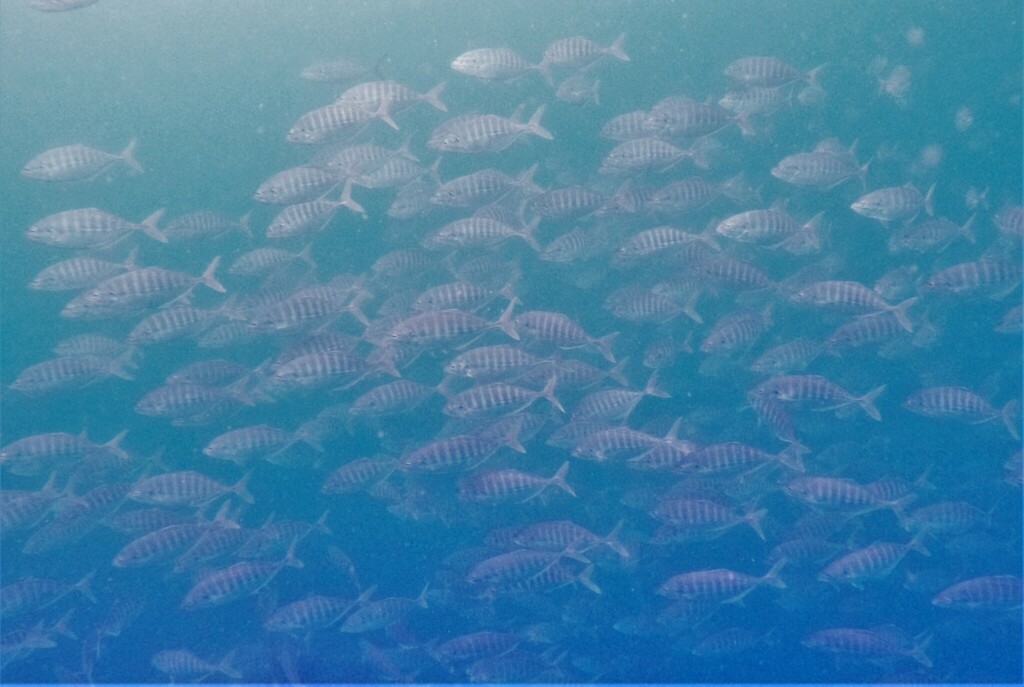
Barred Jack
Caranx vinctus
The cocinero (Caranx vinctus), also known as the barred jack and striped jack, is a species of small marine fish classified in the jack family, Carangidae. The cocinero is distributed through the tropical eastern Pacific Ocean, ranging along the west American coastline from Baja California in the north to Peru in the south. It is a pelagic species, inhabiting the upper water column in both coastal and offshore oceanic waters, occasionally making its way into estuaries. The species may be identified by its colouration, having 8 or 9 incomplete dark vertical stripes on its sides, with scute and gill raker counts also diagnostic. It is small compared to most other species of Caranx, reaching a length of 37 cm in total. The cocinero is a predatory fish, taking small fishes, crustaceans, and various benthic invertebrates in shallower waters. Little is known of the species' reproductive habits. The cocinero is of moderate importance to fisheries along the west coast of South America, and the species has been used in aquaculture trials. It is taken by various netting methods and by spear, and is sold fresh, dried, and salted at market.
From the article Cocinero on Wikipedia (CC BY-SA), quoted section by section
Description
The cocinero is a relatively small species in comparison with most species of Caranx, reaching a known length of 37 cm. The species has a fairly similar body profile compared to the members of this genus, having a relatively deep, compressed-ovate form, although its body is slightly more elongated than the other species. The dorsal profile is slightly more convex than the ventral profile, particularly anteriorly, with the snout slightly pointed. The dorsal fin is in two distinct parts, the first consisting of eight spines, while the second has one spine and 22 or 24 soft rays. The anal fin consists of two detached spines anteriorly followed by one spine and 18 to 21 soft rays, with the lobes of both fins only slightly extended. The lateral line has a strong anterior curve, with the straight section containing none to four scales and 46 to 53 strong scutes. The breast area is fully scaled. The eyes have a slightly developed posterior adipose eyelid, while the upper jaw contains an outer row of strong canines and an inner band of villiform teeth, while the lower jaw has only a single row of canine teeth. There are 39 to 44 gill rakers in total and 25 vertebrae in the species. The cocinero is a dusky-blue color dorsally, fading to a silvery-white ventral surface, often with golden-green reflections when fresh. …
Range & habitat
The cocinero is distributed through the tropical and subtropical waters of the eastern Pacific Ocean. The species ranges along the American coastline from Baja California in the north to Peru in the south, possibly including the Gulf of California. The cocinero is pelagic in nature, inhabiting the top 40 m of the water column in both offshore oceanic waters and inshore coastal waters. The species has been observed in estuaries and tidal mangrove zones of inshore waters. Like many Pacific species, the abundance of cocinero in fishery catches appears to be correlated with the effects of El Nino and La Nina weather events. During 'normal' years, the species becomes more abundant in the tropical (June–December) season, while during the El Nino and La Nina events, it changes to the January–May period.
Wikipedia: “Distribution and habitat”
Where it lives
Recorded sightings
—
geo-referenced records in GBIF, from museums, herbaria and field observers.
Drag the globe to turn it. Dots are where records exist, not a range map; darker means more records.
In the stacks
Searching the stacks…
Every page naming Caranx vinctus in the Biodiversity Heritage Library →
This page is assembled live from iNaturalist, GBIF, Wikipedia, the Source Library and the Internet Archive. It is not yet part of the hand-edited codex. iNaturalist taxon 96741.