- Animals
- ›Chordates
- ›Vertebrates
- ›Ray-finned Fishes
- ›Spiny-rayed fishes
- ›Jacks, Flounders, Barracudas, and Allies
- ›Jacks, Remoras, and Allies
- ›Jacks
- ›Caranginae
- ›Chloroscombrus
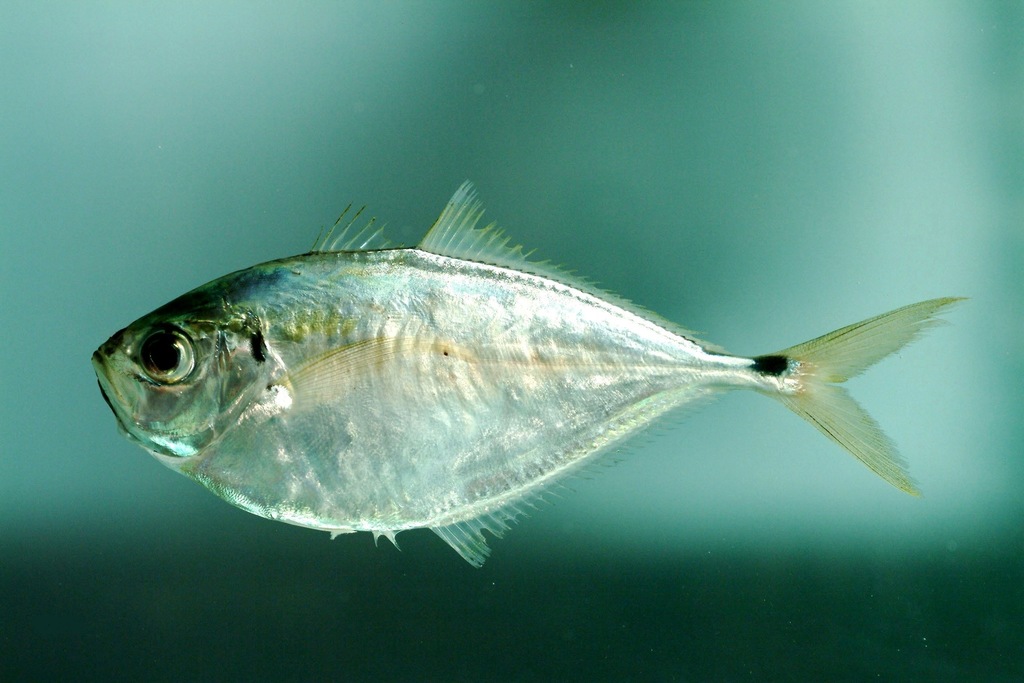
Atlantic Bumper
Chloroscombrus chrysurus
The Atlantic bumper (Chloroscombrus chrysurus) is a game fish in the family, Carangidae. It was first described by the "father of modern taxonomy", Carl Linnaeus in the book, Systema Naturae. Atlantic bumper are known to eat smaller fish, cephalopods, and zooplankton.
From the article Atlantic bumper on Wikipedia (CC BY-SA), quoted section by section
Description
The Atlantic bumper is best recognized by its profile, the bottom being much more curved than the top. Also, the lateral line is arched near the head. Atlantic bumper are generally described as silver to golden colored, with golden yellow on the anal and caudal fins, which have 3 spines, 25–28 rays and 9 spines, 25–28 rays, respectively. There is an obvious black saddle-shaped blotch on the caudal peduncle and a similar patch near the edge of the opercle. Although the average size of Atlantic bumper is 25 centimetres (9.8 in), the largest recorded Atlantic bumper was 65 centimetres (26 in) long.
Range & habitat
In the western Atlantic, Atlantic bumper is found from Massachusetts, to south Brazil. They are known to be found off Bermuda, in the Caribbean, and the Gulf of Mexico. Their range continues south to the coast of Uruguay. In the eastern Atlantic, the Atlantic bumper are known from the coast of Mauritania to Angola. One single record was reported in the Mediterranean Sea off Spain in 1997. They are not found in the eastern Pacific although a visually similar species, Chloroscombrus orqueta, or the Pacific bumper is ranged for that area. Little is known about how these two species relate to each other, and they may represent only one species.
The Atlantic bumper is found in subtropical waters up to 55 m in depth. They usually dwell near soft bottoms of the continental shelf, but have been observed schooling near the surface. While it is primarily a salt water fish, juveniles have been found in brackish estuaries.
Wikipedia: “Distribution and habitat”
Where it lives
Recorded sightings
—
geo-referenced records in GBIF, from museums, herbaria and field observers.
Drag the globe to turn it. Dots are where records exist, not a range map; darker means more records.
In the stacks
Searching the stacks…
Every page naming Chloroscombrus chrysurus in the Biodiversity Heritage Library →
This page is assembled live from iNaturalist, GBIF, Wikipedia, the Source Library and the Internet Archive. It is not yet part of the hand-edited codex. iNaturalist taxon 179633.