- Animals
- ›Chordates
- ›Vertebrates
- ›Ray-finned Fishes
- ›Spiny-rayed fishes
- ›Freshwater Sunfishes, Grunters, and Allies
- ›Morwongs, Hawkfishes, and Allies
- ›fingerfins
- ›Cheilodactylus
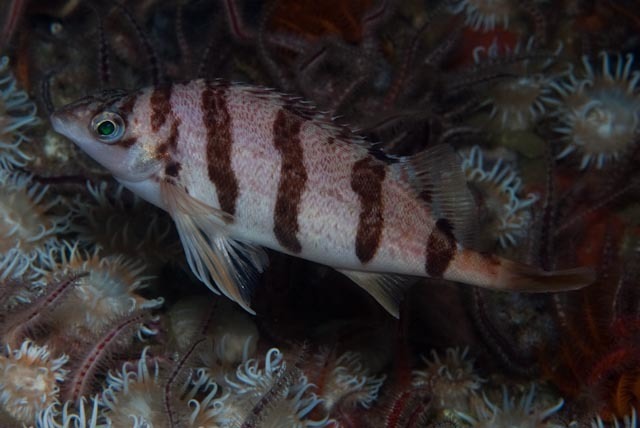
Barred Fingerfin
Cheilodactylus pixi
The barred fingerfin (Cheilodactylus pixi) is a species of marine ray-finned fish, belonging to the family Cheilodactylidae, commonly referred to as morwongs. It is found only in the southeastern Atlantic and southwestern Indian Oceans off the coasts of South Africa.
From the article Barred fingerfin on Wikipedia (CC BY-SA), quoted section by section
Description
The barred fingerfin has a weakly pointed snout and a concave ventral profile. The dorsal fin contains 18-20 spines and 19-23 soft rays while the anal fin has 3 spines and 8-11 soft rays. This species attains a maximum total length of 18 cm (7.1 in). The overall colour of the ody is pale grey with a speckling of pale brown spots and overlain with four clear, diagonal brown bars. There is a fifth more indistinct bar to the back of the head extending to the base of the pectoral fins. The colour of the fins is translucent orange.
Range & habitat
The barred fingerfin is endemic to South Africa where it is found from the False Bay to Coffee Bay in KwaZulu Natal. This species can be found along rocky coastlines and on offshore rocky reefs at depths of 5 to 30 m (16 to 98 ft).
Wikipedia: “Distribution and habitat”
Where it lives
Recorded sightings
—
geo-referenced records in GBIF, from museums, herbaria and field observers.
Drag the globe to turn it. Dots are where records exist, not a range map; darker means more records.
In the stacks
Searching the stacks…
Every page naming Cheilodactylus pixi in the Biodiversity Heritage Library →
This page is assembled live from iNaturalist, GBIF, Wikipedia, the Source Library and the Internet Archive. It is not yet part of the hand-edited codex. iNaturalist taxon 611100.