- Animals
- ›Chordates
- ›Vertebrates
- ›Ray-finned Fishes
- ›Spiny-rayed fishes
- ›Freshwater Sunfishes, Grunters, and Allies
- ›Morwongs, Hawkfishes, and Allies
- ›fingerfins
- ›Cheilodactylus
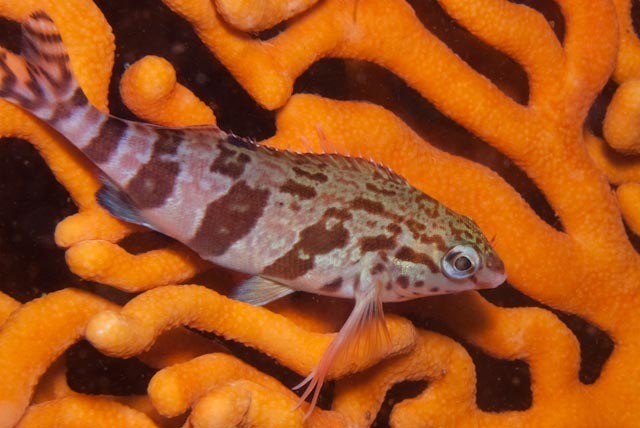
Redfingers
Cheilodactylus fasciatus
The redfingers (Cheilodactylus fasciatus) is a species of marine ray-finned fish, belonging to the family Cheilodactylidae, commonly referred to as morwongs. It is found only off the coasts of Namibia and South Africa, in rock pools and from shallow depths to 120 m, on rocky reef areas. Its length is up to 30 cm.
From the article Redfingers on Wikipedia (CC BY-SA), quoted section by section
Description
The redfingers has body which is oval in shape, with a depth that fits into its standard length 3.2 to 3.7 times. It has a small mouth,. pointed snout and a slightly concave breast. The dorsal fin has 17-19 spines and 23-25 soft rays while the anal fin contains 3 spines and 9-11 soft rays. This species attains a maximum total length of 30 cm (12 in). The pectoral fins have 14 rays with the lower 4-5 rays enlarged and red in colour. There are four wide reddish-brown stripes on lower flanks and five quadrangular marks on the upper flanks which line up with the stripes on the rear of body. The head covered with rectangular spots and dashes and the caudal fin has diagonal brown stripes.
Range & habitat
The redfingers is endemic to the waters of southern Africa occurring in both the southeastern Atlantic Ocean and the southwestern Indian Ocean. Its range extends from Swakopmund in Namibia to northern KwaZulu-Natal in South Africa. They are typically found at depths down to 25 m (82 ft), although they are occasionally recorded as deep as 120 m (390 ft). It is found in rocky areas, especially reefs, while the juveniles are commonly found in tidal pools.
Wikipedia: “Distribution and habitat”
Where it lives
Recorded sightings
—
geo-referenced records in GBIF, from museums, herbaria and field observers.
Drag the globe to turn it. Dots are where records exist, not a range map; darker means more records.
In the stacks
Searching the stacks…
Every page naming Cheilodactylus fasciatus in the Biodiversity Heritage Library →
This page is assembled live from iNaturalist, GBIF, Wikipedia, the Source Library and the Internet Archive. It is not yet part of the hand-edited codex. iNaturalist taxon 570941.