- Animals
- ›Chordates
- ›Vertebrates
- ›Ray-finned Fishes
- ›Spiny-rayed fishes
- ›Freshwater Sunfishes, Grunters, and Allies
- ›Grunters, Stripeys, and Allies
- ›Knifejaws
- ›Oplegnathus
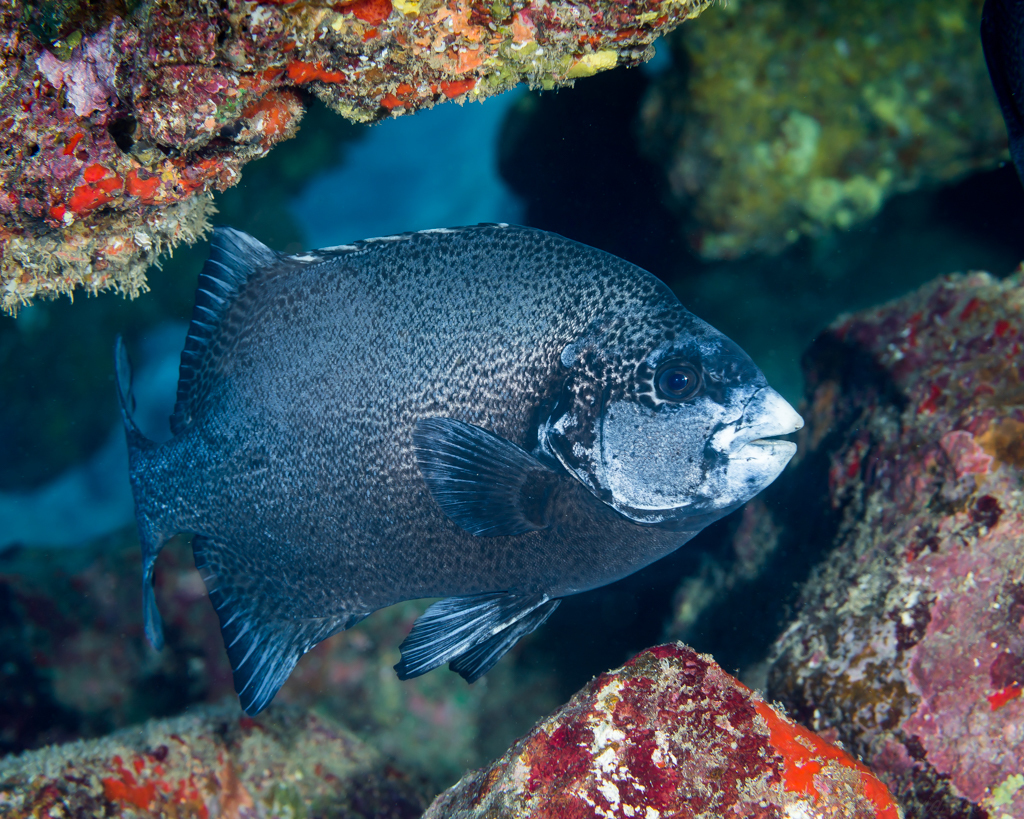
Spotted Knifejaw
Oplegnathus punctatus
Oplegnathus punctatus, commonly known as the spotted knifejaw, is one of seven species in the Oplegnathidae family of knifejaws. These perciform fish, an order of ray-finned fish that are "perch-like", characteristically have teeth fused into a parrot-like beak during adulthood. They diagnostically have a single dorsal fin and body covered in small scales that are known as ctenoid scales. Knifejaws are typically distributed in the Indian and Western Pacific Ocean, near southern parts of the Korean Peninsula, Taiwan, China, Japan, and Hawaii.
From the article Oplegnathus punctatus on Wikipedia (CC BY-SA), quoted section by section
Range & habitat
Spotted knifejaws are members belonging to the middle and lower strata of the temperate and tropical/subtropical coastal fishes. Their preference being to live in more rocky or coral reef waters. Juveniles tend to circle water near drifting seaweed. Water depth ranging in 10–100 m (33–328 ft), which qualify as being in dark states for prolonged periods of time due to the absorption of light by water. Prevalent in the cool Northwestern water of Hawaiʻi, the spotted knifejaws have been reported to reach up to 710 mm (28 in) in length. More popularly found near Kaua'i and Niihau but can also be seen in the Main Hawaiian Islands. They are also commonly distributed in the South China Sea, East China Sea, and Yellow Sea. From November to March of each year, there is water flowing along the Vietnam coast approaching the Peninsular Malaysia centering at 5°N, at a location where there is cold-water inflow making it a suitable rocky habitat and plenty of drifting seaweed for juveniles to attach to.
Wikipedia: “Geographic distribution”
What it does
The fused teeth resembling a beak, enable the spotted knifejaw to prey on hard-shelled organisms such as clams, sea urchins, and oysters. Though there is limited research on specifics regarding dietary habits of the spotted knifejaw, past studies were known to suggest that they were primarily carnivorous fish due to their unique teeth structure. In depth research conducted to find stomach contents of spotted knifejaws, resulted in having large amounts of aquatic algae in the intestinal contents of all specimens collected. The experiment included seaweed, oysters, as well as a strong inclination to plant bait. That same study also seemingly concluded that spotted knifejaws at different stages of growth seemed to prefer a certain type of diet over the other. Juveniles tend to focus more on seaweed as well as zooplankton while adults tend to veer off into larger prey. They had high preferences for cnidarians, chordates, as well as arthropods. Given that their geographic distribution is a vast, their prey preference tends to mirror the different aquatic environments they are in with a correlation in crustaceans and zooplankton as well as phytoplankton. More research is needed in those separate aquatic environments to distinguish between one another and have a more concrete dietary evolution specific to a region of Spotted knifejaws. …
Wikipedia: “Diet”
Where it lives
Recorded sightings
—
geo-referenced records in GBIF, from museums, herbaria and field observers.
Drag the globe to turn it. Dots are where records exist, not a range map; darker means more records.
In the stacks
Searching the stacks…
Every page naming Oplegnathus punctatus in the Biodiversity Heritage Library →
This page is assembled live from iNaturalist, GBIF, Wikipedia, the Source Library and the Internet Archive. It is not yet part of the hand-edited codex. iNaturalist taxon 121421.