- Animals
- ›Chordates
- ›Vertebrates
- ›Ray-finned Fishes
- ›Spiny-rayed fishes
- ›Freshwater Sunfishes, Grunters, and Allies
- ›Grunters, Stripeys, and Allies
- ›Knifejaws
- ›Oplegnathus
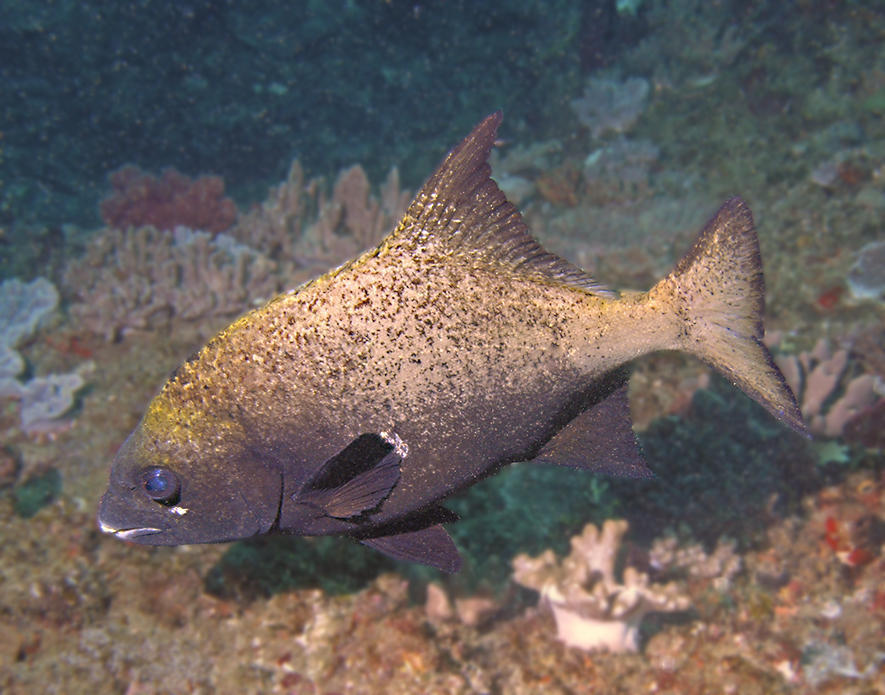
Natal Knifejaw
Oplegnathus robinsoni
Oplegnathus robinsoni, the Natal knifejaw, or also commonly known as Cuckoo Bass and Natalse Kraaibek, is a ray-finned fish that is endemic to the east coast of South Africa and Mozambique. They occur northwards from Transkei.
From the article Oplegnathus robinsoni on Wikipedia (CC BY-SA), quoted section by section
Description
The fish is grey-brown to dark brown color and may be mottled. Juveniles, on the other hand, are yellow in color with several vertical black stripes along the body from the eye to tail. A parrot-like beak and teeth that are a part of the mouth allow it to tear organisms off of surfaces. The Natal knifejaw has a compressed body, with a high second dorsal fin.
Wikipedia: “Appearance”
Range & habitat
The Natal knifejaw is an endemic species, mainly from southern Mozambique and the KwaZulu-Natal waters. They are common in the Pondoland Marine Protected Area (MPA) in the Eastern Cape of South Africa. Juveniles have been seen as far south as Tsitsikamma in the southern tip of South Africa. Research showed that before the Last Glacial Maximum (LGM), the habitats of the fish extended to Cape Horn in South America, the Cape of Good Hope in Africa, and the Great Australian Bight in southern Oceania. Now, the Natal knifejaw's habitat is only concentrated on the south coast of Africa and it suggests that their current distribution is largely affected by environmental factors. These environmental factors include primary production, concentration of iron, and light. The small area of distribution suggests that the Natal knifejaws did not adjust well to their environment after the LGM and only inhabit the southeast coast of Africa.
Wikipedia: “Distribution”
What it does
A Natal knifejaws' diet includes ascidians (sea squirts), soft coral, and reef-encrusting organisms. They have also been observed to feed carnivorously, preying on organisms including small fish, crustaceans, and cephalopods. With their parrot-like beak, the fish are able to tear organisms off of the coral and break through the shells of crustaceans.
Wikipedia: “Diet”
In human culture
There is fossil evidence showing that the family, Oplegnathidae, inhabited the northern part of Seymour Island in Antarctica. This shows that the Oplegnathidae inhabited the cold arctic waters before they were dispersed to warmer areas in South America, Africa, and Oceania, before they concentrated in Africa. This suggests that the Oplegnathidae were poor adapters to water temperature and moved around many times before settling.
Wikipedia: “History”
Where it lives
Recorded sightings
—
geo-referenced records in GBIF, from museums, herbaria and field observers.
Drag the globe to turn it. Dots are where records exist, not a range map; darker means more records.
In the stacks
Searching the stacks…
Every page naming Oplegnathus robinsoni in the Biodiversity Heritage Library →
This page is assembled live from iNaturalist, GBIF, Wikipedia, the Source Library and the Internet Archive. It is not yet part of the hand-edited codex. iNaturalist taxon 347479.