- Animals
- ›Chordates
- ›Vertebrates
- ›Ray-finned Fishes
- ›Spiny-rayed fishes
- ›Freshwater Sunfishes, Grunters, and Allies
- ›Grunters, Stripeys, and Allies
- ›Knifejaws
- ›Oplegnathus
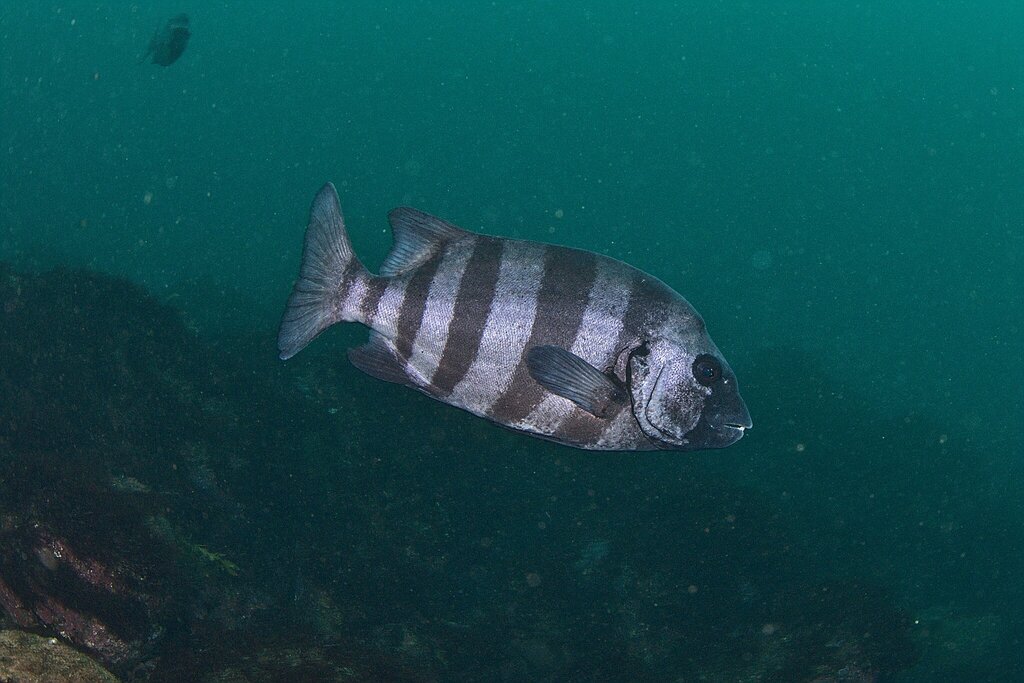
Barred Knifejaw
Oplegnathus fasciatus
The barred knifejaw (Oplegnathus fasciatus), also known as the striped beakfish or rock bream, is a species of marine ray-finned fish, from the family Oplegnathidae. It is commonly native to the north-western Pacific Ocean, though a smattering of records exist from other localities in the eastern Pacific such as Hawaii and Chile. Recently introduced – likely via ballast water – in the central Mediterranean, it is found very rarely from Malta to the northern Adriatic. There is no listed conservation status for this species, though it is farmed for consumption and angling in many Asian countries suggesting it is common.
The barred knifejaw is an inhabitant of rocky reefs and occurs at depths from 1 to 10 m (3 to 33 ft). Juvenile members of this species can be found with patches of drifting seaweed. This species can reach a total length of 80 cm (31 in), with the greatest recorded weight for this species of 6.4 kg (14 lb). As with all members of the Oplegnathus family, the barred knifejaw has a beak-like structure formed by the fusion of its teeth. One of the biggest identifying characteristics of O. fasciatus is the 7 vertical black bars along both sides of its body, from which it derives its name. The first bar characteristically begins over the eye of the fish and the last is on the body’s narrowing towards the caudal peduncle. The end of the caudal fin is also typically black-tipped.
From the article Barred knifejaw on Wikipedia (CC BY-SA), quoted section by section
Range & habitat
The barred knifejaw is endemic to the western Pacific Ocean, notably around the Hawaiian Islands, Japan, and the Osawara Islands. Typically, knifejaw species are found along coastal reefs, though juvenile knifejaw are frequently found in areas with seaweed where their primary food source, zooplankton, is plentiful and the foliage provides cover. Typically, the fish reside as deep as 10 meters deep along reefs, debris, and other structures that can provide shelter and habitat for food sources such as mollusks and crustaceans. Due to the 2011 tsunami in Japan, a large amount of debris was dumped throughout the Pacific Ocean. Of that debris, two fishing vessels washed up in Long Beach, Washington while harboring at least five specimens of O. fasciatus. Of those 5 fish, one remains as a museum exhibit in the Seaside Aquarium in Seaside, Oregon. Since then, scarce sightings of the barred knifejaw have been reported along Monterey County in California and Curry County in Oregon in 2015.
Wikipedia: “Geographic distribution”
At the table
Iridioviruses are one of the biggest threats to many rock bream populations due to high mortality and high transmissibility rates associated with them. Because of the high mortality rates associated with different iridoviruses, they have proved to be an obstacle for many susceptible fishes, and in particular O. fasciatus. A specific iridovirus variant, Red sea bream iridovirus, has caused mass mortality across many fishes, including juvenile yellowfin tuna, and in 1988, the first documented mass mortality was observed across Korean rock bream populations. Since then, high amounts of mortality have happened annually due to iridovirus infections. In 2011, a documentation of Rock Bream Iridovirus, (RBIV)-C1, identified the first genus-specific iridovirus to infect hatchery Rock Bream. Further gene sequencing had been performed and had found that it was likely to have evolved from or alongside other iridoviruses that infected fish in the same geographic area[22]. In lab settings, vaccination using viral membrane proteins similar to those from RBIV had proved effective in yielding an immune response. Furthermore, poly (I:C) inoculation, (a form of mechanism that inoculates via the usage of RNA and antigens from the pathogen) of rock bream has proved to also induce immune responses which play a speculated role in the inhibition of virus replication in infected hosts.
Wikipedia: “Iridoviruses in barred knifejaw populations”
In human culture
Many East-Asian countries (primarily China and Japan) farm the barred knifejaw for many purposes including the commercial sale and recreational activities associated with them. Much of the aquaculture surrounding the barred knifejaw is the result of it having been ranched for the purpose of feeding blue-fin tuna hatcheries. More recently, aquaculture has shifted towards helping support the native populations of the knifejaw throughout the Zhoushan Sea region of the East China Sea due to the pressure to harvest them as a culinary delicacy. As a result of the farming, the barred knifejaws have been selectively bred with the intention of yielding a larger fish. In recent years, studies have been conducted to investigate if the genetic variability of the barred knifejaw was declining due to the constant addition of hatchery fish into their natural habitats. The results of the study concluded that while there were genetic differences between the natural and stocked knifejaws, with approximately a third of the genetic variation also being found amongst the natural population, suggesting that there may be no immediate short-term effects, though the population should still be monitored. One of the biggest challenges that must be overcome while working with the barred knifejaw in aquaculture is preventing or limiting the damage done by pathogenic invasion throughout the species. …
Wikipedia: “Barred knifejaw in aquaculture”
Where it lives
Recorded sightings
—
geo-referenced records in GBIF, from museums, herbaria and field observers.
Drag the globe to turn it. Dots are where records exist, not a range map; darker means more records.
In the stacks
Searching the stacks…
Every page naming Oplegnathus fasciatus in the Biodiversity Heritage Library →
This page is assembled live from iNaturalist, GBIF, Wikipedia, the Source Library and the Internet Archive. It is not yet part of the hand-edited codex. iNaturalist taxon 411105.