- Animals
- ›Chordates
- ›Vertebrates
- ›Ray-finned Fishes
- ›Spiny-rayed fishes
- ›Butterflyfishes, Angelfishes, and Allies
- ›Seabreams and Porgies
- ›Spondyliosoma
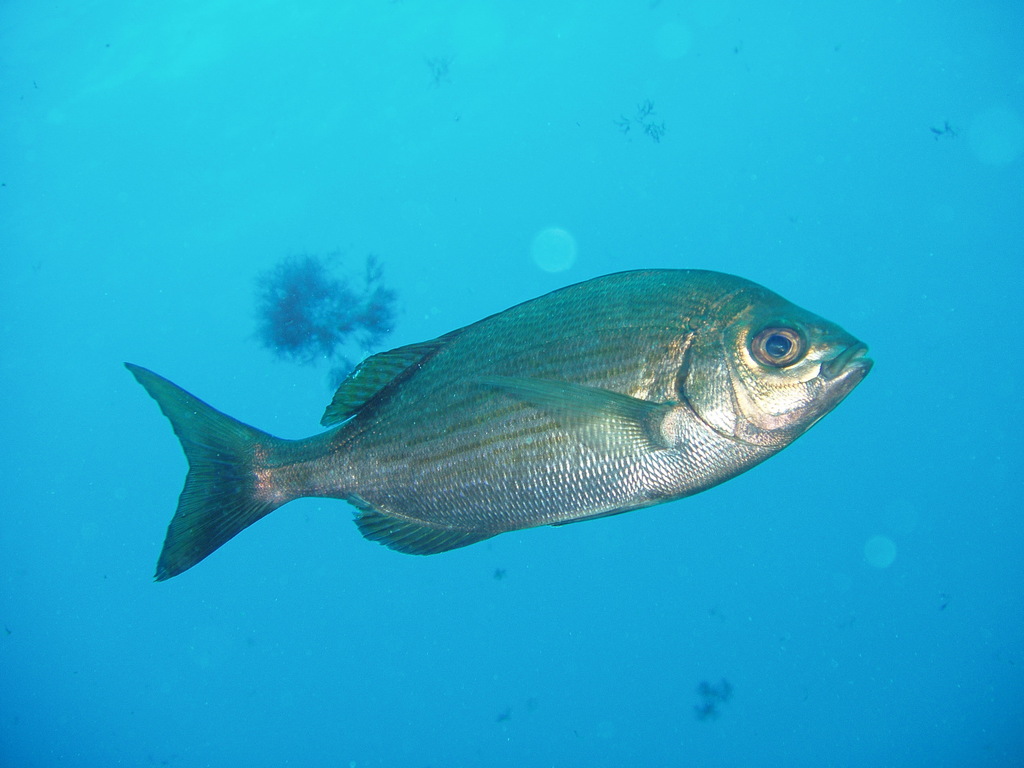
Black Seabream
Spondyliosoma cantharus
The black seabream (Spondyliosoma cantharus) is a species of Sparidae fishes. They are recognisable by their oval compressed body and jaws containing 4-6 rows of slender teeth which are larger at the front. They are silvery in colour with blue and pink tinges and broken longitudinal gold lines. They can reach a maximum size of 60 cm in length. They live in northern Europe and in the Mediterranean, usually found on the inshore shelf at depths varying...
From the article Black seabream on Wikipedia (CC BY-SA), quoted section by section
Description
The black seabream has a moderately deep body with a small, round profiled head with a mouth that extends as far back as the front of the eye. The dorsal fin is supported by 11 spines and between 11 and 13 soft rays and there are 3 spines and 9 to 11 soft rays supporting the anal fin. In adults the dorsal profile of the head is convex. The cheeks, operculum and preoperculum have no scales. There are 4 to 6 rows of conical and thin teeth, the outer teeth enlarged especially at the front of the jaw, in both jaws. The caudal fin is slightly forked. The colour if this fish is darker grey on the upper body, silvery on the flanks, with between 6 and 9 dark vertical bars along the body. The males may turn nearly black when nesting. This species has a maximum published total length of 60 cm (24 in), although 30 cm (12 in) is more typical, and a maximum published weight of 1.2 kg (2.6 lb).
Range & habitat
The black seabream has a wide distribution in the eastern Atlantic Ocean from Scandinavia in the north to Namibia in the south, including the Macaronesia, the Mediterranean and the western Black Sea. It is found at depths between 5 and 300 m (16 and 984 ft) over seagrass beds and rocky and sandy substrates.
Wikipedia: “Distribution and habitat”
In human culture
The black seabream is classified in the genus Spondyliosoma which combines spondylus, meaning "spindle", and soma, which means body. The author of the genus, Cantor, did not explain what thus alluded to, nor is it clear. The specific name cantharus which is a latinisation of kantharos, an Ancient Greek name for this species, dating from at least the time of Aristotle.
Wikipedia: “Etymology”
Where it lives
Recorded sightings
—
geo-referenced records in GBIF, from museums, herbaria and field observers.
Drag the globe to turn it. Dots are where records exist, not a range map; darker means more records.
In the stacks
Searching the stacks…
Every page naming Spondyliosoma cantharus in the Biodiversity Heritage Library →
This page is assembled live from iNaturalist, GBIF, Wikipedia, the Source Library and the Internet Archive. It is not yet part of the hand-edited codex. iNaturalist taxon 118655.