- Animals
- ›Chordates
- ›Vertebrates
- ›Ray-finned Fishes
- ›Spiny-rayed fishes
- ›Jacks, Flounders, Barracudas, and Allies
- ›Snooks, Barracudas, and Allies
- ›Barracudas
- ›Sphyraena
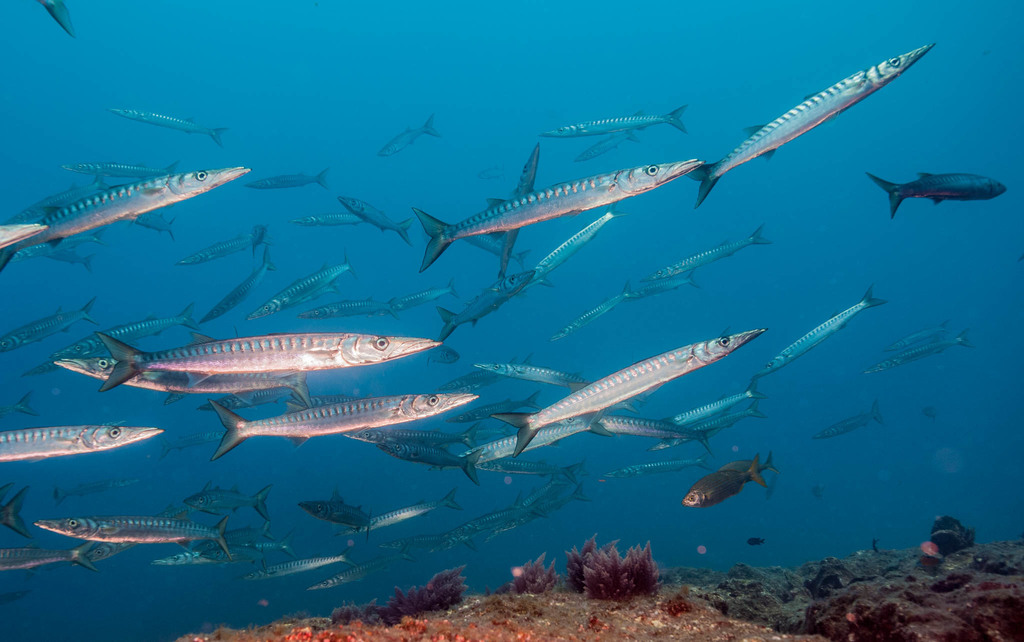
Yellowmouth Barracuda
Sphyraena viridensis
Sphyraena viridensis, the yellowmouth barracuda or yellow barracuda is a predatory ray finned fish from the family Sphyraenidae, the barracudas, which is found in the warmer waters of the western Atlantic Ocean and the Mediterranean Sea. It is often confused with the European barracuda Sphyraena sphyraena.
From the article Sphyraena viridensis on Wikipedia (CC BY-SA), quoted section by section
Description
Sphyraena viridensis has a fusiform body with a long, streamlined pointed snout which has a long mouth lined with two rows of sharp, fang-like teeth and a jutting lower jaw. There are no scales on the preoperculum, unlike the European barracuda, which has scales on both the anterior and posterior margins of the preoperculum. There are numerous transverse dark bars on the dorsum; these usually extend below the lateral line, while the same lines in the European barracuda do not do so. The bars fade in dead specimens. Generally, the colouration of adult S. viridensis is dark above and silvery below (this is an example of countershading), while juveniles are dark yellow or greenish in colour. S. viridensis is smaller than its European counterpart, growing to a standard length of 65 cm (26 in), although the average length is 35–40 cm (14–16 in). However, specimens up to 1,190 mm (47 in) have been caught off the Azores. The rod caught record is 10.2 kg (22 lb 8 oz), which was caught off Lanzarote in the Canary Islands in 2007.
Range & habitat
The exact distribution of S. viridensis is unclear because of confusion with the European barracuda; however, it is known that it occurs in subtropical areas of the eastern Atlantic (around the Azores, Madeira, Cape Verde Islands and the Canary Islands). It has also been recorded in the Mediterranean, including off the coasts of Lebanon, Israel, Algeria, Corsica and Sicily, in the Adriatic Sea, the Aegean Sea, and even as far north as Cornwall in the United Kingdom.
Wikipedia: “Distribution”
What it does
In summer, S. viridensis may form schools of up to 200 fish (although most schools only number 30-40 fish) in areas where there are strong currents. These schools are predominantly made up of sub-adults, with the smaller fish nearer to the surface and the larger ones, usually female, at the bottom, at depths of up to 30 m (98 ft). In winter, the only aggregations are small groups of juveniles in shallow bays. No territorial behaviour has been observed. Schooling is thought to be an anti-predator defence, to facilitate mating (with the smaller males being attracted to the larger females), and to increase the success rate of hunting. This species does not appear to mix with other barracuda species in mixed schools, but there are reports of these fish associating with whale sharks in the Azores and an instance of them actively swimming towards a manta ray.
Wikipedia: “Behaviour”
Where it lives
Recorded sightings
—
geo-referenced records in GBIF, from museums, herbaria and field observers.
Drag the globe to turn it. Dots are where records exist, not a range map; darker means more records.
In the stacks
Searching the stacks…
Every page naming Sphyraena viridensis in the Biodiversity Heritage Library →
This page is assembled live from iNaturalist, GBIF, Wikipedia, the Source Library and the Internet Archive. It is not yet part of the hand-edited codex. iNaturalist taxon 47260.