- Animals
- ›Chordates
- ›Vertebrates
- ›Ray-finned Fishes
- ›Spiny-rayed fishes
- ›Freshwater Sunfishes, Grunters, and Allies
- ›Freshwater Sunfishes and relatives
- ›Freshwater Sunfishes
- ›Centrarchinae
- ›Ambloplites
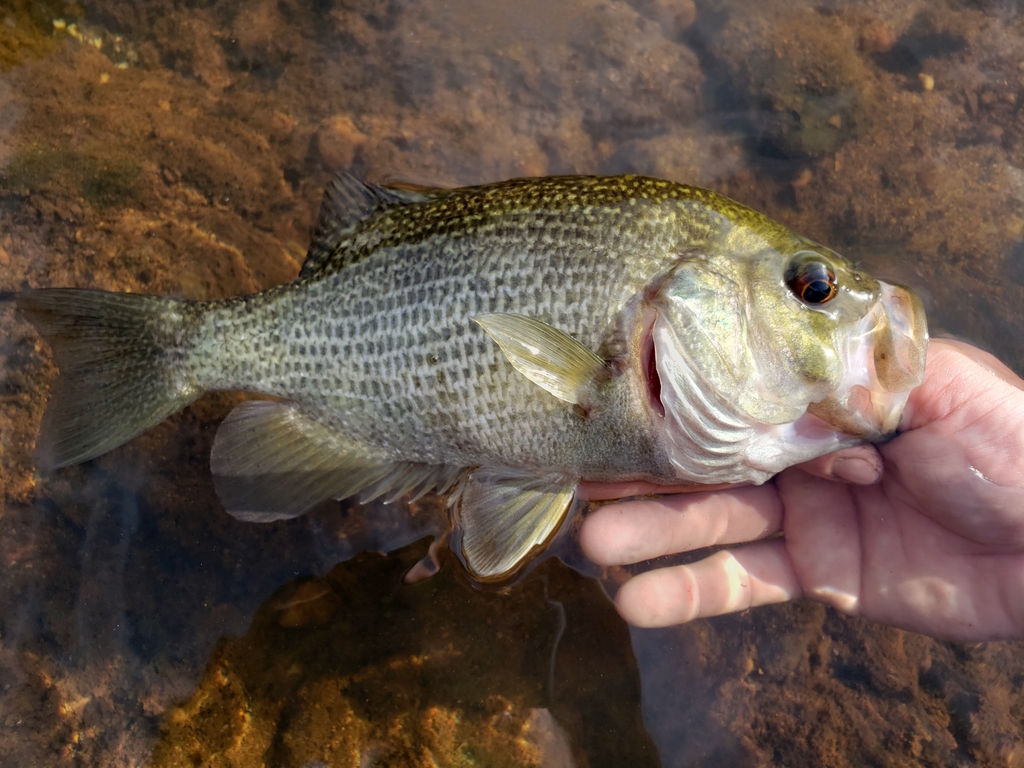
Roanoke Bass
Ambloplites cavifrons
The Roanoke bass (Ambloplites cavifrons) is a species of freshwater fish in the sunfish family (Centrarchidae) of order Centrarchiformes. This species is endemic to rivers in the eastern United States, where it is native only to the states of Virginia and North Carolina.
From the article Roanoke bass on Wikipedia (CC BY-SA), quoted section by section
Description
Roanoke bass have a robust, compressed body with a large, terminal mouth and a nearly scaleless cheek. The anal fin has a dark margin, the pectoral fin is rounded and the caudal fin is emarginate. The eye is large and red contrasting with the dark brown or olive colour of the body. The Roanoke bass closely resembles the rock bass (Ambloplites rupestris) and the two are easily and often confused notwithstanding different coloring. The Roanoke bass is dark, olive green to olive brown on the back, fading to grayish on the flanks and white on the underside. The spots on its scales are smaller than those of rock bass and they have paler small whitish or yellowish spots on the upper body. The forehead is slightly concave and this and the paucity of scales on the cheek also distinguishes the Roanoke bass. The maximum published total length for this species is 36 centimeters (14 in) and the maximum weight is 620 grams (1.37 lb).
Range & habitat
Roanoke bass are native to a few river systems in Virginia and North Carolina on the Atlantic seaboard of the United States. Its range covers the Chowan, Roanoke, Tar, Neuse, and Cape Fear drainage systems but it has seemingly been extirpated from the extreme upper reaches of the Roanoke system. Historical introductions into the middle New River and upper and lower James River drainages for sportfishing did not produce viable populations.
Wikipedia: “Distribution”
Where it lives
Recorded sightings
—
geo-referenced records in GBIF, from museums, herbaria and field observers.
Drag the globe to turn it. Dots are where records exist, not a range map; darker means more records.
In the stacks
Searching the stacks…
Every page naming Ambloplites cavifrons in the Biodiversity Heritage Library →
This page is assembled live from iNaturalist, GBIF, Wikipedia, the Source Library and the Internet Archive. It is not yet part of the hand-edited codex. iNaturalist taxon 93810.