- Animals
- ›Chordates
- ›Vertebrates
- ›Ray-finned Fishes
- ›Spiny-rayed fishes
- ›Freshwater Sunfishes, Grunters, and Allies
- ›Freshwater Sunfishes and relatives
- ›Freshwater Sunfishes
- ›Centrarchinae
- ›Centrarchus
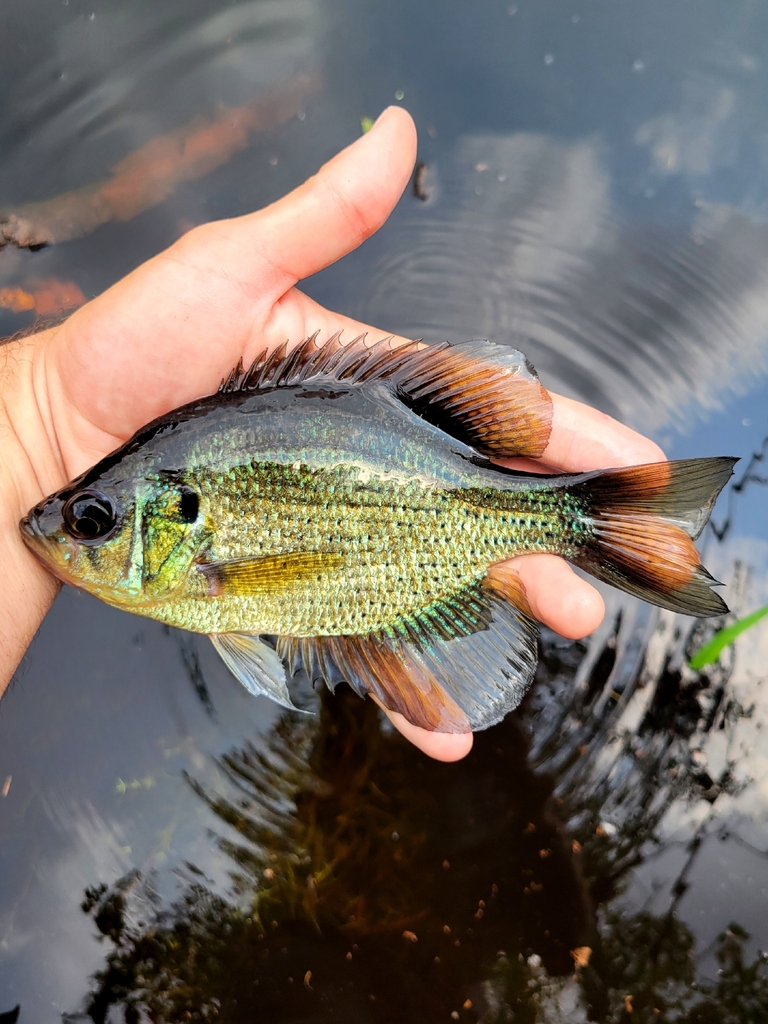
Flier
Centrarchus macropterus
The flier (Centrarchus macropterus) is a species of freshwater ray-finned fish, a sunfish from the family Centrarchidae which is endemic to the southern United States. It is the only species in the monospecific genus Centrarchus. A Second World War United States Navy submarine was named the USS Flier after this fish.
From the article Flier (fish) on Wikipedia (CC BY-SA), quoted section by section
Description
The flier is a small, strongly compressed species of sunfish which has a moderately sized, oblique mouth. The dorsal fin has 11–13 spines and 12–14 soft rays while the anal fin has 7–8 spines and 13–15 soft rays. It has a lateral line and the scales are ctenoid. The flanks have a scattering of dark spots, the underside is pale, and the upperparts are olive in color. There is a vertical dark line through the eye which continues below the eye in what has been described as a "teardrop". Fish of a standard length less than around 45 millimeters (1.8 in) have an obvious dark eyespot, or ocellus, which has a reddish margin on the soft part of the dorsal fin. The pectoral and pelvic fins are dusky with paler reticulations. The maximum total length recorded is 29.2 centimeters (11.5 in) but they are more commonly around 13 centimeters (5.1 in) and the maximum published weight is 1.35 pounds.
Range & habitat
The flier is found in the southern part of the United States along the Atlantic seaboard from the Potomac River drainage in Maryland, where it was most likely introduced, to central Florida. It is then found along the Gulf of Mexico drainages as far west as the Trinity River in Texas, and then north in Mississippi River system to above the fall line in southern Illinois and southern Indiana.
Wikipedia: “Distribution”
In human culture
The flier was first formally described by the French naturalist Bernard Germain de Lacépède (1756–1825) in 1801 as Labrus macropterus with the type locality given as South Carolina. In 1829 Georges Cuvier placed it in the genus Centrarchus. The genus Centrarchus is the sister taxon to the Archoplites and in turn these two are sister to Pomoxis. The generic name is a compound of the Greek kentron meaning "sting" and archos meaning "anus", a reference to the long spines in the anal fin. The specific name macropterus is also Greek and means "long fin".
Wikipedia: “Taxonomy and etymology”
Where it lives
Recorded sightings
—
geo-referenced records in GBIF, from museums, herbaria and field observers.
Drag the globe to turn it. Dots are where records exist, not a range map; darker means more records.
In the stacks
Searching the stacks…
Every page naming Centrarchus macropterus in the Biodiversity Heritage Library →
This page is assembled live from iNaturalist, GBIF, Wikipedia, the Source Library and the Internet Archive. It is not yet part of the hand-edited codex. iNaturalist taxon 96911.