- Animals
- ›Chordates
- ›Vertebrates
- ›Ray-finned Fishes
- ›Spiny-rayed fishes
- ›Freshwater Sunfishes, Grunters, and Allies
- ›Freshwater Sunfishes and relatives
- ›Freshwater Sunfishes
- ›Centrarchinae
- ›Pomoxis
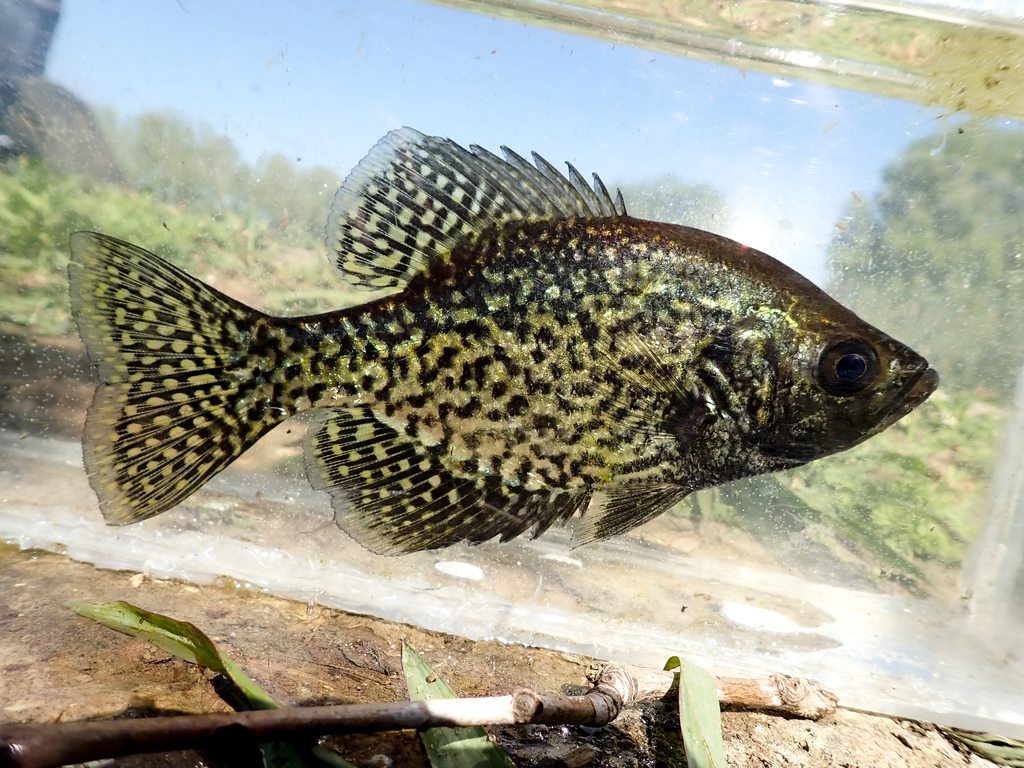
Black Crappie
Pomoxis nigromaculatus
The black crappie (Pomoxis nigromaculatus) is a freshwater fish in the sunfish family (Centrarchidae). It is endemic to North America, one of the two types of crappies. It is very similar to the white crappie (P. annularis) in size, shape, and habits, except that it is darker, with a pattern of black spots. Alternate names for the species include calico bass, speck, speckled perch, speckled bass, moonfish, grass bass, strawberry bass, shiner, crappie, oswego bass, sac-a-lait, and marigane noire.
From the article Black crappie on Wikipedia (CC BY-SA), quoted section by section
Description
Black crappies are most accurately identified by the seven or eight spines on its dorsal fin (white crappies have five or six dorsal spines). Crappies have a deep and laterally compressed body. They are usually silvery-gray to green in color and show irregular or mottled black splotches over the entire body. Black crappies have rows of dark spots on their dorsal, anal, and caudal fins. The dorsal and anal fins resemble each other in shape. Both crappies have large mouths extending to below the eye, and thin lips—both suggestive of their piscivorous feeding habits. Crappies are typically about 4–8 inches (10–20 cm) long. The current all-tackle fishing world record for a black crappie is 2.47 kg (5 lb 7 oz). The maximum length reported for a black crappie is 19.3 inches (49 cm) and the maximum published weight is just under 6 pounds (2,700 g).
Range & habitat
The black crappie's range is uncertain, since it has been widely transplanted, but it is presumed to be similar to the white crappie's. Its native range is suspected to be in the eastern United States and Canada, and as of 2005, populations existed in all of the 48 contiguous U.S. states. Introduced populations also exist in Mexico and Panama.
Wikipedia: “Distribution”
What it does
Crappies feed early in the morning and from about midnight until approximately 2 am. Individuals smaller than about 16 centimetres (6.3 in) in length eat plankton and minuscule crustaceans, while larger individuals feed on small fish (like shad), as well as minnows. Adult black crappies feed on fewer fish than white crappies do; instead they consume a larger volume of insects, insect larvae and crustaceans. According to scientific studies carried out in California, the mysid shrimp Neomysis awatschensis and amphipods of genus Corophium were most commonly eaten by all sizes of black crappie, followed by copepods, cladocerans and chironomid larvae and pupae. Although this diet is popular among black crappies in general, their diet may significantly change based on habitat, availability of food, and other biotic factors such as amount of resource competition. The same study also showed that young, small crappie tend to feed on small aquatic invertebrate animals and changed to a fish-filled diet as they matured to adulthood. Its diet, as an adult, tends to be less dominated by other fish than that of the white crappie.
Wikipedia: “Diet”
Where it lives
Recorded sightings
—
geo-referenced records in GBIF, from museums, herbaria and field observers.
Drag the globe to turn it. Dots are where records exist, not a range map; darker means more records.
In the stacks
Searching the stacks…
Every page naming Pomoxis nigromaculatus in the Biodiversity Heritage Library →
This page is assembled live from iNaturalist, GBIF, Wikipedia, the Source Library and the Internet Archive. It is not yet part of the hand-edited codex. iNaturalist taxon 49594.