- Animals
- ›Chordates
- ›Vertebrates
- ›Ray-finned Fishes
- ›Spiny-rayed fishes
- ›Blennies, Damselfishes and Allies
- ›Blennies
- ›Combtooth Blennies
- ›Salariin Blennies
- ›Parablennius
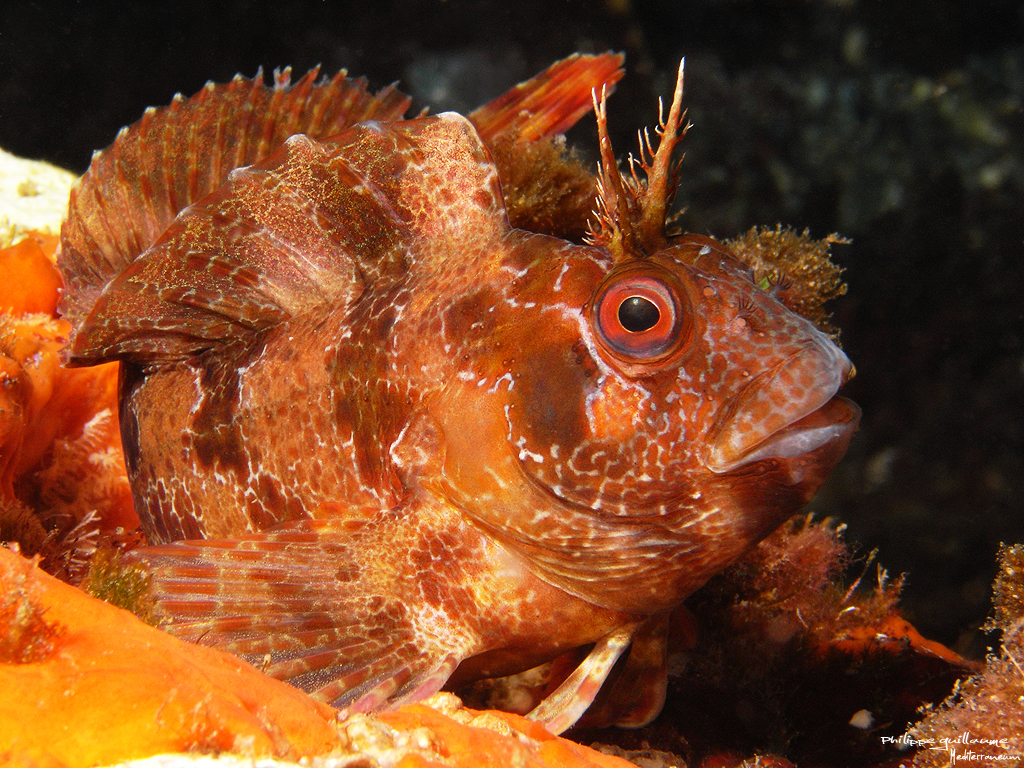
Tompot Blenny
Parablennius gattorugine
The tompot blenny (Parablennius gattorugine) is a medium-sized blenny growing to about 30 centimetres (12 in), part of the large family of blennies that live on the seabed of rocky areas in shallow water (down to 20 metres or 66 feet). The tompot blenny is found on the northern, western and southern coasts of Great Britain and is unusual on the east coast, although it has been seen on wrecks off the North Norfolk coast. The species...
From the article Tompot blenny on Wikipedia (CC BY-SA), quoted section by section
Description
The tompot blenny is a relatively large blenny with an elongated body, large head and large eyes which grows to up to 30 centimetres (12 in) in length. The eyes are bicoloured with their top part being brown and the bottom part is white. There is a single branched tentacle over each of its eyes. It is mainly yellow-brown in colour, although occasionally it is greenish and is marked with at least seven dark bars starting at the dorsal fin and which reach the belly. As well as the tentacles over the eyes there are also tentacles over the nostrils. The lateral line is continuous but becomes broken towards the tail. The breeding males become chocolate brown in colour and develop bulb-like glands on the spines of the anal fin. The dorsal fin runs the length of its body and is divided into two halves by a shallow notch. The anterior portion of the fin is contains the spiny rays while the posterior portion contains the soft rays. The dorsal fin has 13–14 spines and 17–20 ray while the anal fin has 2 spines and 19–23 rays. It has relatively large pectoral fins. Each individual has a unique set of markings on the scales of the face which mean that studies of their biology can identify individuals.
Range & habitat
The tompot blenny is found along the Atlantic coast of Europe from southern England and Ireland to Morocco. It is also found throughout the Mediterranean Sea to the Sea of Marmara and the Black Sea. In Great Britain it is mainly recorded off the south and west coasts and is largely absent from the North Sea coasts, although it has been seen on wrecks off the North Norfolk coast. and off eastern Scotland as far north as the Shetland Islands.
Wikipedia: “Distribution”
What it does
Tompot blennies have sharp, comb-like teeth which they use to scrape food from the substrate. They feed on sea anemones and on other invertebrates such as prawns and other crustaceans. They are crepuscular, being active mainly at dawn and at dusk.
Wikipedia: “Feeding”
Where it lives
Recorded sightings
—
geo-referenced records in GBIF, from museums, herbaria and field observers.
Drag the globe to turn it. Dots are where records exist, not a range map; darker means more records.
In the stacks
Searching the stacks…
Every page naming Parablennius gattorugine in the Biodiversity Heritage Library →
This page is assembled live from iNaturalist, GBIF, Wikipedia, the Source Library and the Internet Archive. It is not yet part of the hand-edited codex. iNaturalist taxon 118685.