- Animals
- ›Chordates
- ›Vertebrates
- ›Ray-finned Fishes
- ›Spiny-rayed fishes
- ›Butterflyfishes, Angelfishes, and Allies
- ›Angelfishes
- ›Pomacanthus
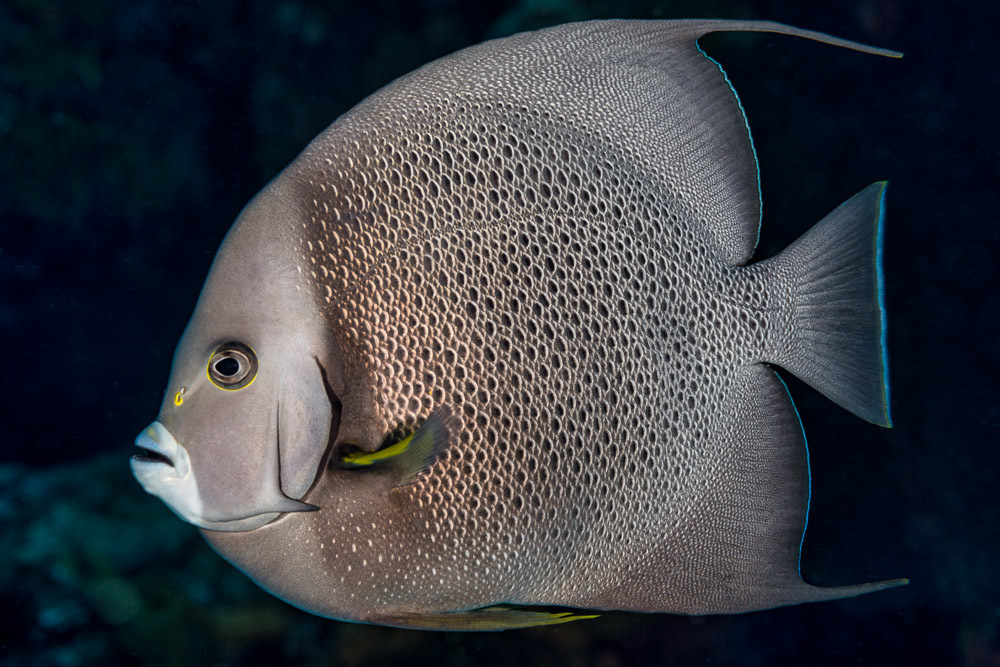
Grey Angelfish
Pomacanthus arcuatus
The gray angelfish, grey angelfish or black angelfish (Pomacanthus arcuatus) is a large angelfish of the family Pomacanthidae, found in the western Atlantic from New England to the vicinity of Rio de Janeiro, Brazil, and also the Bahamas, the Gulf of Mexico, and the Caribbean, including the Antilles, at depths of between 2 and 30 m. With a length up to 60 cm, this is the largest species of marine angelfish. It weighs about 2.0 kg. It feeds mainly...
From the article Gray angelfish on Wikipedia (CC BY-SA), quoted section by section
Description
The gray angelfish has a disk-shaped, compressed body with a large head and small snout. The snout has a mouth at its tip, which is filled with small, bristle-like teeth. The preoperculum has a sizable spine at its corner and a smooth vertical edge.
The juveniles have a black body marked with five vertical yellow stripes, three on the head and two on the body. The caudal fin has a black blotch which can be elongated or rectangular. Adults are pale grayish in color and covered in black spots. The head is plain pale gray with a white mouth. The dorsal and anal fins frequently show elongated streamers. The dorsal fin contains 9 spines and 31–33 soft rays, while the anal fin contains 3 spines and 23–25 soft rays. This species attains a maximum total length of 60 centimetres (24 in).
Range & habitat
The gray angelfish is found in the Western Atlantic Ocean from New York to Rio de Janeiro, though it is typically not found north of Florida during the winter. Its range extends to all of the Caribbean Sea and the Gulf of Mexico. It has been introduced to Bermuda from the Bahamas.
Wikipedia: “Distribution”
What it does
The gray angelfish is a diurnal species hiding in the reef during the night. They mainly feed on sponges but have also been recorded feeding on algae, as well as tunicates, zoantharians, gorgonians, hydroids, and bryozoans. The juveniles act as cleaner fish, establishing a cleaning station which is visited by a variety of larger fishes for the juvenile gray angelfish to remove and consume their ectoparasites.
Wikipedia: “Diet”
Toxicity
The consumption of gray angelfish is known to occasionally cause ciguatera poisoning. However, the risk of ciguatera poisoning from consuming this species is nonetheless considered low.
Where it lives
Recorded sightings
—
geo-referenced records in GBIF, from museums, herbaria and field observers.
Drag the globe to turn it. Dots are where records exist, not a range map; darker means more records.
In the stacks
Searching the stacks…
Every page naming Pomacanthus arcuatus in the Biodiversity Heritage Library →
This page is assembled live from iNaturalist, GBIF, Wikipedia, the Source Library and the Internet Archive. It is not yet part of the hand-edited codex. iNaturalist taxon 49427.