- Animals
- ›Chordates
- ›Vertebrates
- ›Ray-finned Fishes
- ›Spiny-rayed fishes
- ›Mackerels, Tunas, Butterfishes, and Allies
- ›Scombroidei
- ›Snake Mackerels
- ›Thyrsites
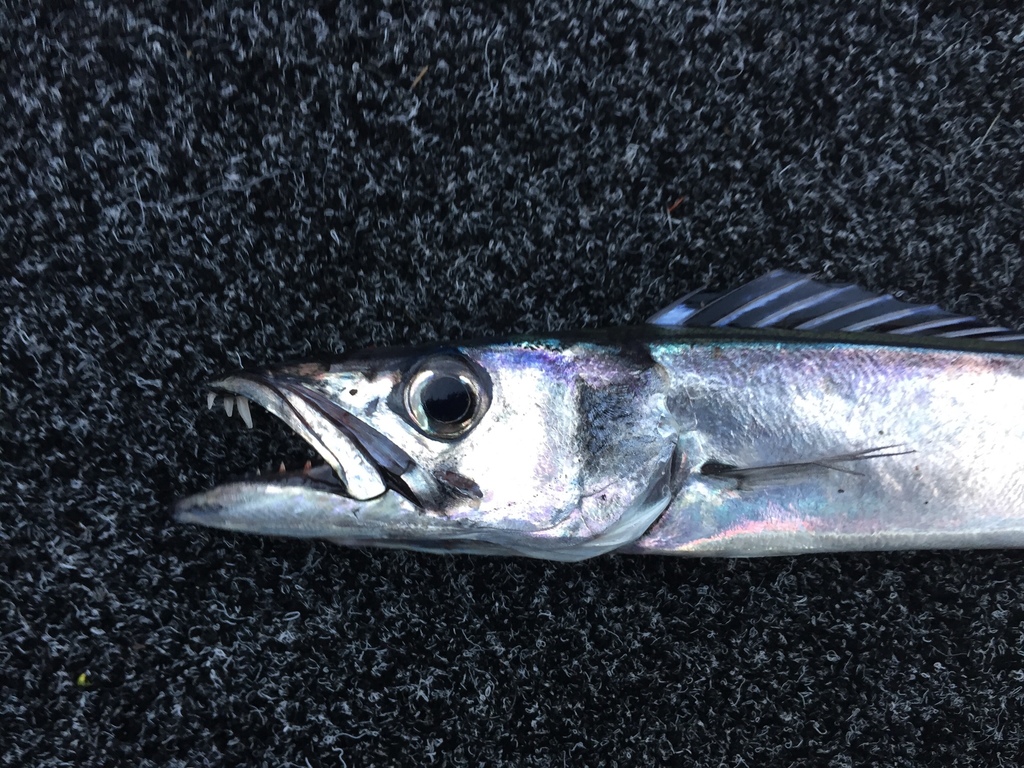
Snoek
Thyrsites atun
Thyrsites atun (Euphrasén, 1791), the snoek, is a long, thin species of snake mackerel found in the seas of the Southern Hemisphere. This fish can reach a length of 200 centimetres (79 in) SL though most do not exceed 75 centimetres (30 in) SL. The maximum recorded weight for this species is 6 kilograms (13 lb). It is very important to commercial fisheries and is also a popular game fish. It is currently the only known member of its...
From the article Leionura atun on Wikipedia (CC BY-SA), quoted section by section
Description
The fish can reach a length of 200 cm (79 in) SL though most do not exceed 75 cm (30 in) SL. The maximum recorded weight for this species is 6 kilograms (13 lb). It is very important to commercial fisheries and is also a popular game fish. It is currently the only known member of its genus. L. atun has 19 to 21 dorsal spines and about 113 dorsal rays, 1 anal spine and 10 to 13 anal rays, 35 vertebrae. The body is elongate and compressed, with a single lateral line on the upper body then curving ventrally. Body colour is blue-black on top with a paler belly, first dorsal fin is black. It is believed to contain an anticoagulant in its bite, but this is not supported by scientific research.
Range & habitat
Leionura atun is widely distributed in the colder waters in the Southern Hemisphere. In the southwest Atlantic, it is known from Uruguay, Argentina and Tierra del Fuego. In the eastern Atlantic, from Tristan da Cunha and South Africa. In the western Indian Ocean, from South Africa and the St. Paul and Amsterdam islands. In the eastern Indian Ocean, Tasmania and the southern coast of continental Australia. In the southwest Pacific, from New Zealand and the southern coast of Australia. In the southeast Pacific, from southern Peru, Chile, and Tierra del Fuego. On the African coast, it is found from Moçâmedes in northern Angola, along the coast of Namibia and the coast of the Northern Cape and Western Cape provinces of South Africa as far east as Algoa Bay, but mostly between the Kunene River and Cape Agulhas. Although it is distributed circumglobally, Leionura atun lives in coastal waters, and regional populations may consist of discrete stocks. Off New Zealand, three stocks are recognised. Off Australia, the population may made up from three to five stocks, and it is thought that the southern African population may comprise a northern and a southern stock, with some mixing, mostly from north to south.
Wikipedia: “Distribution”
What it does
In the South African population 50% sexual maturity occurs at 3 years at a fork length of about 73 cm (29 in). Spawning occurs during winter and spring, (May to November with a peak from June to October) along the continental shelf break of the western Agulhas bank and the South African west coast, at a depth of between 150 and 400 m (490 and 1,310 ft). The eggs and larvae are transported by currents to the primary nursery area north of Cape Columbine and the secondary nursery area east of Danger Point, where the juveniles remain until maturity. L. atun eggs hatch about 50 hours after fertilization, and the larvae initially eat phytoplankton, first feeding at 3.5 mm (0.14 in), about 3 to 4 days after hatching. When they reach about 8 mm long, they start eating the larvae of other fishes, which are most abundant during spring and summer in this region. After the first year of growth they reach between 33 and 44 cm (13 and 17 in) in length. The main prey species of the South African population are the Clupeoid fishes sardines, Sardinops sagax and anchovies, Engraulis japonicus, on which it is a major predator in the southern Benguela ecosystem. …
Wikipedia: “Life cycle and feeding”
At the table
It is sold fresh, smoked, canned and frozen. It can be cooked by frying, broiling, baking, and microwaving. In South Africa, it is often braaied (a form of barbecue). It is also made and eaten as fishcakes in regions such as Japan. It is prepared most often by grilling, frying or smoking. Snoek is oily, extremely bony (although the bones are large and easily removed from the cooked fish) and has very fine scales which are almost undetectable, making it unnecessary to scale the fish while cleaning. Snoek has a very distinctive taste.
In South Africa, snoek is caught and consumed along the west and southwestern coastal parts of the country. Commercially, snoek is sold as a prepared and processed food throughout South Africa, usually in the form of packaged smoked snoek, snoek pates and as a canned food. Fresh Pacific sierra imported from Chile or Mexico may be sold as snoek in the U.S. Snoek is usually bought fresh at the quay side. In and around Cape Town, this may be at Hout Bay, Kalk Bay and as far as Gordon's Bay. Up the west coast and down the coast towards Mossel Bay, much of the catch is often salted and air-dried for local consumption. Fresh snoek is typically barbecued over an open grill or wrapped in aluminium foil with butter and herbs and served with boiled sweet potatoes and "tamatiesmoor" – a fried-up hash of chopped tomatoes, onions, garlic and herbs. …
Wikipedia: “Modern-day use as a food”
Where it lives
Recorded sightings
—
geo-referenced records in GBIF, from museums, herbaria and field observers.
Drag the globe to turn it. Dots are where records exist, not a range map; darker means more records.
In the stacks
Searching the stacks…
Every page naming Thyrsites atun in the Biodiversity Heritage Library →
This page is assembled live from iNaturalist, GBIF, Wikipedia, the Source Library and the Internet Archive. It is not yet part of the hand-edited codex. iNaturalist taxon 47258.